Good Tuesday Morning My Friend!
After it literally took us 12 hrs of drive time to get to Kentucky, we showed up right at 3pm to sign our closing paperwork and drove directly to the new house. The seller was a very unpleasant, angry older woman with attitude a mile wide. Money hungry to say the least. Once we entered the house, we realized it hadn't been occupied for at least a year. Good thing I have cats! 🙄
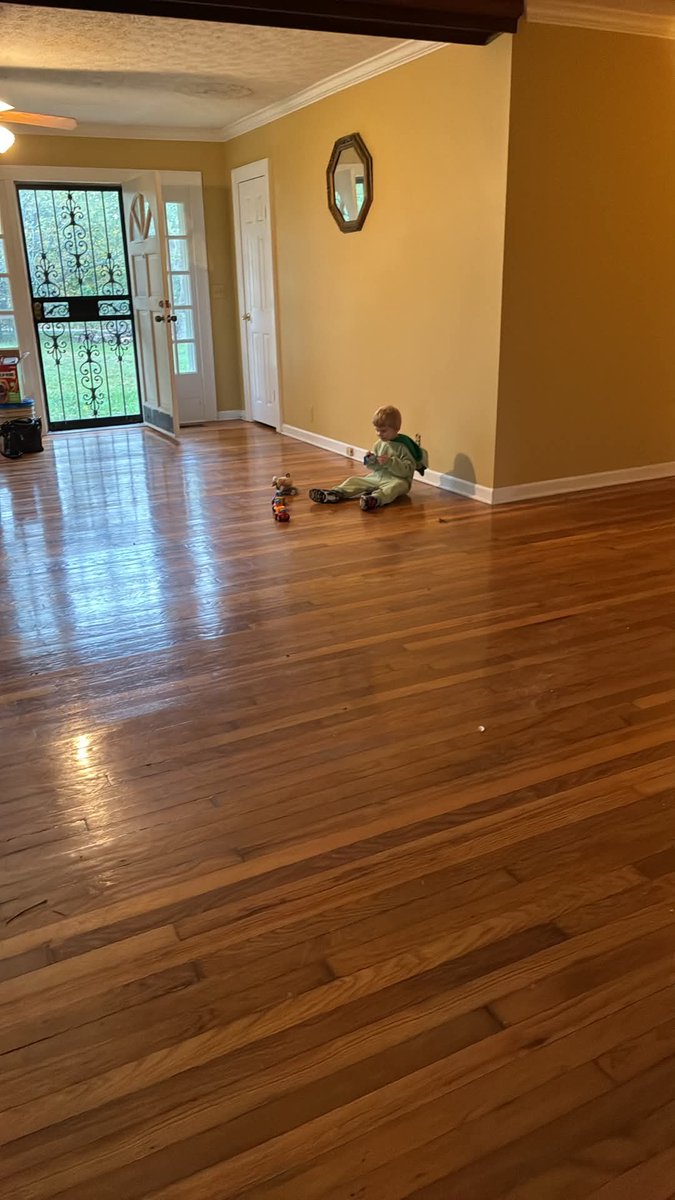
We were told the kitchen appliances worked. They may have at one time.. I have 2 burners that actually work on the electric cooktop, the oven just makes sound and tells time and the dishwasher doesn't work. It's nasty. No one cleaned anything it looks like. Both bathrooms have mold from water accumulating and from the roof leak they have (roof was replaced last year) Whoever they had do the "upgrade" surely had no idea what they were doing. They also didn't clean up after themselves well. Most of the lights don't work and they're all ceiling fans. The fireplace is inoperable at this time (good thing the heater works!) All the carpets in the bedrooms need to be pulled up and new flooring installed, though the original hardwood in the living room is gorgeous. The land? We bought just shy of 5 acres. 3.5 of that is overgrowth, brush, saplings, a destroyed barn, a dilapidated livestock shelter and questionable fencing. We're getting a quote on land clearing. Meanwhile, the hubby has already driven back to Kansas, after building some temporary coops for the chickens, turkeys and ducks. (pics). Our grandson and our daughter and her hubby were hear to unload the car/truck before we pulled in. Our grandson was super happy to be helping Papa build the coop! This next trip, David will be bringing all the birds and some necessities from the house to the new one, and then he finally agreed to get a moving truck to get the rest. I think he finally realized he's not as young as he used to be! Pray for us! NO ONE has toured the farmhouse in KS. We need to sell it so I can gut this kitchen and these two moldy bathrooms! Have a great day!
🚨 JEFF BEZOS ON HIS VISION FOR HUMANITY IN THE SOLAR SYSTEM:
"I would love to see a trillion humans living in the solar system. If we had a trillion humans, we would have at any given time a thousand Mozarts and a thousand Einsteins. Our solar system would be full of life and intelligence and energy."
How we get there:
"The only way to get to that vision is with giant space stations. Planetary surfaces are just way too small. We'll take materials from the moon and from near Earth objects and from the asteroid belt and build giant O'Neill-style colonies."
What life looks like:
"People will get to choose whether they live on Earth or whether they live in space. You can spin the stations to get normal Earth gravity. You can put them where you want them."
"People will go to Earth for vacation. Same way you might go to Yellowstone National Park."
$AEHR fell 42% in nine sessions on the back of the AI buildout sell off.
Another trigger was Teradyne launching Titan HP on Oct 6. The market read it as a threat to Aehr. I think it misread where Aehr's edge actually sits.
AI chips get burned in. Held hot at high voltage for hours so the weak ones die in the factory and not in a data center when they actually need to work.
You can do it after the chip is packaged. Or before, on the bare wafer.
Teradyne and KYEC compete after packaging. Aehr's FOX does it on the wafer, before the die is bonded to thousands of dollars of HBM. Aehr's 10K puts a failure found after packaging at 10x to 100x the cost.
Aehr's lead AI customer moved all of its burn in to wafer level. Then dropped system level test entirely.
As far as I can find, nobody else runs wafer level burn in for AI chips in production at this power.
The pivot in numbers:
> EV chips: 92% of revenue two years ago. 17% now
> FY27 guide: $130 to 150M, up 160 to 200%
> About 70% AI processors, 15 to 20% silicon photonics
And the year is mostly booked:
> Effective backlog $100.6M in July
> +$22M AI wafer level order in Aug
> +$6M Sonoma for the hyperscaler's second processor in Oct
> $128.6M+ known vs a $140M midpoint. About 92%
However, there are also a causes of concerns:
Management cut or withdrew the full year guide in two of the last three years; Two customers drive most of the AI revenue. Package level is arguably becoming more crowded. Insiders sold about $61M in a year and bought nothing. Beta is around 3.5, making this a highly volatile stock, not for the faint of heart.
This year looks mostly done. What decides the stock is what fills the order book after these builds ship. Three things I'm watching:
> The benchmark AI customer moving to pilot production on FOX
> The hyperscaler's second processor ramping on Sonoma without a second supplier
> Memory showing up as orders. None of it is in the guide. (But will be extremely bullish)
imo the market is pricing this year as the peak.
Q1 prints Nov 2. Options imply about a 24% move either way.
I wrote it all up: how burn in works, who else can do it, the guidance track record, the insider selling, my Bear/Base/Bull/Moonshot math and what Nov 2 needs to show.
Full deep dive on https://t.co/HgSlHdmXT0
America’s AI infrastructure expansion is running into SERIOUS financial and operational problems:
At least 47 major data center projects have been DELAYED, withdrawn or blocked so far in 2026.
Furthermore, only an estimated 35% of planned US data center projects are likely to materialize, as more than 1,000 communities have tried to limit or block infrastructure development.
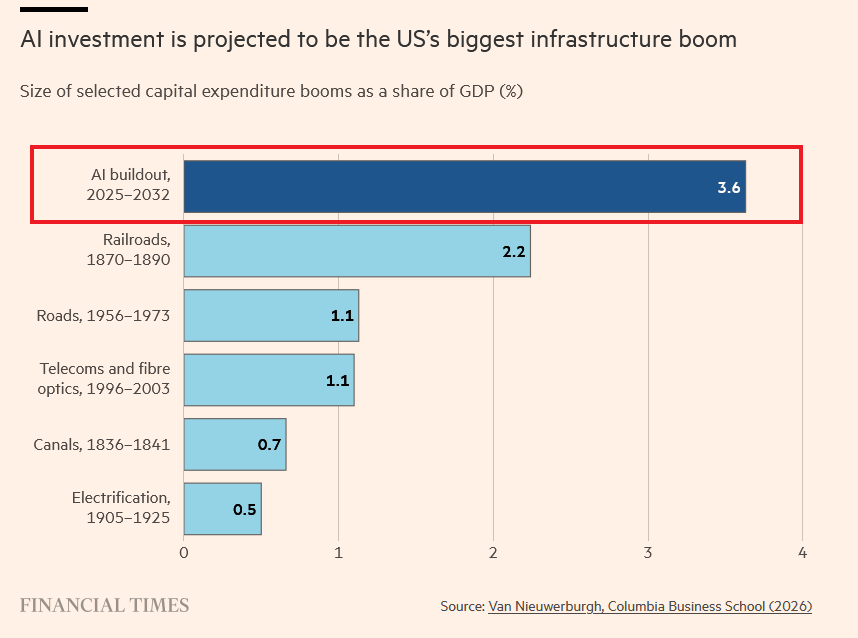
Meanwhile, US AI infrastructure spending is projected to exceed $10 trillion between 2025 and 2032, equivalent to around 3.6% of GDP annually, yet rising interest rates and a weaker bond market are threatening the financing needed to deliver this build-out.
For example, SoftBank-backed SB Energy has yet to complete a single data center and faces $174 billion in capital needs to fulfill contracts worth $430 billion, while Nebius estimates that its planned 5 gigawatts of capacity would require $250 billion in financing, of which it has secured only ~20%.
Execution risks are growing as well, with project delays threatening tenant contracts, developers absorbing hundreds of millions in cost overruns, and power-grid restrictions making construction increasingly difficult.
The AI infrastructure buildout is facing severe constraints, raising the risk that trillions in planned investment fail to deliver the returns investors expect.
A scorching marshmallow planet 1,300 light-years away has weather so extreme that one edge of its atmosphere is a blast furnace while the other is relatively cool — and its high clouds are made of tiny quartz crystals.
WASP-17 b is a classic hot Jupiter. It orbits its star every 3.7 days, locked by tides so that one face always faces the star (eternal day) and the other faces eternal night. Its equilibrium temperature sits around 1,500–1,760 K (roughly 1,200–1,500 °C). Yet it is astonishingly puffy: only about half Jupiter’s mass but nearly twice its radius, giving it a density of roughly 0.08 g/cm³ — about twelve times less dense than water. Astronomers call these ultra-low-density worlds marshmallow or zephyr planets. Weak gravity plus relentless heating inflate its hydrogen-helium envelope into a vast atmosphere whose scale height stretches for thousands of kilometers.
For two decades, most exoplanet atmosphere studies treated the limb (the edge that filters starlight during a transit) as a perfect circle and averaged everything into a single spectrum. That simplification fails for tidally locked hot Jupiters, where huge day–night temperature contrasts drive powerful global winds.
James Webb has now mapped that uneven edge angle by angle. In March 2023 the telescope observed WASP-17 b with three instruments covering 0.6–12 μm. A team led by Lili Alderson applied a new technique called transmission strings. Instead of forcing a circular outline, the method describes the planet’s radius as a function of angle around the limb using a Fourier series. This lets researchers extract separate spectra from different sectors — morning terminator, evening terminator, equator, and poles — rather than one blended average. The light curve clearly rejects a perfect circle; the atmosphere is slightly egg-shaped.
The map reveals a dramatic climate split:
Morning terminator (where the atmosphere rotates into daylight): about 858 K (~585 °C).
Evening terminator (where it rotates into night): about 1,522 K (~1,249 °C).
Difference: roughly 664 K.
The hotter evening side has a scale height nearly 1.8 times larger and puffs outward, increasing the effective radius by about 1–1.6 % relative to cooler regions. The morning spectrum is almost flat — cooler gas plus high-altitude aerosols mute the signal. The evening spectrum shows deep absorption from water vapor and carbon dioxide. Water and carbon dioxide abundances stay roughly constant around the limb, but methane increases toward the poles, and sulfur dioxide appears on the nightside, consistent with photochemistry on the dayside being swept around by winds.
The engine is equatorial superrotation: strong west-to-east jets blow heat from the permanent dayside hotspot toward the evening terminator. The gas then cools as it crosses the nightside before reaching the morning edge. Simple one-dimensional equilibrium models cannot reproduce the evening-side inflation even with maximum heat recirculation; the atmosphere is in clear dynamical disequilibrium and needs three-dimensional circulation and chemistry models.
Earlier James Webb work had already found the first pure quartz nanocrystals in an exoplanet atmosphere — grains only about 10 nanometers across, so small that roughly 10,000 could fit across a human hair. These form directly from gas in the extreme heat and low pressure, then get lofted and blown around by the same violent winds.
In short, WASP-17 b is a laboratory for extreme planetary weather: a low-density gas giant with glass-crystal clouds, a lopsided atmosphere shaped by thousand-kilometer-per-hour winds, and a day–night contrast that simple averaging had hidden. The transmission-strings approach turns a single transit into a spatial map and opens the door to weather-scale studies of many other worlds.
SK hynix is a top HBM maker. So why does TSMC build the bottom die of its HBM4?
SK hynix stacks its HBM4 memory on a base die made on TSMC's 12nm-class logic process. Samsung makes its base die in its own logic foundry. The memory comes from a DRAM line. The logic under it does not.
That split comes from what each process is built for.
A logic transistor is built to switch fast. It balances speed, power and leakage.
A DRAM cell transistor switches on to read and write, then must barely leak, so a tiny charge lasts until refresh. So DRAM makers bury its gate in the silicon. The path bends under the gate, and the longer path leaks less.
The capacitor is the other big difference. DRAM builds rows of tall capacitors, and those memory steps run hot for hours. The sense amps and drivers are built first, so they must survive that heat. That limits which logic transistors can share the wafer.
HBM has always had a base die under the memory stack. It handles the link to the GPU. Through HBM3E, SK hynix built it in house. For HBM4 it moved that die to TSMC's logic process to fit more functions into limited space.
Samsung's bonded 4F² prototype takes a different route. It puts the cell array and its periphery on separate wafers, so each can be optimized on its own.
Watch who makes HBM4E base dies, and whether the first 4F² DRAM ships with its logic on a second wafer.
Same silicon. Different jobs.
A chart site that adds a swap button has to answer one question;
Do i want to own the trade, or just show it?
Tenero v2 answered it and i think the answer is the real story.
The feature list is easy to repeat;
In-app swaps, automatic routing across stacks DEXes, adjustable trade settings and swapping straight from a token page but look at how they did it. Tenero didn’t build its own router or its own DEX. Swaps inside it run on zest protocol’s stacks swap, which finds the best route across the stacks DEXes with 0% aggregator fee. The pools still charge their usual fees, but the aggregator layer takes nothing.
So there are now three jobs and three different owners. Tenero is the screen. Zest’s aggregator is the routing. The DEXes are the liquidity nobody had to become the other two that’s rare in crypto, where most apps want to own the whole stack.
The history makes it make more sense. @stx launched in jan 2024 as a dextools for stacks, it became tenero in dec 2025 and most of us used it to look at tokens and went somewhere else to buy them. Along the way it became a source people actually cite;
Its research on AI agents on stacks (105 to 766 active agents in a few weeks) got picked up by crypto press. V2 doesn’t change the place where you look, it just removes the trip to go act on what you saw.
Honestly a screen that ranks what’s trending and also executes the trade has a responsibility the old version didn’t, shorter distance between “huh, interesting” and a swap cuts both ways, so i want liquidity, holders and the buy/sell split sitting right next to that button.
So i see the v2 as “tenero adds swaps” i seeit as tenero deciding to stay the screen and let everyone else do their job. I’d judge it on how clearly it shows me the route and the risk, not on how long the feature list is.
V2 is live! - https://t.co/8xvXp8QaFL
$STX $BTC
Talked with a guy selling his mowing company he wasn't pleased when I told him and his broker on the phone that there was nothing to sell. I desperately want to talk with the Broker and ask how in the world he came up with that number and how he thinks its sellable?
🚨 BREAKING: Claude can now help you build entire presentations.
You can use it to create any deck like a $5,000 presentation consultant.
Here are 7 prompts you should try:
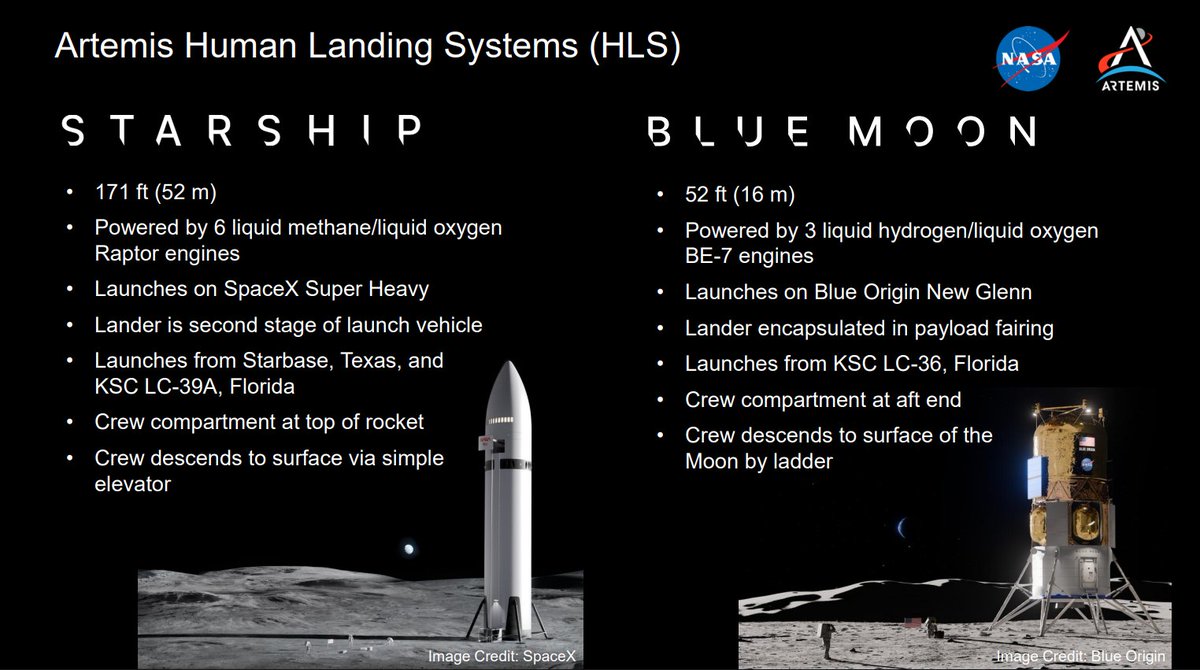
Notice the language used on Starship here? "simple elevatory"
For years the HLS doubters have been saying the elevator for HLS is "complex" and "unsafe"
I think the average astronaut would rather stand next to their equipment as they descend down than to climp up a very tall ladder in their space suit with their equipment.
When asked about the historic Apollo 11 Moon landing in 1969, 87-year-old Pablo Picasso delivered a surprisingly blunt response. While millions around the world celebrated humanity’s first steps on the Moon, the legendary artist reportedly stated that the achievement meant nothing to him, that he had no opinion on it, and that he simply did not care. His remarks appeared on page six of The New York Times on July 21, 1969, alongside reactions from people around the world.
At a time when the Moon landing was being hailed as one of humanity’s greatest accomplishments, Picasso’s indifference stood out. Rather than sharing the excitement surrounding the scientific and technological breakthrough, he remained seemingly unmoved by the spectacle. For an artist whose life revolved around creativity, human emotion, and the world around him, even mankind’s extraordinary journey beyond Earth apparently failed to capture his imagination.