From my time in the State Senate, to my service now as your Secretary of State, I have always strived to represent our conservative values.
Next week, I will be making a special campaign announcement for the future, and I would be honored if you will join me at one of the events near you.
Myth-Busting March's MYTH #2: “School choice drains money from public schools.”
This one surprises people:
In many cases, public schools actually keep money when a student leaves.
Why?
Because scholarships are nearly always less than the total per-student funding. Usually this is because districts keep their share of the funding when a student leaves BUT they don't decrease the over spending by an equal amount.
Multiple fiscal studies found choice programs were neutral—or financially positive—for public schools.
Less crowding and more resources per student.
That’s not draining the system.
That’s changing it. https://t.co/cNouiOuqwE
Myth #3 next week.
I really appreciate how @shakamitchell paints this picture of how (and why) state legislatures can fund traditional public education AND school choice programs.
Watch this:
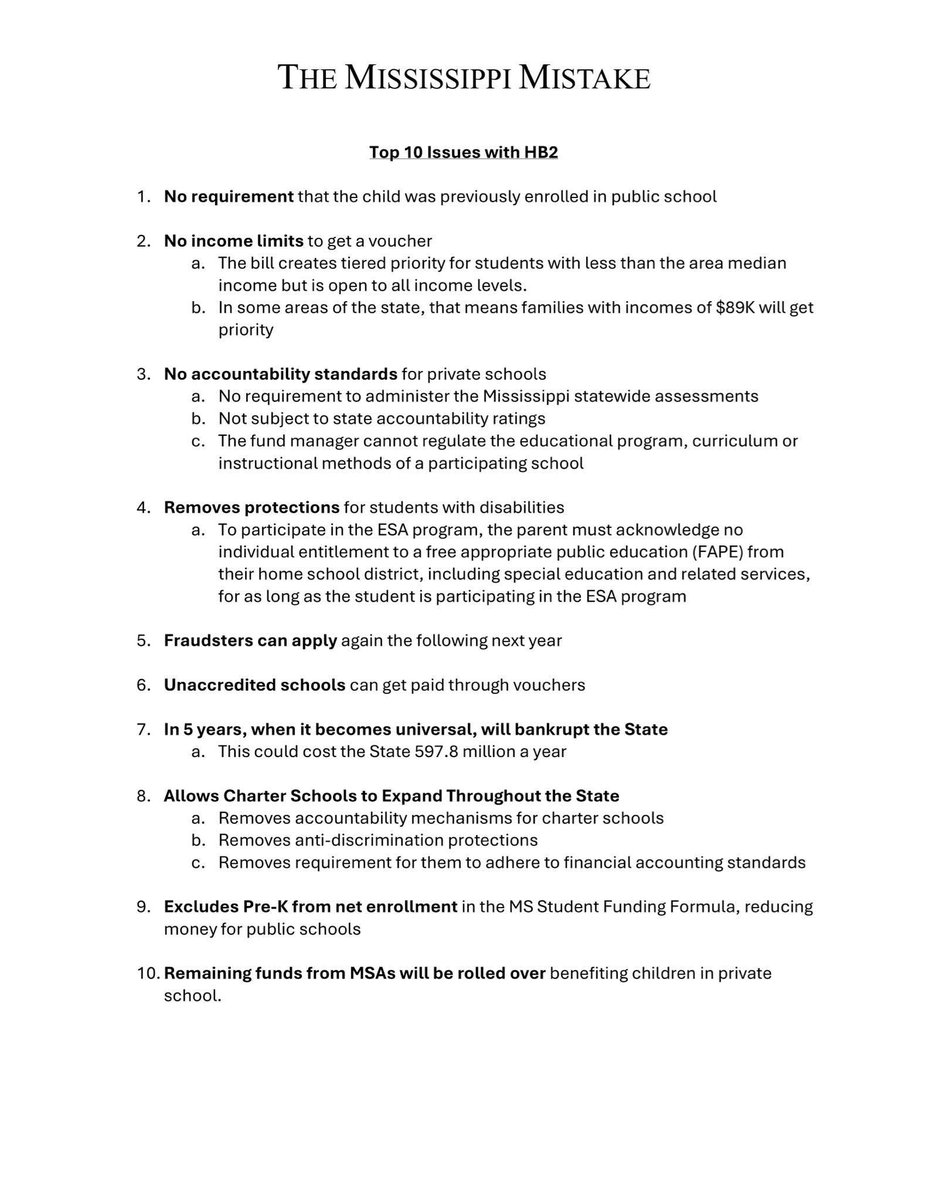
This morning I'm seeing this loony document making the rounds, yet it contains factual errors and tons of misleading information.
So, here's a thread 🧵 with the facts on each point:
"In poll after poll taken over the last decade, support for school choice in the Magnolia State has consistently been at or above 70 percent. Most people understand that every kid is different, with different learning needs."
LOUDER FOR THE PEOPLE IN THE BACK 📣
I’m thrilled to see Mississippi advancing an ambitious school choice expansion in their 2026 session. Giving parents options is essential to improving education outcomes & ensuring every child finds the learning environment that best fits their needs.
Well done, @JasonWhiteMS!
Mississippi Governor Tate Reeves is making SCHOOL CHOICE a top priority this year.
"I'm not so arrogant to believe that I know better – what's best for that kid – than that kid's parents."
"Universal school choice is what our goal should be."
MPE should be ashamed of this post. Misleading and uninformed at best. No one in the legislature is tying school choice policy to a teacher pay raise. You use the term “hostage” in your post, but the only “hostages” in this entire conversation are the Mississippi families and kids trapped in failing school districts with no options. The House education reform bill will be big, bold and sweeping, but there won’t be hostages, only wins for Mississippi families.
There's an argument going around that deserves a response.
A thread 🧵
@parentscampaign keeps saying that MS is gaining academically, yet the "top choice states" plummeted. This is naive, lacking any academic rigor, and a dishonest interpretation of the data. Here's why:
I'm proud to see so much interest in our Education Freedom Select Committee. We heard from subject matter experts, @Laurietoddsmith and @lindseymburke. Thank you, @robroberson43 and @JansenOwen, for leading an excellent meeting. They are already planning for their next hearing. Education Freedom continues to gain momentum in Mississippi!
The House Education leadership team is hard at work preparing for our robust Education Freedom bill. My office and I have been fortunate to develop a relationship with The @WhiteHouse, and we are excited to welcome two key education leaders from the @realDonaldTrump Administration to Mississippi for our first Education Freedom Select Committee meeting. Continuing the House’s pursuit of commonsense, conservative legislation – we will once again diligently study this opportunity, engage key stakeholders in meaningful dialogue, and cultivate widespread support to pass legislation that truly benefits Mississippians as the House aligns with @POTUS’s top priority for parent power.
@MSGOP@robroberson43@JansenOwen
Also notice the states that *aren’t* in this chart.
Most states either don’t collect K-12 open enrollment data or refuse to share it.
Basic info—such as the number of transfer applications, applications rejected, etc.—should be published annually.
For state policymakers, the fruit is so low it’s basically on the ground.