this is pure f*cking treasure.
my ai bill last month:
claude max 20x ............ $200
chatgpt pro ............... $200
supergrok heavy ........... $300
total ..................... $700
then i went through github and found 5 repos that eat the boring half of that bill on my own machine
rizzo-flow ................ 833 stars
the open local take on typesafe's jev. a 4.4gb model on llama.cpp answers yes / no / pick one / score with a probability on every answer, and you point your api at localhost by changing one url
llm2jev ................... 391 stars
turns qwen3.5-4b into a jev-style decision model. 48ms p50 in their own benchmark, against 652ms for the real jev
fast-browser-use .......... 202 stars
a browser agent that runs 100% local on qwen3.5-9b and plugs into claude code and codex as a skill. opens the right wikipedia article in about 4 seconds, zero cloud calls
deepseekgui ............... 84 stars
a desktop workbench on deepseek harness with git, a built-in browser and memory. you pay deepseek per token instead of a flat $200 a month
oriveo .................... 25 stars
one app for openai, anthropic, gemini, grok, deepseek and 10 more providers, plus ollama on your own gpu. your keys, no subscription, no account
claude still writes my hardest code. the yes or no calls, the browser clicking and the everyday chatting moved to my gpu and my own api keys, and the receipt stopped looking like rent
repos in the comments
this is pure f*cking treasure
A Stanford AI research group found how to orchestrate Claude Opus 5.5 and GPT-6.1 Sol together, and it completely breaks the search scaffolding wall
most developers try to combine frontier models by chaining prompts in one context window or hardcoding rigid evolutionary loops. you burn tokens on context bloat and freeze models into fixed search rules that out-date themselves within 5 iterations
Stanford's architecture eliminates human-designed search scaffolding and splits the cognitive stack:
> search director: Claude Opus 5.5 plans the search, querying a persistent idea-graph where MAP-Elites and MCTS reduce to single Cypher queries
> candidate proposer: GPT-6.1 Sol explores high-entropy code variations inside isolated execution sandboxes
> zero context bleeding: sessions reset after each iteration to prevent prompt bloat while the graph stores lineage
> evaluator isolation: candidate code never touches the scoring process, stopping reward hacking and test leakage cold
> meta-agent distillation: an offline meta-pass extracts verified lessons and updates search guidance across branches
the benchmark metrics outclass standard discovery baselines:
> 3.2x lower model spend than fixed evolutionary frameworks
> 1st place rank across 7 competitive AtCoder heuristic contests against human competitors
> beats published SOTA on Anthropic kernel builder and 11 mathematical optimization tasks
> 0% reward hacks: candidate-controlled metric tampering eliminated
Opus directs the search graph. Sol explores the code
you stop writing rigid search harnesses. you let frontier models own the discovery loop
Opus 5.5 + Jev make this AI stack look f…cking illegal
10 GitHub repos that put a decision layer around the model
01 JevRouter
▸ https://t.co/87nptDJN3Z
→ Jev picks the model, subagent, skill or tool for each request, code checks permissions before anything runs
02 blink
▸ https://t.co/I2zVHpe5Wm
→ Jev walks your directory names to find the right file, no embedding index
03 jev-engineering
▸ https://t.co/u9UI2YxqMX
→ hard rules first, then one Jev call, as a Claude Code PreToolUse hook
04 jev-lint
▸ https://t.co/MTJahOFiHF
→ checks every edit against your team rules before code review
05 skills
▸ https://t.co/OoQyo7ddAh
→ the official skills for building and evaluating Jev workflows
06 jev-guard
▸ https://t.co/R2UREiUG6I
→ scores every tool call: allow, ask or deny
07 jevguard-mcp
▸ https://t.co/sXPjcRbvtp
→ an MCP server that rates shell commands and patch regression risk, zero dependencies
08 Edward
▸ https://t.co/lKUvJ55vR7
→ one Jev call judges the whole session: continue, pause or escalate, with signed receipts
09 foreman
▸ https://t.co/4zXSOYEh8S
→ a supervisor that keeps coding agents on task
10 jev-use
▸ https://t.co/aS81vriWYD
→ batched Jev questions inside Claude Code, unsure steps go back to the LLM
the architecture:
route → rules → guard → supervise → ship
I'd split the stack like this:
route:
JevRouter → blink
rules:
jev-engineering → jev-lint → skills
safety:
jev-guard → jevguard-mcp
control:
Edward → foreman → jev-use
Opus 5.5 plans and writes the code. every fork around it goes to Jev
the model is one folder in the stack ⭣
🔴 ESTO ES UNA LOCURA
Alguien creo un repo en GitHub que te deja usar Claude Code completamente GRATIS y PARA SIEMPRE
Redirige todo tu trafico a 49 proveedores gratuitos como DeepSeek y Kimi
1.3 mil millones de tokens gratis cada mes
Toma 5 minutos en configurarlo
Ya tiene mas de 46k estrellas y miles de devs usandolo ahora mismo
CLAUDE CODE CAN NOW PULL LIVE DATA FROM 17,000+ STOCKS, CRYPTO PRICES, AND FINANCIAL STATEMENTS IN SECONDS.
One command. 60 seconds. Done.
Here is the exact setup:
Step 1: Open Claude Code and paste this:
claude mcp add --transport http financial-datasets https://t.co/4twbpUMYd6
Step 2: Authenticate
Type `/mcp` inside Claude Code and complete the OAuth flow in your browser.
Verify the connection anytime:
claude mcp list
Step 3: Start prompting
- "What is Apple's current P/E ratio and market cap?"
- "Show me Tesla's income statement for the last 4 quarters."
- "How has Bitcoin's price changed over the past year?"
That is it.
Claude Code now has direct access to real financial data across 17,000+ stocks, earnings reports, balance sheets, income statements, cash flow data, and crypto prices.
The analysts paying $24,000 a year for a Bloomberg Terminal are not going to be happy this exists.
Before this you needed a Bloomberg Terminal or a complex financial data API or hours of manual research across multiple sources.
Now you need one command and 60 seconds.
The quants, analysts, and portfolio managers who figure out how to combine Claude Code's reasoning with live financial data access will have a research edge that compounds every single day.
Bookmark this before you open your next brokerage account.
Docs if you run into errors: https://t.co/CgF6B3dS5V
Follow @cyrilXBT for every Claude Code integration that changes how you work with data.
this is my AI marketing engine
say I have an idea I want to turn into a campaign. a guide, a cohort, a webinar, something we have been planning for a while, or just something cool I came across and want to build around.
it usually starts as one thing, an idea or an evergreen piece, and this engine is how that one thing becomes a full campaign and fans out across every vertical
the engine is a graph, a general step-by-step the idea moves through. at each step I can swap the harness, the loop, the tool, or the model to fit the campaign
right now I'm testing gstack, superpowers, and matt's skills, engineer tools I'm bending toward marketing
the models can write and design well now. what takes work is the context you feed them, the routing per job, and the evals that catch what is weak
there are eval stops all through the graph. both human and other agents evaluating and reviewing output, and then looping it back if it doesnt
here is the path it travels, from a raw idea down to a shipped campaign
PLANNING
1. the idea in
I dictate the whole thing out loud, every half-formed thought, and let the skill bundle catch the mess and hand me back a starting brief. this is the karpathy point, get it out of your head first and clean it up after
2. ideation
off that brief it opens the idea into angles and directions to choose from. I throw most of them out
3. research and context
this is where I pull context, and how much I need depends on the campaign, sometimes a ton of internal history, sometimes barely any. the internal side is our company brain (gBrain), the voice, the past campaigns, what converted, the offers, the ICP. externally I pull the market, the competitors, the hooks working this week
4. synthesis
different models merge all of that into a draft plan. the plan itself, the architecture and the trade-offs, runs on opus 5, and the narrow work underneath gets cheap fast models. that split is model routing
5. the sign-off
nothing crosses into execution until I sign it off. I read the draft against our marketing protocols, the voice rules, the brand, the SOPs, and I cut, sharpen, or send it back
EXECUTION
6. handing it to the build
once the plan clears the sign-off it goes into the build, and the idea splits into all the parts a campaign needs. here I run two shapes depending on the job. when a piece is one task that has to clear a bar I run a loop, the agent drafts, checks itself, fixes, and keeps circling until it is good.
the bigger many-part pieces I build as a graph, drawing the steps and routes ahead of time so the agents travel the map I laid down. it is usually a bit of both
7. the models doing it
routing runs in execution too, you do not pay opus prices to resize a thumbnail for example
8. what stays with people
some of it I coordinate, some assets I make myself, and the work that needs taste, a relationship, or a client in the room I hand to the agency team
that one idea comes out the other end as a full campaign across every vertical, landing pages, blogs and guides, video scripts, email, PR, paid, and the social cuts
then the results come back in, what got bookmarked, what converted, what died, and that updates the brain for the next campaign
everyone has the same models, so the edge is the graph, the brain, and the protocols, and those you have to build yourself
PEOPLE ARE PAYING FOR AI ENGINEERING BOOTCAMPS BUILT FROM THIS EXACT MATERIAL.
Andrew Ng gave 3 hours of it away free.
00:00 Building agentic AI systems
04:25 Where AI engineering is actually headed
23:38 The full prompting course
2:52:17 Building an app with AI in 30 minutes
The man who taught 8 million people AI just handed you the 2026 curriculum for free.
Watch it, then read the self improving system guide below.
Follow @cyrilXBT
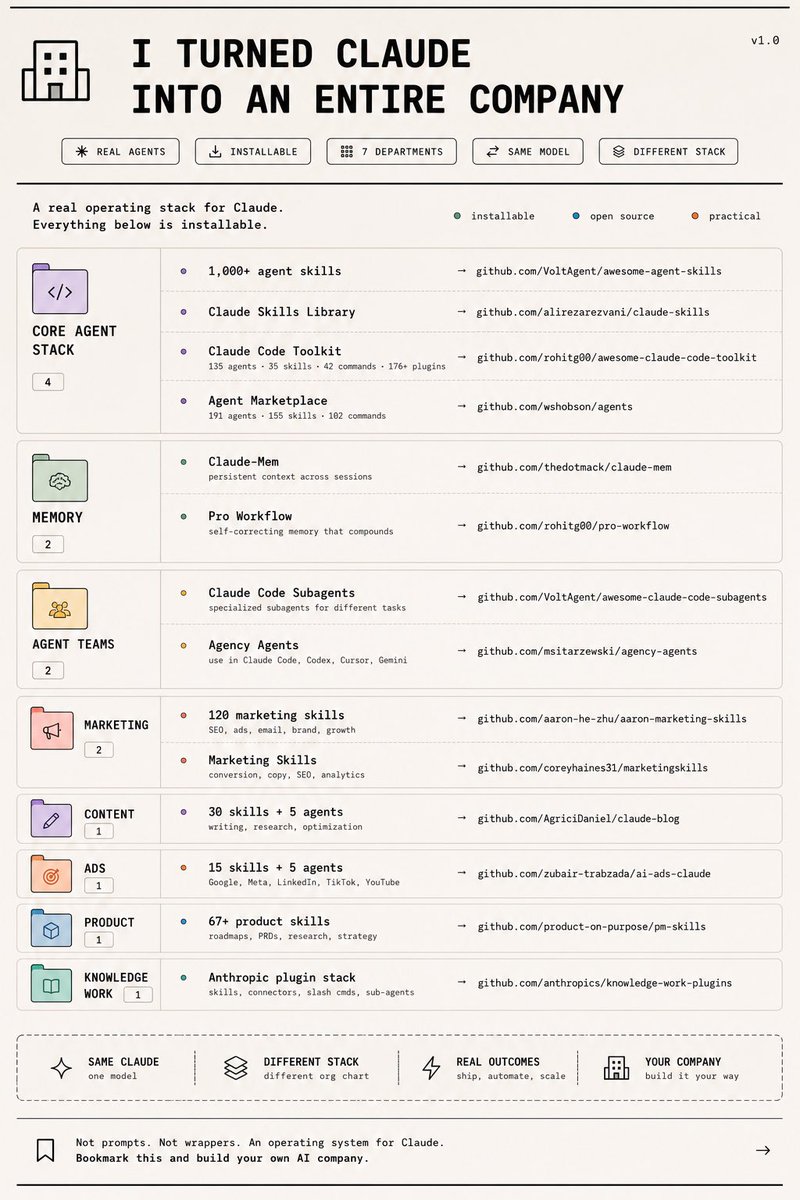
I turned Claude into an entire company
Real agents, skills, memory, and workflows
Everything below is installable
Core Agent Stack
1,000+ agent skills
→ https://t.co/7IQSWp2Rww
Claude Skills Library
→ https://t.co/S5ybKxnjhB
Claude Code Toolkit
135 agents
35 skills
42 commands
176+ plugins
→ https://t.co/8OI86bQLne
Agent Marketplace
191 agents
155 skills
102 commands
→ https://t.co/J4V2c994FM
Memory
Claude-Mem
→ https://t.co/mBL34QvVnK
Pro Workflow
→ https://t.co/MtyvKJDF8U
Agent Teams
Claude Code subagents
→ https://t.co/kHjb3R0Ffd
Agency Agents
→ https://t.co/riYORiBKQr
Marketing
120 marketing skills
→ https://t.co/afVzykVNBe
Marketing Skills
→ https://t.co/UrPt9uUcZt
Content
30 skills + 5 agents
→ https://t.co/6qWbcg6GBz
Ads
15 skills + 5 agents
→ https://t.co/Upups1MGTD
Product
67+ product skills
→ https://t.co/oZijif7WFk
Knowledge Work
Anthropic’s own job-specific plugin stack
→ https://t.co/qHsYYuM69j
Not prompts
Not wrappers
A real operating stack for Claude
Bookmark this and build your own AI company
I turned Claude into an entire company.
42 skills, organised like a real org chart (links below):
Here is every department, and where to get each one.
Developers
Superpowers
→https://t.co/tGNwFVYsEa
Context7
→ https://t.co/oExBVynS4S
Skill Creator
→ https://t.co/iR9fyxUFvL
MCP Builder
→ https://t.co/iR9fyxUFvL
Webapp Testing
→ https://t.co/iR9fyxUFvL
Claude-Mem
→ https://t.co/emHpdPtiUO
Designers
UI UX Pro Max
→ https://t.co/54NvwKmBix
Taste
→https://t.co/gFud3Sa93j
Frontend Design
→ https://t.co/gFud3Sa93j
Transitions
→ https://t.co/kZP238n3Zy
Web Artifacts
→https://t.co/iR9fyxUFvL
Brand Guidelines
→ https://t.co/iR9fyxUFvL
Marketing
45 skills to run your marketing, from copywriting to SEO to lead magnets.
Access them all here
→ https://t.co/oBsac9TKK4
Social Media
17 skills to run your social media, from post writing to Reels to thumbnails.
Access them all here
→ https://t.co/ZwNtoUTdVm
Finance
8 skills to run your finances, from statements to reconciliation to audits.
Access them all here
→ https://t.co/qk0ioMAxim
Small Business
31 skills to run your small business, from cash flow to payroll to invoicing.
Access them all here
→ https://t.co/m9kHptmfv9
Legal
9 skills to handle your legal work, from contract review to NDAs to compliance.
Access them all here
→https://t.co/ucxqTYH4v9
Every skill on the chart is real and installable from the links above.
Repost ♻️ this to help your network build their own.
Claude Code team just dropped a free course on loop engineering with Fable 5:
00:00 - how Claude Code works under the hood
05:01 - the agentic loop explained
16:21 - the feature 99% of devs miss: auto mode
19:01 - why voice beats typing
32:34 - auto code review with draft PRs
58:39 - Fable 5 for non-code work
this free course replaces every paid Claude Code tutorial
watch today, then read the article below on loop engineering by Karpathy
ANTHROPIC JUST OPEN SOURCED THE ENTIRE WALL STREET WORKFLOW AND FIRMS ARE NOT GOING TO BE HAPPY ABOUT IT.
DCF models. LBO models. Equity research reports. Merger analysis. KYC checks.
All of it. Free. On GitHub.
Here is what just became available to anyone with a laptop.
Direct connections to Bloomberg, FactSet, S&P Global, Morningstar, and PitchBook.
Real Excel models with live formulas and sensitivity tables built automatically.
CIMs, IC memos, earnings reports, and buyer lists drafted on demand.
PE due diligence, GL reconciliation, and NAV tie-outs running as production agents.
This is not a chatbot wrapper that summarizes financial news.
These are production agents that own entire financial workflows end to end.
The kind that investment banks and private equity firms pay $50,000 to $500,000 per year in software licenses to run.
Now it is a one-line Claude Code plugin install.
19,800 GitHub stars.
Apache 2.0 license.
100% open source.
Think about what this actually means.
A junior analyst at a bulge bracket bank spends 80% of their 100-hour week running models, drafting memos, and compiling data across Bloomberg and FactSet.
That entire workflow just became a Claude Code agent.
The banks charging clients $500 an hour for analysis that this system produces in minutes are not going to tell you this exists.
The boutique advisory firms charging $50,000 retainers for due diligence work that these agents handle autonomously are not going to promote this repo.
But it is already live.
19,800 people have already starred it.
The window where knowing this gives you an edge over every analyst, associate, and advisor still doing this manually is open right now.
Star it. Fork it. Deploy it this weekend.
Bookmark this before your next financial model.
Follow @cyrilXBT for every open source release that disrupts an overpriced industry the moment it drops.
KARPATHY REPORTEDLY SAID 10X ENGINEERS ARE NORMAL NOW.
REAL AGENTIC ENGINEERS ARE 100X.
The actual playbook for getting there. Context engineering.
Tool design.
Orchestrator and subagent patterns. Evals. The harness mindset.
None of these are optional anymore if you want to be in that second category.
Watch it this weekend. Bookmark it before then.
CLAUDE AHORA OPERA MI TRADINGVIEW SOLO.
NO TOQUÉ EL RATÓN NI UNA VEZ
Le pedí:
"Encuéntrame todos los futuros de BTC con RSI por debajo de 30 y volumen +200% a la vez"
14 segundos después:
→ 6 contratos encontrados
→ Gráficos cargados automáticamente
→ Soportes dibujados
→ Script de Pine corriendo backtest
→ Zonas de entrada marcadas
Luego: "Reproduce la semana pasada y enséñame dónde habría entrado mi sistema"
Pasó solo a modo replay. Vela por vela, marcando cada entrada y calculando PnL en directo.
9 operaciones. +4.780$ teóricos en el backtest. 83% de acierto (en esa prueba, ojo, backtest no es real).
También le pido indicadores:
"Escríbeme un oscilador de momentum que cruce actividad de ballenas con tendencia de precio"
40 segundos. Script listo, indicador en el gráfico.
La mayoría sigue pasando 50 gráficos a mano.
Esto barre 200+ en un minuto.
Escanea, dibuja, testea, calcula.
No reemplaza tu estrategia.
La ejecuta mucho más rápido.
El tutorial del post de abajo te enseña cómo montar tu propio bot de trading👇