Wall Street says you cannot beat the market. My subscribers are up +976% on one stock alone. Get the signal on Substack (link below). Not Investment Advice.
➡️ Three forces are quietly rewriting the world order:
1. Electricity as a strategic asset
2. Low‑Earth orbit folded into defense planning
3. The AI optics race pushing computing towards light speed.
🚀In the latest issue of The Disruptive Investor, I break down seven listed companies sitting at the center of this shift:
From high density batteries powering NATO‑aligned drones to an Nvidia‑backed optics supplier guiding to 80+ percent revenue growth.
Read it here 👉 https://t.co/PfhEUkXcF9
Five and a half years ago, I took the hardest decision of my professional life: leaving one of Europe's greatest private banks to go solo.
Today, the fund I manage for qualified investors is up +62.1% year-to-date, and the model portfolio I share with my francophone subscribers is up more than +100%.
I had never written the story behind that decision. This week, I finally did.
Read it here: https://t.co/IFRWGiZcV2
#Investing #AI #Finance #StockMarket #Entrepreneurship
The telephone took 75 years to reach 100 million users.
➡️The mobile phone: 16 years.
➡️The internet: 7 years.
➡️ChatGPT: 2 months.
This is not a coincidence. It is a law.
➡️Every successive wave of transformative technology compresses the adoption curve by an order of magnitude. What took generations in 1450 took years in 1990. What took years in 1990 took months in 2022.
➡️And the wealth it creates moves even faster.
$AAPL, $AMZN, and $MSFT each took more than 20 years from founding to reach their first trillion.
$NVDA went from $1 trillion to $5 trillion in under three years.
➡️$4.9 trillion of new wealth. In four years.
THE INFRASTRUCTURE BEHIND THE NEXT WAVE IS ALREADY BEING BUILT.
➡️Not with copper wire. With light.
The latest article on The Disruptive Investor traces the full arc of this acceleration — from Gutenberg's press in 1450 to the AI optical buildout of the 2020s — and identifies the single company at the center of it.
➡️Read the full article below
https://t.co/sgxAK2kEyB
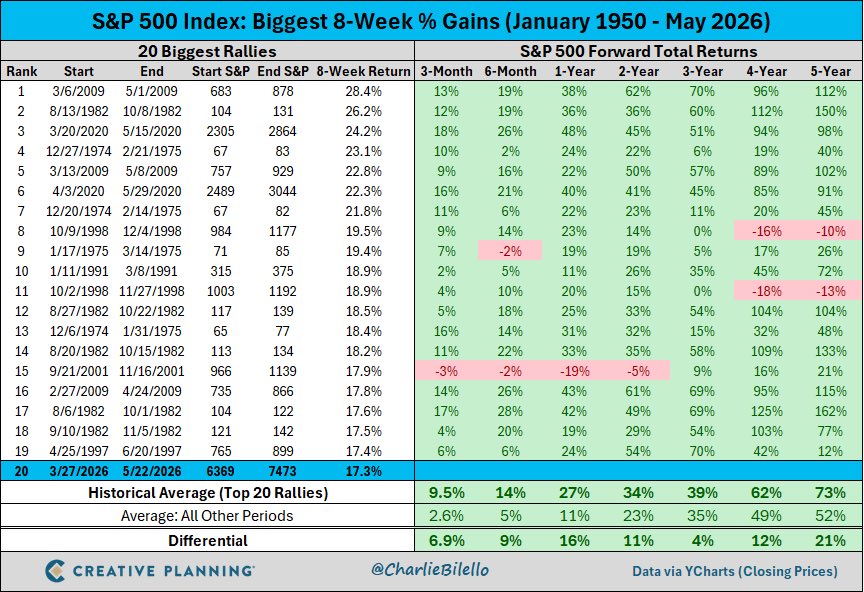
You have a choice this week. Aim for average. Buy the $SPY, ride the rally. After an 8-week gain of +17.3% (the 20th biggest since 1950), history says the S&P 500 returns +27% over the next 12 months, as shown in the table below. Decent. Not yours. Just average.
Or aim significantly higher.
In February 2026, Finansavisen, Norway's ‘Financial Times’, published seven of my convictions. Ninety days later, the market delivered its verdict:
▸ Portfolio: +65.0%
▸ S&P 500 same window: +7.2% | Nasdaq 100 $QQQ: +15.9%
▸ Top pick $SNDK: +143.9%. Six winners. One miss. No asterisks.
Thirty years of quantitative work, four factors, one portfolio.
The full breakdown is here, and at the bottom of the article you will find a 20% off coupon for a paid subscription, valid 24 hours.
👉 https://t.co/oC4OwTJsr7
Average is a choice. So is significantly above it.
Table courtesy of Charlie Bilello, Creative Planning.
Most newsletters tell you what they got right. Few publish their picks in a national newspaper first, then let you check the math three months later.
➡️ I did.
Here is what happened (link):
https://t.co/U32TBSR47M
$SNDK $RKLB $MU $PL $WDC $LITE $APH $QQQ $SPY
$NVDA reports Wednesday after the bell. Morgan Stanley just raised its price target to $285, implying 28% upside from current levels, and the setup heading into earnings looks unusually clean.
➡️ The expected pattern: beat revenue by $3b, guide $4bn above consensus. That is the machine doing what it has done every quarter for two years.
➡️ Morgan Stanley now models $79.3b in revenue and EPS of $1.72 for the quarter ended April 30.
➡️ The figure that matters most is buried in the detail. Nvidia currently holds $95 billion in purchase commitments, enough to cover the vast majority of what it intends to ship over the next 18 months.
➡️ In an industry where supply chain visibility is measured in weeks, that number redefines what “backlog” means.
➡️ 57 out of 61 analysts covering the name carry a buy rating.
Near-unanimous conviction of that magnitude, for a stock already up 66% over 12 months, is either a warning sign or a statement about the durability of the AI infrastructure cycle.
➡️ The Disruptive Investor on Substack reads it as the latter (link in bio).
Wednesday evening will be instructive. Expect noise around the guidance. Focus on the purchase commitments figure and any update to data center revenue composition.
#Finance #Investing
Can you actually believe this? Driven by AI capex deployment, memory maker Micron ($790) has seen its 2027 consensus EPS estimates rise by a factor of TEN over the last year.
✅Yes, you read that right. A 10x increase in earnings expectations. The kind of upgrade cycle that happens once in a generation.
➡️Yet the shares are up "only" 715% over the same period. Which sounds insane until you do the math.
Because 715% equals roughly 8x. And when earnings estimates go up 10x but the stock goes up 8x, something remarkable happens: the forward P/E ratio actually DECREASED.
➡️Think about that for a second. $MU stock is now CHEAPER than it was a year ago on a forward earnings basis.
In plain numbers, the 12-month forward P/E was 10.1x twelve months ago and sits at 8.8x today.
➡️The company delivered a monster earnings revision cycle and somehow got less expensive in the process.
Wall Street gave Micron credit, sure, but not nearly enough credit relative to the fundamental transformation underway.
➡️Here's where it gets interesting. Micron has regularly traded at 14x forward earnings during previous upcycles.
Apply that multiple to today's 2027 consensus estimate of $99.08, and you're looking at a stock trading at $1,400. Just multiple expansion back to historical norms.
The operating performance has outpaced the stock performance. The market hasn't fully arbitraged this gap yet.
I'll let you do the math.
-> Follow me on Substack (Link in Bio)
#Finance #Investing
Burry says AI components are in a bubble.
He is wrong.
$NVDA: 26x fwd PE. A DECADE LOW.
$SNDK: 10x fwd PE. Stock at all-time highs. Earnings revisions are moving faster than the price.
$MU: 8x fwd PE. CEO says supply short of demand “for the foreseeable future.”
Hyperscalers committed $805b in AI capex for 2026. $1.1 trillion in 2027.
THE BIG SHORT IS THE WRONG SCRIPT.
Link to full article in comments.
#Finance #AI #Investing
MID-SESSION UPDATE. THREE FREE PICKS. THREE WINNERS.
Applied Optoelectronics ($AAOI) gained +71.4% in 35 days. Bloom Energy ($BE) surged +66.8% in 28 days. Planet Labs ($PL) returned +33.4% in 48 days.
Three positions documented before the move. All verifiable on my Substack channel.
THREE WINS ON RECORD.
Six additional picks for paid subscribers carry three-digit price targets.
The most recent addition carries a +200% price target.
The full deep dive is live now: Link in Bio
#Investing #Finance
Applied Optoelectronics ($AAOI) has returned +65% for my free subscribers since April 6th, 2026. Not a backtest. Not a hypothetical. A documented, timestamped entry published on The Disruptive Investor on Substack.
Go check the Saturday, April 4th post, it is still there, open to every subscriber, immutable. Twenty-eight days. Clean execution. The thesis is still running.
Here is what drove it, and why the move is not over.
The GPU arms race at Microsoft, Amazon, and Google is not won on silicon alone. It is won on bandwidth.
Copper hits a physical wall at 200 Gb/s per lane. The moment you are building 100,000-XPU clusters, you need optical at scale. 800G is the floor. 1.6T is the new battleground.
Applied Optoelectronics sits precisely at that bottleneck, with a $124 million hyperscaler transceiver order already booked and a $20.9 million Texas state grant securing domestic production capacity. This is not speculative positioning. This is certified hyperscaler procurement.
The stock has compounded +409% year-to-date.
The price target, published on Substack and fully documented, stands at $372. From current levels, that is +110% of remaining upside.
Still on the table, still structural, still driven by fundamentals that the consensus has not yet priced in.
Earnings land May 7th. The repricing has started. It is nowhere near finished.
Twenty-eight days. +65%. Published on this channel before anyone was watching. And the destination — $372 — is not yet reached.
Every pick on The Disruptive Investor is dated, sourced, and permanently on record.
No revisionism. No cherry-picking. If you want to be in the room where the next thesis gets built — before the +65% happens, not after — subscribe to The Disruptive Investor on Substack (link in bio).
The next pick is already in research.
This content is for informational purposes only and does not constitute investment advice.
#Finance #Investing
Q1 2026 EPS growth at +25% y/y, the strongest in five years. The market is celebrating. But read the footnote: this boom is largely debt-funded. $400bn in AI-related IG and HY issuance since mid-2025. The hyperscalers are borrowing to build. Which means the real question isn’t “is AI capex real?”, it’s “what happens to this EPS trajectory if credit spreads widen?” The infrastructure supercycle is intact. The leverage underneath it probably deserves more attention than it’s getting.
@Schuldensuehner $1.1 trillion in hyperscaler capex by 2027. That’s not a forecast anymore. It’s a construction contract. Every dollar of that trillion needs to move through fiber. Coherent optical transceivers. Data center power infrastructure. Position accordingly.
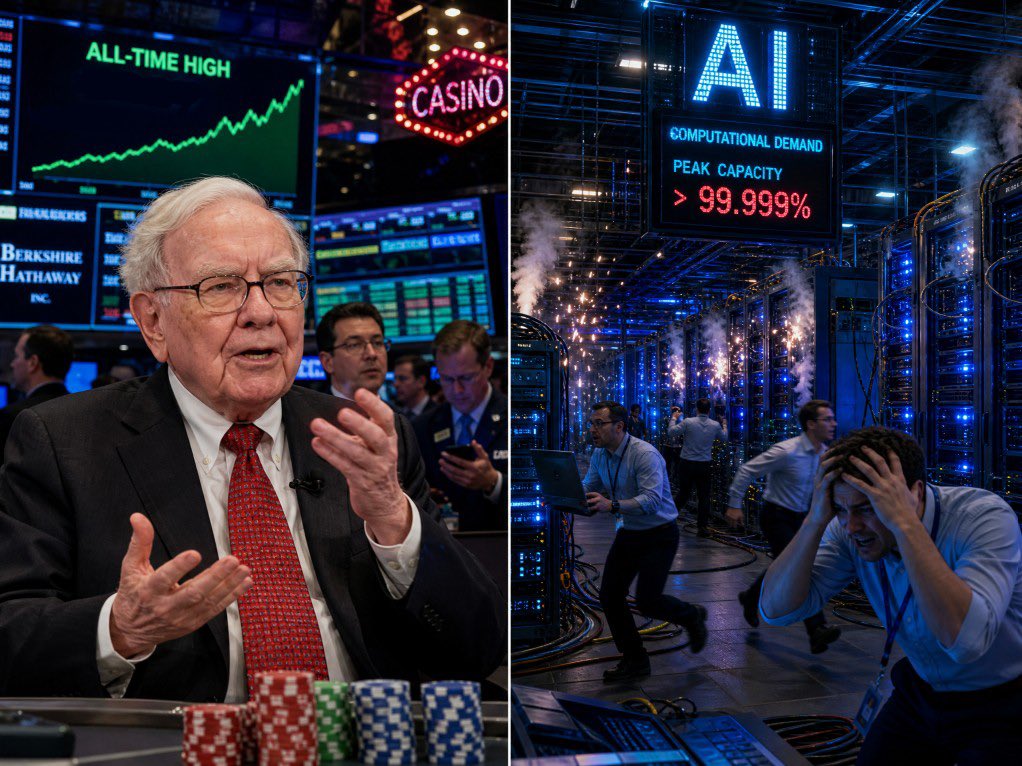
Warren Buffett says markets have turned into a casino. The sceptics say AI monetisation is years away.
Yet, last week, the AI cash flows showed up in audited accounts. At a magnitude no consensus model had anticipated, across four of the largest companies on earth.
➡️ Amazon Web Services ($AMZN) is the world's largest cloud platform, with over $150 billion in annual revenue. It just posted its fastest quarterly growth rate in 15 quarters. Up 28% year over year. CEO Andy Jassy put it in perspective: three years after AWS launched, its entire revenue run rate was $58 million. Three years into the AI wave, AWS's AI business alone is already running at $15 billion. 260 times larger.
➡️ Microsoft ($MSFT) runs the world's second-largest cloud computing platform. That platform grew +40% last quarter. Not because Microsoft got better at selling cloud storage, but because enterprises are deploying AI workloads at scale and paying for the infrastructure to run them. Microsoft's AI products now generate an annualised revenue run rate of $37 billion. Up +123% in one year.
➡️ Google Cloud ($GOOGL) , which was growing at 20-30% annually before AI, accelerated to +63% revenue growth last quarter, reaching $20 billion. Its revenue backlog nearly doubled to $460 billion in just three months. AI demand already signed, already committed, waiting to be recognised as revenue. Management's constraint: not enough AI data centre capacity to meet what is already in the pipeline.
➡️ Meta ($META) has 3.6 billion daily active users and a singular business model: selling advertising. Last quarter, AI-optimised ad targeting generated revenue of $56.3 billion, beating consensus by nearly $1 billion. The monetisation is already happening, at consumer scale, every day. The company is now investing $145 billion in capital expenditure this year to extend that advantage.
These four companies are planning to spend over $700 billion in capital expenditure in 2026, approaching the entire GDP of Switzerland.
Every single one of them says AI demand is outpacing their ability to build.
THAT IS NOT OVERCAPACITY. THAT IS A SUPPLY SHORTAGE.
If you need a single data point to prove it: the CEO of Micron ($MU) , one of the three largest memory manufacturers on earth, stated this week his company can supply only 50 to 65% of what customers need — a gap he described as "unprecedented".
This is a full-stack constraint across the entire memory and storage ecosystem: NAND, DRAM, enterprise storage, capacity-driven disks. SanDisk ($SNDK) beat revenue consensus by $1.2 billion. Western Digital ($WDC) posted +45% revenue growth.
Bloom Energy ($BE) more than doubled revenue year over year on AI data centre power contracts.
Bubbles have no effect on margins. This cycle is expanding them. Across the entire supply chain.
Warren Buffett built the greatest compounding record in history by reading businesses, not narratives.
THE BUSINESSES ARE ALL SAYING THE SAME THING RIGHT NOW.
#Finance #Investing
In 2013, the Nobel Committee awarded its prize in economics to Eugene Fama (pictured, left) for a theory that states, in essence, that you cannot consistently beat the market.
The Efficient Market Hypothesis. THE EMH.
The idea is elegant and brutal in equal measure: all available information is already reflected in asset prices at all times. Attempting to outperform the market through stock selection or timing is, by definition, a zero-sum game against the aggregate intelligence of every participant simultaneously. The market is always right. Mispricings correct instantly. Alpha is an illusion.
The Nobel Committee, in awarding this prize, also awarded it to Robert Shiller — a man who spent his entire career demonstrating that markets are predictably irrational.*
They gave the same prize, in the same year, to two economists whose life's work directly contradicts each other.
That detail alone should tell you something about the state of financial theory.
But here is what is more interesting. Fama himself.
The man who won the Nobel for saying markets cannot be beaten spent the following decades publishing research that explains, in extraordinary detail, how to beat them. Not through luck. Not through prediction. Through systematic factor exposure.
In 1993, Fama and his colleague Kenneth French (pictured, right) published what would become the most cited paper in financial economics: the Fama-French Three-Factor Model.*
The original CAPM said that a stock's return was explained by one thing: market risk. Fama and French said that was incomplete. Two additional variables had been consistently and demonstrably predictive of outperformance across decades of data:
Size — smaller companies tend to outperform larger ones over time. Value — companies with low price relative to book value tend to outperform growth stocks.
These were not one-off observations. They were systematic, documented, persistent anomalies. The kind that, under a strict reading of the EMH, should not exist.
In 2015, Fama and French expanded the framework to five factors, adding:
Profitability — companies with high operating profitability tend to outperform. Investment — companies that invest conservatively tend to outperform aggressive capital allocators.
Four factors, beyond market risk, with documented and persistent predictive power over long-run returns. Identified and formalised by the man who said the market could not be beaten.
The most famous practitioner of the value factor, of course, requires no introduction. Warren Buffett built one of the greatest compounding records in financial history by concentrating in undervalued businesses with durable competitive advantages — which is, in the language of Fama and French, a systematic tilt toward the value and profitability factors. He did not predict the market. He exploited a structural inefficiency that academic finance had not yet named. And then Fama named it, measured it, and confirmed it was real.
Factor investing has since evolved considerably. Academic research has now documented close to fifteen factors with statistically robust and persistent predictive power: momentum, low volatility, quality, dividend yield, earnings revision, and others. Not all of them are equally robust. Not all of them survive transaction costs or capacity constraints. But the core insight — that systematic, rules-based exposure to specific company characteristics generates abnormal returns over time — is now one of the most empirically supported findings in all of finance.
The EMH is a useful starting assumption. It is not a law of nature.
The Disruptive Investor (link in bio) is built to identify the companies that score highest across the factors with the most robust predictive power — those with the highest probability of generating abnormal returns before the broader market has priced them in.
This content is for informational purposes only and does not constitute investment advice.
#Finance #Investing