🌐 @Visa is expanding stablecoin settlement to Monad
Participating issuers and acquirers can now settle Visa obligations in stablecoins on the Monad blockchain
Last month, we introduced Monad Private Settlement. Today, we're publishing the technical white paper.
It details private execution domains, shared sequencing on Monad, cross-domain messaging, and configurable access controls.
Read the research: https://t.co/oK16NeoPll
Crypto looks like it is about money.
I think money is only the visible layer.
I wrote about why I work at Monad Foundation, what drew me to @monad and why underneath all the noise are time, ownership, power and the freedom to choose another path. https://t.co/5xeOQNJmwV
JUST IN: @category_xyz revealed Monad Private Settlement
Private Settlement is being developed to provide confidential execution domains with encrypted transactions, atomic settlement, and access to L1 liquidity.
Designed for banks, funds, and other institutions that need a privacy solution for their activity.
Today we are announcing Monad Private Settlement, which gives banks and enterprises the best of both worlds: sovereign execution environments with privacy and compliance by default, which benefit from the composability and performance of Monad
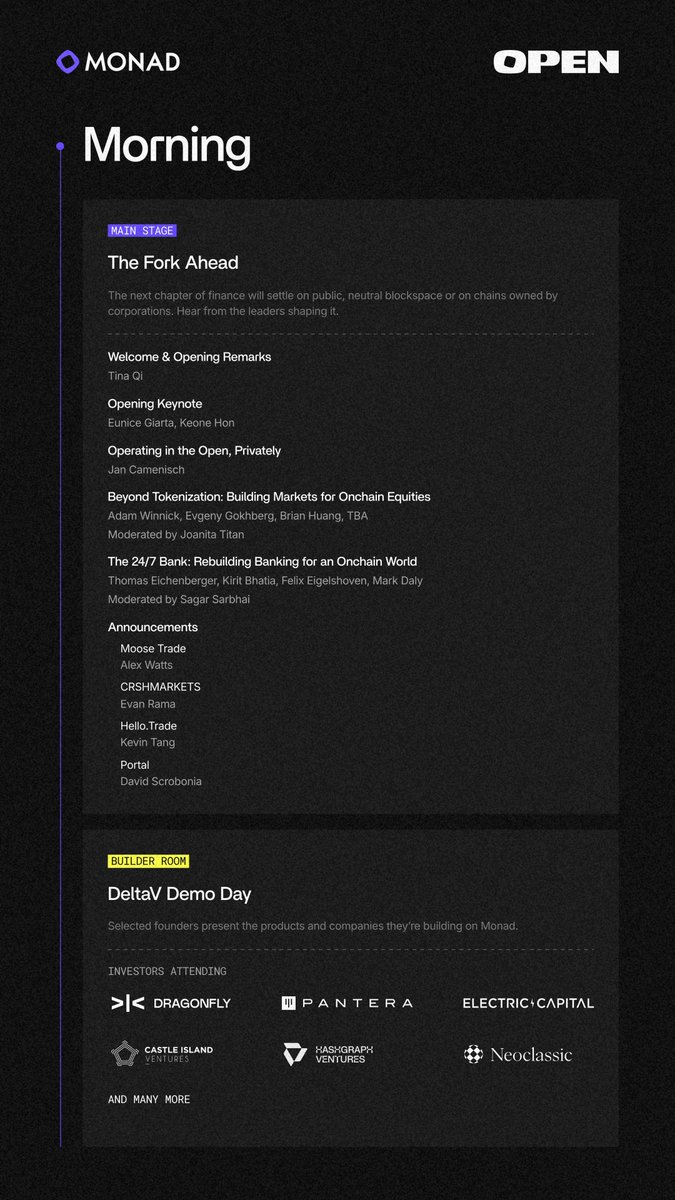
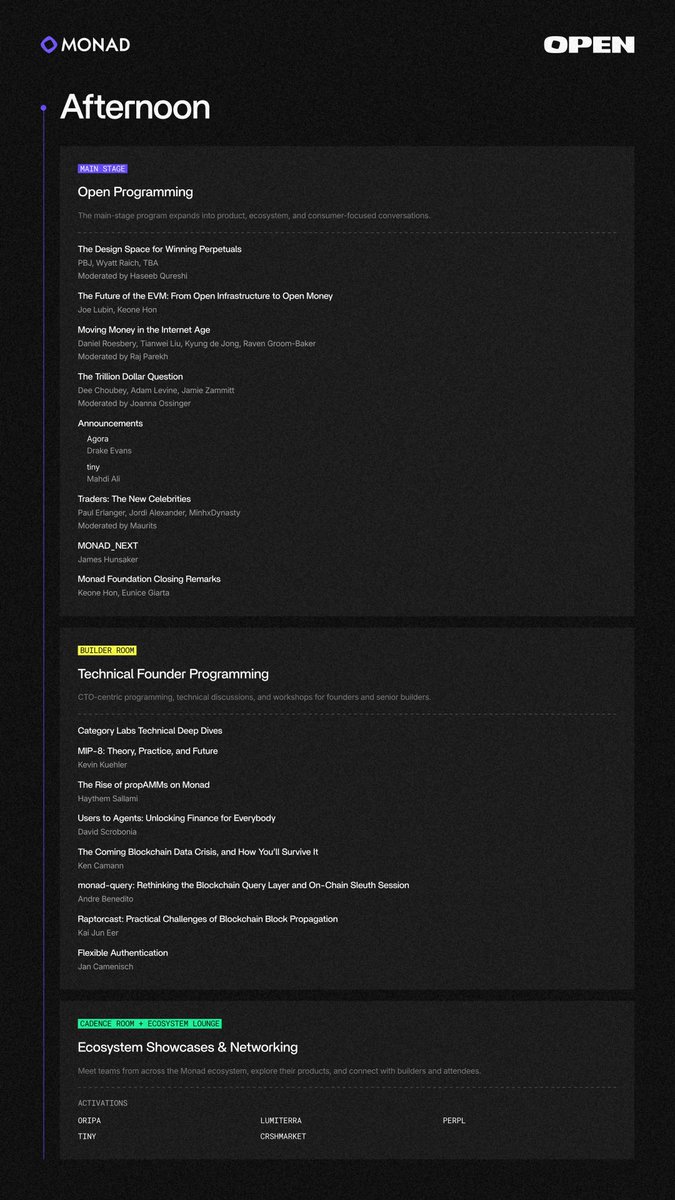
One week until Open in Singapore!
From institutional finance to ecosystem updates and technical deep dives, Open has something for everyone.
Check out the full schedule here: https://t.co/1tkMOpPdWF
We asked @keoneHD 9 questions about the current state of crypto
Timestamps👇
0:00 Intro
0:35 Wyoming and the SALT Conference
1:28 Policy, regulation and institutional adoption
1:50 Is the word “crypto” dead?
3:22 Corporate chains vs. open networks
4:00 Where tokenized assets will settle
4:45 What users gain from open networks
5:36 Why neutral infrastructure matters
6:15 Cadence, BTX and MEV resistance
7:24 Why open infrastructure can win
Introducing the Metropolis global hackathon
Six weeks to build the next generation of startups on Monad.
4 tracks. Over $250K in prizes for builders.
Submissions end October 13th.
https://t.co/TOL6M5njId
explaining monad's edge in 2 minutes
simply: it's a highly performant open system
why does that matter? that doesn't feel unique!
it sounds like a vision for crypto that's been around for 10 years...
exactly.
allow me to briefly elaborate:
corporations don't want to build on a chain that's controlled by a competitor
and most don't want to spend the resources to run their own chain
neutral blockspace gives everyone fair access - users, startups, corporations... everyone
but neutrality is only viable if it's fast enough to scale
monad is not the first neutral option, but it's the most performant one
an open, neutral and performant settlement layer enables an efficient and productive onchain economy
capital markets create liquidity, shared liquidity makes trading, lending, payments, and RWAs useful
(see monad in the top 3 chains of RWA usage in DeFi)
it is also EVM compatible, which clearly matters
EVM remains the dominant smart contract standard and has the most locked capital
because monad is EVM, apps from Ethereum and other EVM chains can deploy in a matter of minutes, with minimal code changes
and they run much more efficiently on Monad
see: Aave, Balancer, Beefy, Curve, Euler, KyberSwap, Morpho, OpenSea, PancakeSwap, Pendle, SushiSwap, Uniswap
monad has 300ms block times, a globally distributed set of ~200 validators (currently) that can run on consumer grade hardware
and then you have Category Labs
founded by HFT veterans from Jump Trading, CL is quickly becoming the premier EVM R&D firm
recent research (Cadence + BTX) aims to drastically reduce MEV and solves problems that have stumped the cryptography community for decades
(they're winning awards for this research)
there is a clear vision for the future of crypto UX and the team is shipping at record pace
nobody else is doing this, and the proof is public
sooner rather than later, it will become consensus that monad stands alone