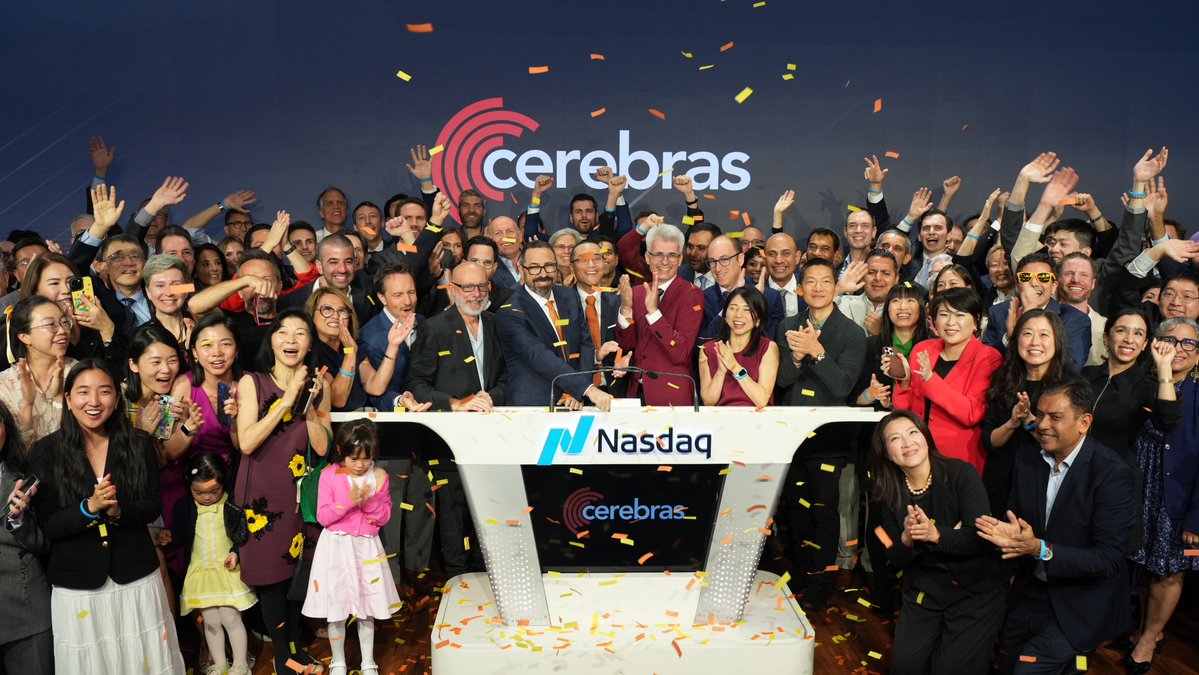
@btrenchard at @firstround was our first backer.
We had no customers, revenue or proof that anyone could build an agentic ERP from scratch.
He saw the vision early, backed a hard build, pushed us where needed and supported us when things didn’t go well.
Thank you Bill. Couldn’t have done it without you.
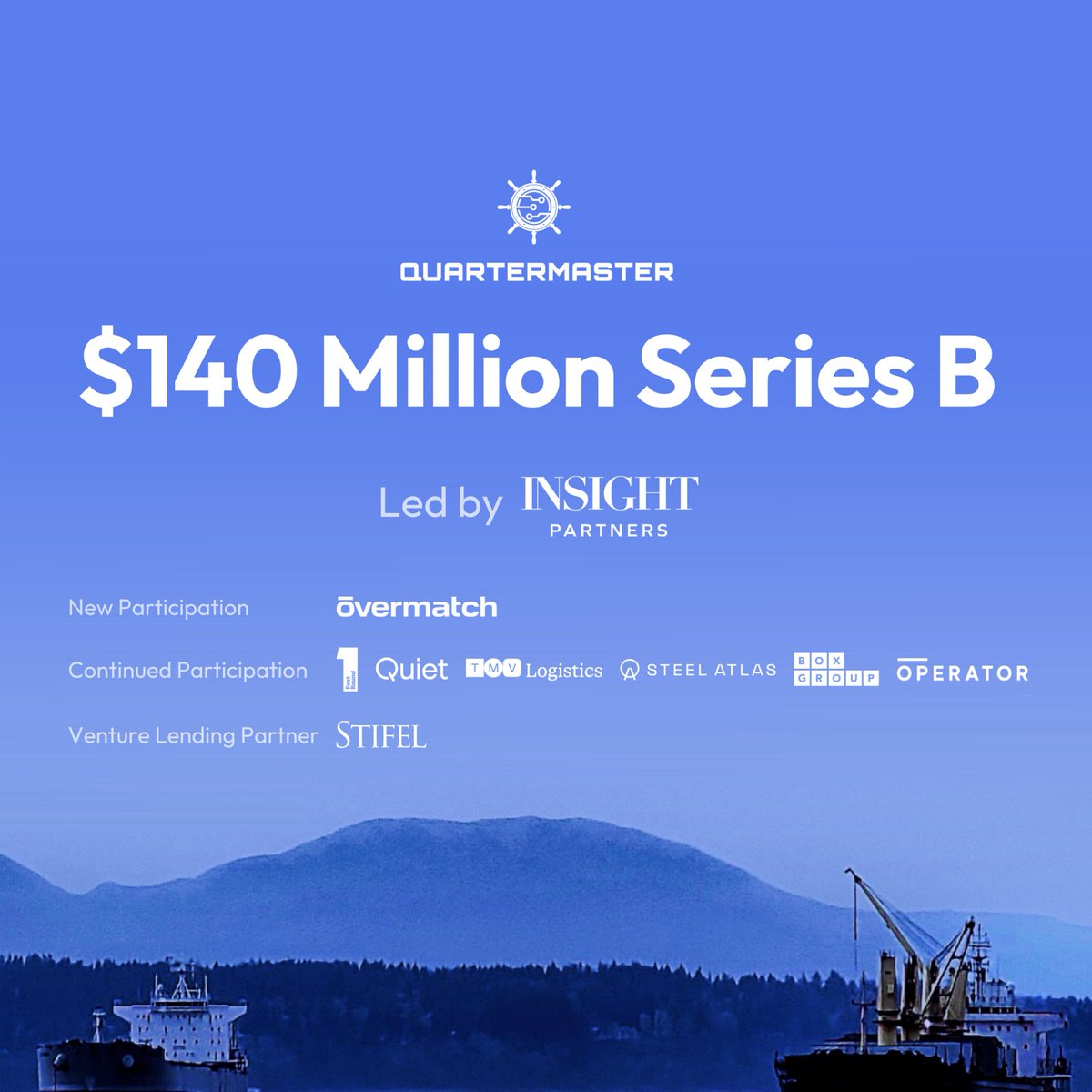
Just four months since we co-led their Series A, @quartermasterai has grown its coverage by 77% and raised a preemptive $100M Series B from @insightpartners. Even for a software company, this pace would be very impressive, but @SobinNeil is doing it with hardware, out at sea, in incredibly volatile geopolitical conditions.
Neil started Quartermaster with a simple premise: the only sensing network that can actually scale to the ocean is the one that's already on the ocean.
This team is moving quickly, putting their SmartMast product on 650 working vessels from 25 countries. It very cleverly combines HD video, AI, radar, RF sensing, and AIS to turn working vessels already on the water into a live sensor network for the ocean’s surface.
This increased visibility helps mariners of all types navigate congested waters and busy ports, avoid potential hazards, and call for help in an emergency.
It also comes with tremendous built-in network effects that only become more valuable as they scale up. Neil has gone unreasonably deep on how all these different pieces of the business fit together, and we are so fortunate to be his partner here @firstround.
If you are a current student (undergrad or grad) -- you should apply to be a student partner at @DormRoomFund! Probably the most valuable community, credential and experience you can get while in school!
The tsa using ai for security is great, but whatever they are using to decide if a backpack is dangerous is taking way too long and is a solvable problem. Better models exist guys!!
Today we are introducing Dyna-2, a world-action model pre-trained on one million hours of human video. At this scale, for the first time, we discovered several new scaling laws:
• world-action models exhibit scaling law on human data across four orders of magnitude, from 1000 to 1,000,000 hours,
• this human data scaling law implied a scaling law on never seen robot data,
• both data and objective matter; world modeling and scaling on video data are essential for cross-embodiment scaling transfer to emerge
🧵
Our biggest round yet: @K2SpaceCo has raised a $500M Series D at a $6.8B post-money valuation. The round was led by @kleinerperkins and @ICONIQCapital, with participation from @CapitalG, @lightspeedvp, @AltimeterCap, @sparkcapital, Sands Capital, @ARKInvest, @TRowePrice, and other existing investors.
"Scaling” is probably the word I’ve used most often the past few months in conversations with our investors, customers, and employees when talking about what’s next for K2 Space in 2027 and beyond:
--We’re going to continue to scale up mass production, to deliver against the $1B + in contracts we’ve won to-date.
--We’re going to scale up the satellite itself, from the 20kW Mega to the 100kW class Giga. Its no longer just 100kW, but we’ll save that update for another day.
The capital from the Series D will turbocharge this scaling.
Thanks to everyone who has been on this journey with us for the last four years – let's keep building bigger.
In 2022, when we said we wanted to build giant satellites, people told us “No one is ever going to need satellites that large” and “Building satellites that large would be really difficult.”
When we said that we wanted to call our company K2, for a Type 2 Kardashev civilization, people asked us “What is a Kardashev?”
Fast forward four years and the Kardashev scale is now a mainstream concept, the entire market is moving bigger, and we just completed 100 days on orbit for our first giant satellite mission.
This is the story of Gravitas, from @firstround
I met @jasonyuan in 2024 while he was building Dot at @newcomputer. I was struck by his thoughtfulness, authenticity, and deep passion for what he was building, and as I looked at what he’s created over time, it became clear that he’s a special person whose intuition allows him to see the future before it’s obvious.
In 2019, Jason created Mercury OS. He told us the story of how it came together: at the time, he felt, “This computer doesn’t adapt to my brain. I have all these files. There’s so much value from emails. It has Siri. Why am I opening all these apps to do things, to respond to emails, to coordinate?” This led him to envision a computer that understood context and could generate interfaces on the fly – which seven years later, we now refer to as generative UI.
In 2023, he teamed up with @sjwhitmore to build Dot, an AI with deep, personal memory designed to help you better understand yourself. It was an early bet on memory and proactivity before either became central to consumer AI, and I felt it was a beautiful product, both visually and how it felt to interact with.
@hivemind is the culmination of a lifetime of Jason’s insights and intuition and years of experimentation at the intersection of AI and social. And I believe that, once again, he’s seeing something the rest of us haven’t – a new kind of social network (check out the video!). It’s a privilege to have had the opportunity to back Jason when he had nothing but an idea, and to have since seen firsthand so many magical moments in the Hive.
The team is hiring – please reach out to me or Jason if you want to learn more!
Introducing HIVEMIND: the Social Intelligence.
Watch the film, based entirely on true stories from @jasonyuan, @biz, @supercgeek, @Reshusaur, and more...
Human biology matters. Scientists and AI need human data to understand health and disease.
Crownlands is open sourcing Gateway 4M, the largest single-cell tissue dataset ever released from living humans, to advance research on brain aging and neurodegeneration.
I remember first meeting @jakebolling & being 'wowd' by his desire to transform an otherwise overlooked industry. We knew we had to invest.
12 months later, Scotch launched.
3 months after that, pre-empted for their A.
Now, Scotch has passed a $1B GPV run-rate.
Scotch is quickly becoming the defacto operating system for liquor stores nationwide. Kudos to the entire Scotch team, and a big 🍻 to Jake — one of the best operators out there.
Back in February, I got early access to @TownAI. Now 93% of @firstround is using it. There was never a top-down mandate — it went viral inside First Round the way great products do.
Today, Town announced its $55M Series A. Huge congrats to @jgreze, @tonydevincenzi and the whole team!
It’s hard to imagine getting my work done without my Townie “Brock” helping me. Here’s how Town took off at First Round:
1) Most AI assistants want you to come to them. Town comes to you. It learns how you work and then starts working. After connecting email, calendar and Slack, Town gives you a briefing — who you work with most, what’s high priority, your communication style and patterns. Everyone gets a custom version of this. Connect Town to more tools (Granola, Notion, Google Drive, etc.) and it starts drafting perfect emails and nailing investment snapshots. Customization even extends to “Townies,” the names, avatars, and personalities people assign their Town assistants.
2) First Rounders create routines in Town to solve real problems…then share them. Chiefs of staff were nodal users. Town is a glass of water in the desert for them. So much of their work is processing email, filling out updates, checking spreadsheets and gathering context. Town does this natively. Roy Rosin, one of First Round’s board partners, automatically tracks all his follow-ups (“commitments I made to founders”) at the end of each day. We share new routines in a # town-square Slack channel so it’s easy for other people to use the same routines the chiefs or Roy created.
3) Town works for every function — even people who’d never set up Mac minis to get the benefits of using agents. Our finance team saves hours on repetitive work it can now automate. Our marketing team tells me it “essentially replaced Claude and ChatGPT” for them. Without skills or markdown files but with persistent memory, the more you use it, the better Town gets over time.
A few specific routines we’re using across First Round 👇
The world’s oceans span roughly 140 million square miles and carry 80% of global trade, and yet most of that area is effectively unmonitored.
All of the existing methods for ocean surveillance fall short: Satellites see broadly but inconsistently, often going dark for hours or days in between snapshots. The Automatic Identification System (AIS) is effective but only works for honest actors, because it’s easy for a vessel that doesn’t want to be seen to turn it off. Fully autonomous vessels exist, but they’re insanely expensive and hard to scale.
@SobinNeil has built both the hardware and software needed to tackle the massive scale of this physical-world problem. At Hivemapper, he went deep in hardware, creating a decentralized network of cars by mapping the world block by block. And at Scale AI he learned that any AI solution is only as good as the data it has.
He’s applying both lessons with @quartermasterai, which just announced their $43M Series A, co-led by @firstround and @QuietCapital. Instead of building entirely new infrastructure, they’re installing hardware on existing fleets to collect live maritime data, and then feeding that data into a software layer to turn those raw feeds into actionable intelligence.
They’ve already covered more than 10 million square miles of ocean, adding 2.8 million square miles in April alone, and they have over 600 active vessels across 25 countries and four continents.
Couldn't be prouder to partner with Neil and the Quartermaster team. More on what they're up to below.
Today we’re launching our newest podcast, Executive Function. The question we’re trying to answer is: what is the difference between good and truly great scale up executives?
We’re beginning this journey by sitting down with Jeanne DeWitt Grosser, who’s currently the COO @vercel and previously spent almost 10 years @stripe, where her final role was Chief Business Officer.
So much of her perspective can be summed up in this observation: “Most executives have a playbook and won’t contextualize it. They over pattern match and lack the intellectual curiosity to figure out what’s different. They don’t actually get their hands dirty.”
Hope founders, execs, and future execs find as much value in this conversation as I did.
Timestamps:
(5:04) What keeps star talent from ascending to the top spot in a company
(19:59) How to balance being demanding and supportive as an executive
(22:47) Jeanne’s interview process for hiring executives
(29:04) The thread that ties together failed executives
(34:57) How Jeanne uses “driver trees” to determine metrics
(43:24) Why your executive peer set needs to be your first team
(57:16) How Stripe got 30 execs to operate as one team
(1:02:43) Why execs should be working themselves out of a job
(1:09:26) The performance review from @collision that sticks out in Jeanne’s mind