@CNBC Squawk Box with Altimeter founder & CEO Brad Gerstner (@altcap), Andrew Ross Sorkin (@andrewrsorkin), and Joe Kernen (@JoeSquawk) | October 21, 2026
Key takeaways of Brad’s views:
> SpaceX’s earnings show the magnitude of the AI buildout. It plans to stand up 10 GW of compute next year, roughly 25% of the US total, and scale in capital, compute, and data wins the race to superintelligence
> The people calling a compute glut over the last two years have all been wrong. Unlike 2000, demand is unconstrained and supply is limited by wafers and power
> Starlink is on a path to becoming a real alternative carrier, with fast adoption in the US and around the world
> The US has a robust framework for AI safety, with pre release review of every frontier model, the White House Accord on Super Intelligence, and the SI Force
> @elonmusk will give one share of @SpaceX to every child in America through @InvestAmerica24, which Brad calls Giving Pledge 2.0
Watch: https://t.co/dCwOm7kupz
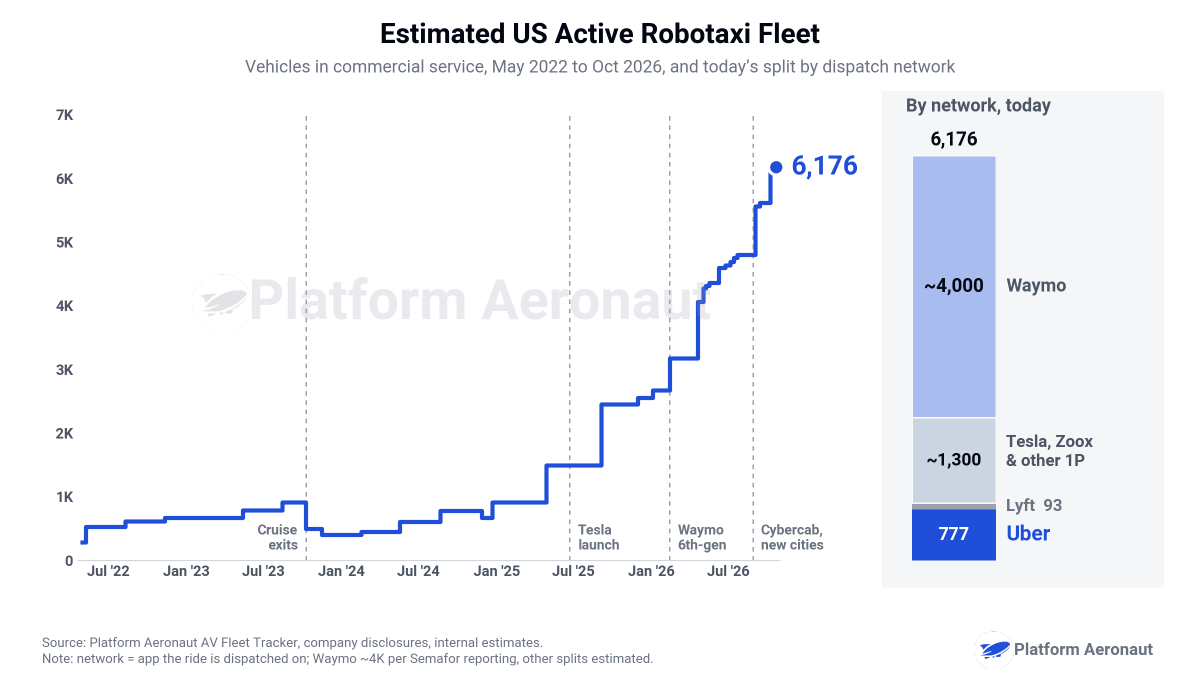
The US robotaxi fleet on my tracker crossed 6,000 vehicles this month, roughly 2.5x where we sat a year ago. $UBER has committed $10B+ to its AV program and this week it was reported that @Waymo wants to double its fleet to 8,000 by year end 2026 and hit 20,000 by the end of 2027.
Those headlines together frame two things:
1) Robotaxis are finally scaling and
2) Uber is spending to defend against disintermediation.
But I think that framing gets the math backwards. The question everyone keeps asking is "who wins the robotaxi race?", but the question that actually matters for Uber is a lot simpler: Does the rideshare pie get bigger faster than 1P networks take slices of it?
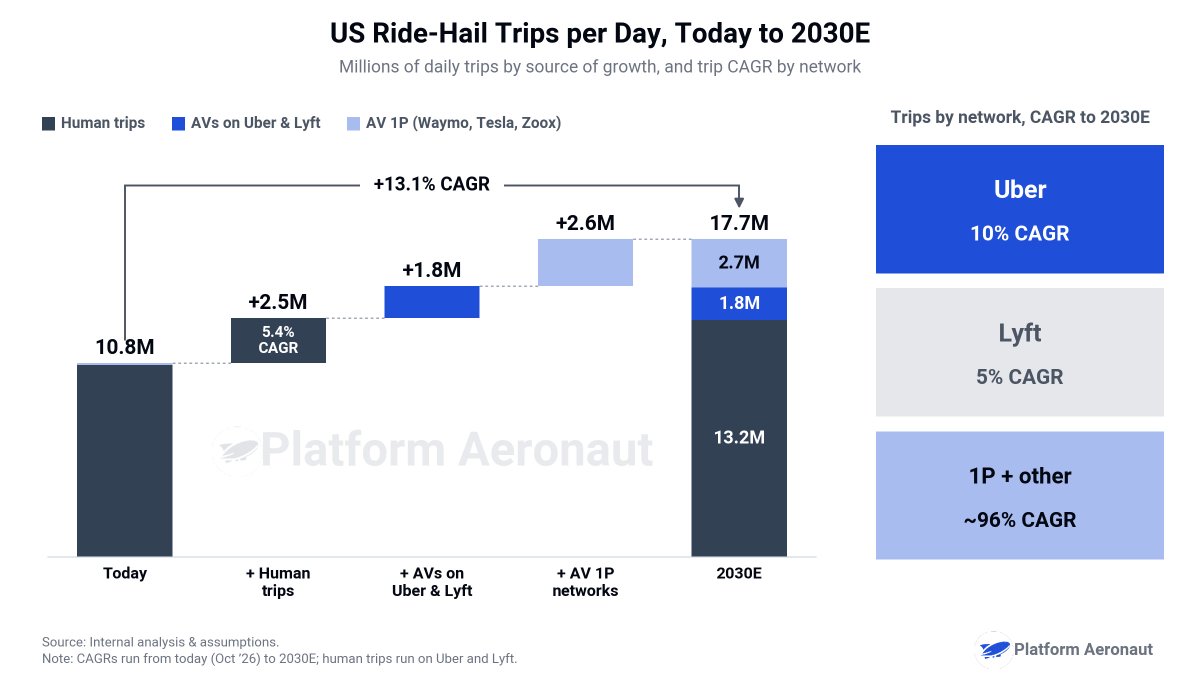
My base case has the US AV fleet reaching 225k vehicles by 2030, which will account for about 17% of the ride-hail fleet doing about 25% of total trips. To be clear this is not a model where Waymo or $TSLA stumble. The 1P networks still end 2030 with 145k vehicles or 64% of the fleet.
Uber goes from under a thousand vehicles on network today to 70k by 2030, which is 31% of the US AV fleet and second only to Waymo. While the aggregators give up share to 1P networks (99% → 85%), the category compounding at 13% means @Uber still compounds trips at 10% a year.
That's true because of three things:
1. The category grows faster with AVs than without them.
2. Humans stay a demand shock absorber that allows Uber to run AV utilization a lot higher.
3. Every AV provider that isn't Waymo/Tesla needs demand.
To be clear, trips are necessary but not sufficient. Hold human trips flat and Uber trip growth is closer to 5% than 10% through 2030.
Uber doesn't need to win the robotaxi race to win the trip math, it needs the pie to keep growing and for there to be successful competitors outside of Waymo and Tesla. @dkhos@_balaji_km
Altimeter Partner Apoorv (@apoorv03) joined @Arda_Industries founder and CEO @bobmcgrewai on @CNBC with Kate Rooney (@Kr00ney) to talk about Arda’s launch and bringing advanced manufacturing back to America 🇺🇸
Key takeaways:
🔹 Speed is the bottleneck. You can retrain a human worker in a day, but updating factory automation takes three to six months. That’s why fast moving products get assembled overseas.
🔹 Act One is a Claude or Cursor for manufacturing engineers. At Anduril, an engineer used Arda to build out a 2,000 part avionics box in two days instead of a week.
🔹 Act Two is flexible automation: assembly lines that reconfigure as fast as you can teach a person a new task.
“The response to cheap manufacturing labor overseas is not cheaper labor.” The answer is AI and robotics.
📽️: https://t.co/efqAECaBlT
Congrats to Arda and @bobmcgrewai on launching from stealth!
Arda's AI turns product designs into assembly lines that keep up as designs change, so America can build hardware that changes every year.
Altimeter is proud to lead the $160M Series A led by Altimeter partner Apoorv Agrawal (@apoorv03) with @Accel and @KhoslaVentures.
We started Arda in 2025 to speed up American manufacturing. We have spent the last year building with Anduril as our design partner. Today we are launching the company publicly on CNBC and announcing our Series A: $160M at a $1.5B valuation.
Our platform helps manufacturers design and operate manual assembly lines, putting designs into production faster now. Next we'll build automated lines that can be reconfigured as quickly as human workers, letting America make products that now require armies of workers in Asia.
Are you a small business? You can donate to all of the kids of your employees TODAY! Just have parent claim their kid’s free, lifetime stock acct - and then zap the $$ in. Keep a record for your biz expense. Altimeter did this for our 50 kids & people loved it! 💰🚀 https://t.co/K0apujZGeU
Thanks for the shoutout @Jason
Yes it’s true: a full Chrome exploit was achieved by just 1 researcher + @Xbow ’s AI agents in 6 days with ~$40K of compute! 1B+ users protected, all patched✌️
The takeaway is that elite cyber defense (and offense) is now compute-bound, not talent-bound. Annual security reviews and pen tests can't keep up when software is being updated real-time! XBOW like autonomous white-hat should be mandatory part of your security stack!
Ensure your (digital) doors and windows are locked!
Multimodal reasoning is foundational to the next generation of AI applications.
Exciting to see @ElorianAI pushing the frontier with Glimpse.
Glad @AltimeterCap is partnered with Andrew and team thanks to @jaminball.
Very excited to share Glimpse with the world - the first visual thinking model from @ElorianAI
To hit ASI models need to get visually smarter - Elorian is making that possible!
You can try it for free here: https://t.co/kUNmyzS02s
@CNBC Halftime Report special, AI in America, with Altimeter founder & CEO Brad Gerstner (@altcap) and Scott Wapner (@TheJudgeCNBC) | October 15, 2026
Key takeaways from the hour:
> AI revenue exploded higher this year, and the market is now consolidating. The chop is healthy because it avoids bubbles, and the view out to 2027 and 2028 is even more positive
> AI is accelerating as models write more of the code behind each new release, a recursive loop that compounds
> The consensus says the frontier labs’ lead is shrinking. Brad sees it growing, driven by recursive improvement and the most compute
> The U.S. already has a three part approach to AI oversight, and it should keep evolving with the technology
📽️: https://t.co/qxgvkJp1ah
Our third annual sit down with @JensenHuang is live on @BG2Pod.
Brad Gerstner (@altcap) and Clark Tang (@_clarktang) go deep with Jensen on why compute demand is heading to a billion X, how to build AI safely, the 40+ gigawatts coming online next year, physical AI, and data centers in space.
Full episode 👇
Pod up! Some good nuggets on lab revs, Nvidia supply unlock, AI capex & millions of Nvidia agents to employees as we enter the singularity & recursive flywheel starts spinning. 🧐🇺🇸🚀 @JensenHuang@BG2Pod
Hadrian x Lockheed x DoW 🇺🇸
Rebuilding America’s defense industrial base requires more than expanding capacity. It requires reinventing how we manufacture.
@HadrianInc is bringing its technology directly onto @LockheedMartin’s factory floor to scale production of our nation’s most critical missile systems.
This is how we rebuild the Arsenal of Freedom.
@SecWar@USDASDuffey@DeptofWar
PSA: Update Chrome!
Security is changing fast with AI. Case in point: Chrome. One of the most hardened pieces of software on earth. 3.8 billion users of which 2 B are daily! Google just paid @XBOW for finding a full-chain exploit.
A full-chain exploit lets an attacker take total control of a machine, where they can read every email, password and bank login the user types. You don’t need to download anything or click a phishing link. Visiting the wrong site is enough.
So, please get that update. And secure your browser.
@oegerikus 🙏