We scaled Higgsfield to a $400M run rate and 24M+ users in just 13 months after launch.
That makes us the fastest-growing video AI startups in the world.
But I’ve never shared how it started. Here’s the story:
My favorite @elonmusk quote that I often send friends:
Do not fear losing. “You will lose,” Musk says. “It will hurt the first fifty times. When you get used to losing, you will play each game with less emotion.” You will be more fearless, take more risks.
> you’ll never start a rocket company
> you’ll never build your own engines
> you’ll never be able to use off-the-shelf parts
> you’ll never survive three launch failures
> you’ll never reach orbit
> you’ll never win NASA’s trust
> you’ll never launch cargo to the ISS
> you’ll never compete with Boeing
> you’ll never compete with Lockheed
> you’ll never make rockets reusable
> you’ll never land a rocket vertically
> you’ll never land one on a drone ship
> you’ll never reuse a booster
> you’ll never fly the same booster 10 times
> you’ll never fly the same booster 20 times
> you’ll never fly the same booster 30 times
> you’ll never recover and reuse the fairing
> you’ll never lower launch costs
> you’ll never launch every month
> you’ll never launch every week
> you’ll never launch multiple times a week
> you’ll never carry astronauts
> you’ll never replace Roscosmos
> you’ll never fly civilians to orbit
> you’ll never manufacture satellites at scale
> you’ll never build the biggest constellation ever
> you’ll never make satellite internet work
> you’ll never make satellite internet fast
> you’ll never make satellite internet affordable
> you’ll never serve rural customers
> you’ll never serve aircraft and ships
> you’ll never build a methane rocket engine
> you’ll never make full-flow staged combustion work
> you’ll never build the most powerful rocket ever
> you’ll never build a rocket bigger than Saturn V
> you’ll never build it out of stainless steel
> you’ll never launch Starship
> you’ll never separate Super Heavy and Starship
> you’ll never relight Raptor in space
> you’ll never bring Super Heavy back
> you’ll never catch a booster with Mechazilla tower arms
> you’ll never launch 85% of mass to orbit worldwide
> you’ll never change the economics of space
> you’ll never force the entire industry to copy you
> you’ll never win
> you’ll never IPO
Congratulations to @elonmusk and the SpaceX team. You did what countless people said was impossible, and you did it time and time again.
Today is your day. You deserve this. May it be a glorious one.
@BrendanFoody It seems like they’re over indexing on funding any Ivy League kid with a half-baked idea vs. the Airbnb, Reddit, Instacart, stripe, etc. founder archetype that made them successful
OpenAI and Anthropic are effectively telling the market they can't solve every problem with a generic AI coworker.
You don't pour billions into massive forward-deployed joint ventures if you think the next model release is going to take care of it.
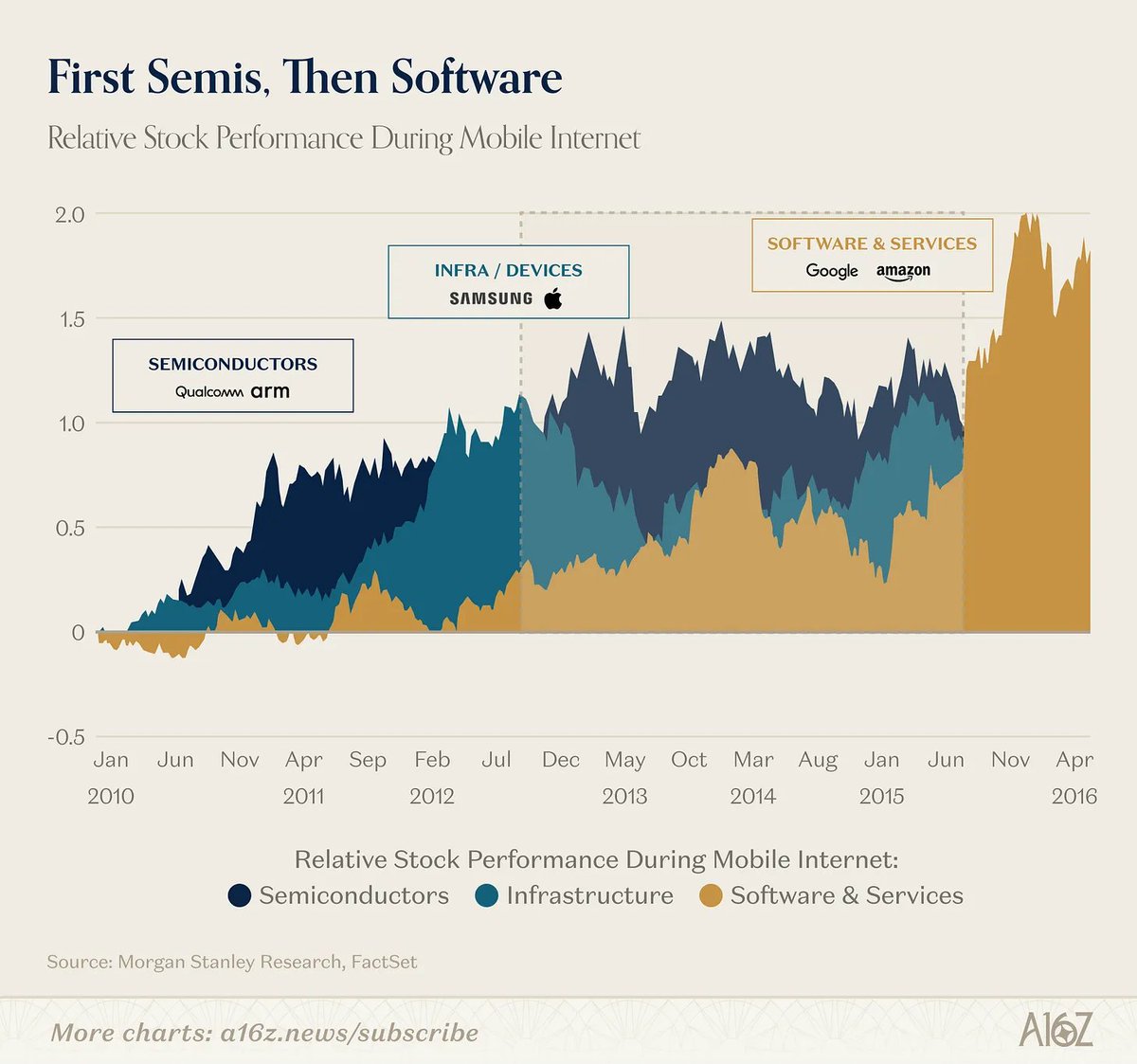
In the cloud supercycle, semis led and software followed (and you didn't need Qualcomm or ARM to tell you the value was migrating up the stack).
In AI, the infra layer itself is telling us the application layer is a separate, massive opportunity they can't fully capture.
a16z's @joeschmidtiv on why the app layer isn't dead: https://t.co/84QN5Mj9T3
Devin's numbers just came out. And they're wild.
$1 million in ARR in September 2024. $445 million run rate today. Usage doubling every eight weeks.
Cursor held the all-time SaaS record at $1M to $100M in 12 months. Devin crossed that line in roughly 10. Cursor reached $100M through 360,000 individual developers at $276 ACV. Devin reached it through the US Army, Goldman Sachs, Mercedes-Benz, Citi, Dell, Cisco, and Palantir. The United States military pays production rates for an autonomous coding agent.
Cognition is now raising at $25 billion. That's 56x run rate. Cursor cleared $9.9B at a similar multiple last May, and the multiple held because the curve hadn't bent. The unusual part isn't the price. The unusual part is that the doubling is still happening at $445M.
The buried number is the burn. Cognition has spent under $20 million cumulatively since founding two years ago. Most Series B companies spend that in a single year. Devin's $445 million was built on Series A money.
Then the Windsurf paragraph. Google paid $2.4 billion in licensing fees in July to pull Windsurf's founders out the door. The remaining company sold to Cognition inside 72 hours for a fraction of that. Combined enterprise ARR rose more than 30% in seven weeks post-close. Less than 5% customer overlap pre-acquisition. Google paid two and a half billion dollars to hand Cognition the IDE distribution layer.
In March 2024, independent testers said Devin completed 3 of 20 tasks. The internet called it a fake demo.
Two years later, that product codes for the US Army.
Michael Seibel, Managing Director at Y Combinator, on why shipping a crappy product in under a month beats building a perfect one for a year:
Michael starts with a simple challenge:
"Do you remember the day Snapchat launched? Do you remember the day Instagram launched? Do you remember the day that WhatsApp launched? Remember the day that Uber or Lyft launched? Most likely you don't."
His point cuts against how most founders think about launch day:
"It turns out that launching is nowhere near as significant event to your users as it is to you. So, you should move up the launch as soon as possible."
The reason comes down to validation.
"Until you can get your product in front of customers, you can't validate whether it solves their problem. And so, it's much better to build a crappier product, release it sooner, and get it out there in front of customers, see if they want to use it."
@mwseibel acknowledges the approach isn't universal:
"There's some exceptions. In some extremely regulated markets like banking, for example, or lending, it's just really hard to launch. You actually have to get one s*** done before you're even allowed to get customers."
But for most founders, the bar is far lower than they think:
"In most consumer and B2B startups that we encounter, it's actually possible to get some form of MVP built and launched in less than a month. And so, that's what you should be thinking about."
“ok this startup is cool but …”
1980:
… what if IBM builds this?
1995
… what if Microsoft builds this?
2010
… what if Google builds this?
Today
… what if <huge AI lab> builds this?
reality is, if founders listened to the “what if” pessimists we’d never have any startups or new products. That’s why they’re building and the pundits aren’t
My observation: When these huge waves happen, these new markets are so damn big there will be tens of thousands of new viable companies, hundreds of unicorns, and a few iconic companies that become generational. The big cos play a role but can never compete with the glorious open market known as capitalism
So for all the “what if” people - sit down, log off X for a bit, and let the founders do their thing. And let’s cheer them on when they do
Everyone says they want a culture of experimentation. They put it in the all-hands deck. They say the words out loud: “We need to take more risks.”
And then they go back to their offices and quietly punish the people who do.
You have no experience.
You’ve never started a company.
You’ve never had a full time job.
Nike is going to kill you.
You’re a kid.
You don’t have technical skills.
You shouldn’t build hardware.
Apple is going to kill you.
You can’t build hardware.
You can’t measure heart rate non-invasively.
Athletes don’t care about recovery.
Under Armour is going to kill you.
It won’t be accurate.
You don’t listen.
You’re an ineffective leader.
You can’t recruit great talent.
You’re going to have to pay every athlete.
You can’t measure sleep non-invasively.
It’s too expensive to research.
Athletes are a small market.
The product costs too much to make.
The product costs too much to sell.
Your valuation is too high.
Consumers aren’t going to want it.
Hardware is too hard.
You should measure steps.
Fitbit is going to kill you.
You can’t build a marketing engine.
You can’t raise enough money.
You need a real CEO.
Google is going to kill you.
You can’t be a subscription.
You can’t build a brand.
You can’t do consumer in Boston.
Your valuation is too high.
You shouldn’t make accessories.
You shouldn’t make apparel.
Lululemon is going to kill you.
You can’t predict Covid.
Stay in your niche.
You are going to run out of money.
You can’t build a health platform.
Amazon is going to kill you.
You can’t measure blood pressure.
You can’t get medical approvals.
The market is too small.
You don’t understand AI.
The market is too competitive.
It won’t work internationally.
The supply chain is too complicated.
You can’t build an AI.
You can’t raise enough money.
It’s too competitive.
Healthcare isn’t going to want it.
…
Just keep going ✌️
Kevin O’Leary thinks the highest paying job right now is customer acquisition on social media
“I used to pay those guys $48,000, now I’m paying them $250,000 because you can measure their work based on customer acquisition every week”
“Most of them become contractors, they make half a million dollars a year because they know how to take content, turn it into a 59 second ad on social and acquire 200 customers”
“Those people in their early 20’s are so valuable now. If you know how to use your phone, somebody wants to hire you”