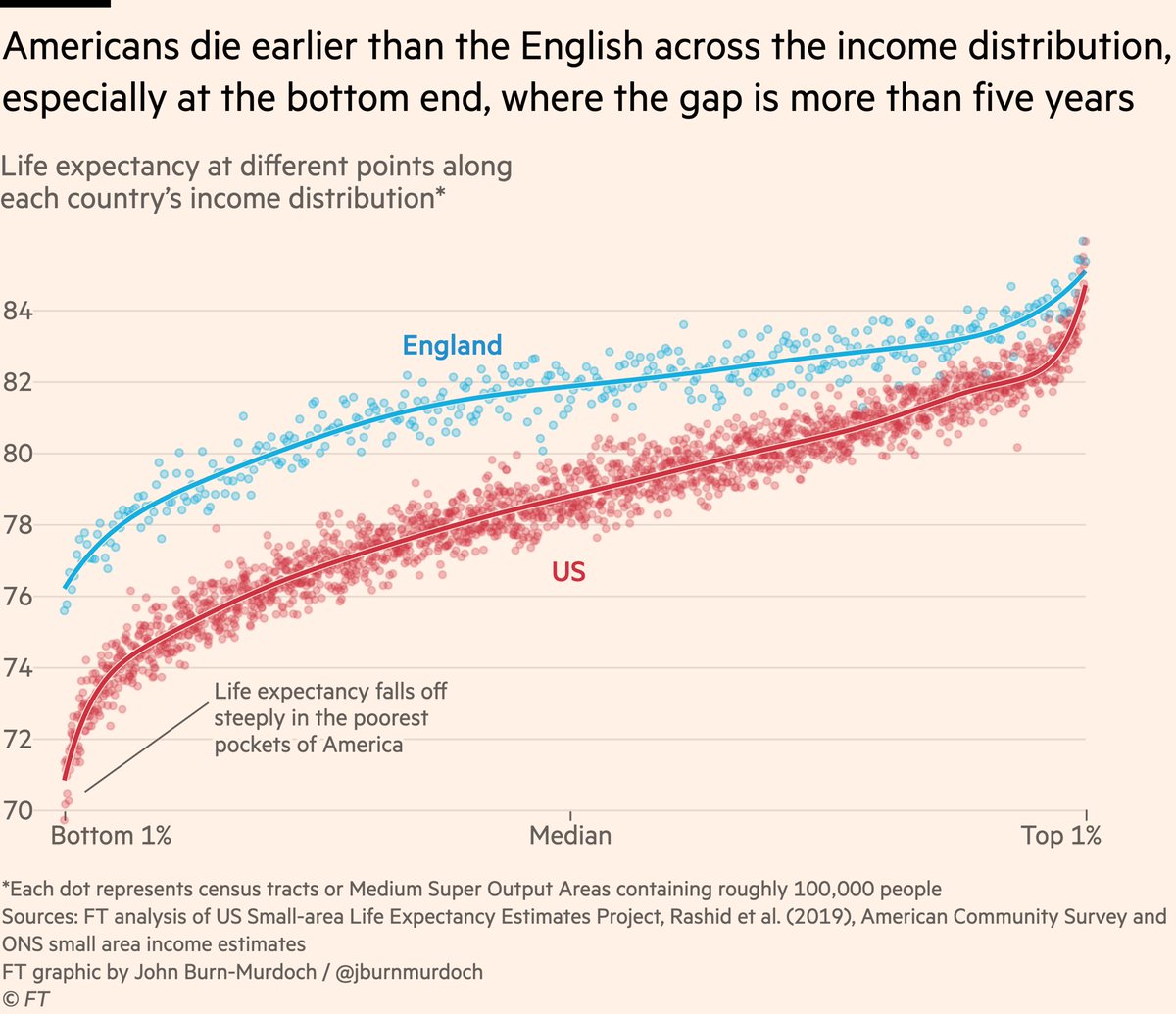
NEW: I’m not sure people fully appreciate how dire the US life expectancy / mortality situation has got.
My column: https://t.co/dBIhT9eZLv
And some utterly damning charts.
1) at *every* point on the income distribution, Americans live shorter lives than the English.
I picked the solution for 17 because that one looked particularly funny to me, but it's not just this number with an awkward looking solution - the arrangements for most numbers are asymmetrical, the neat ones like 16 are the exception.
https://t.co/uBJwYCs8qn
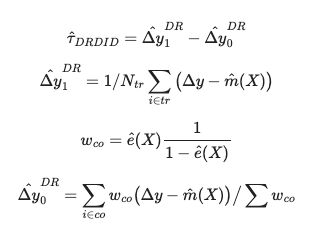
Here is a very simple python implementation of Doubly-Robust DID, by Sant'Anna and Zhao. It helped me understand the paper, but also showed me how to view DID through the lens of delta outcomes. Hope someone else finds it useful.
https://t.co/AnvN50O747
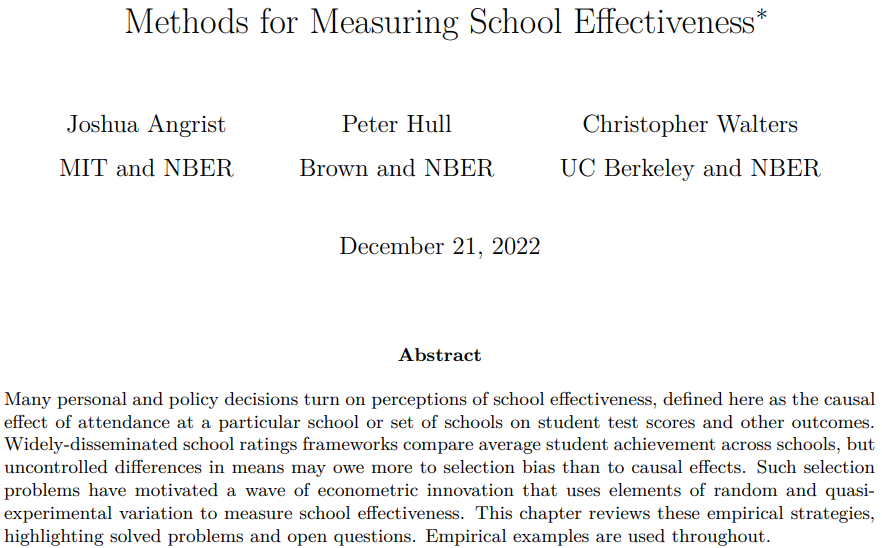
Want to learn the latest in estimating school quality w/ quasi-experimental data? Or the various IV tips & tricks @BlueprintMIT has accumulated over the years?
Check out this new-and-improved handbook chapter with Josh (@metrics52) and Chris (@c_r_walt)!
https://t.co/wvfw2aXtZg
In math, there are lists of "open problems" -- i.e. Qs that the field thinks are important but no one knows the answer to.
Do we have open problems in econometrics?
Or is the issue that we don't know what Qs we should be asking?
#EconTwitter
I also recommend using methods that actually recover LATE (or LATT) when covariates are needed. Our (@TymonSloczynski@sderyauysal) DR LATE (LATT) estimators are easy to compute and doubly robust. Let Doctor LATE cure your identification ills. 😬
https://t.co/f8UhMOae9Q
Hi #EconTwitter!
This paper by @cblandhol (@Princeton), @theJohnBonney (@Stanford), Mogstad and Torgovitsky (@UChi_Economics) shows that 2SLS estimates of LATE 𝐭𝐫𝐞𝐚𝐭𝐦𝐞𝐧𝐭 𝐞𝐟𝐟𝐞𝐜𝐭𝐬 could be invalid if the specification includes covariates.
Highly recommended!