SpaceX trades at 94x sales. Nearly 4x the next most expensive company on earth, and 27x more than Amazon.
Every other trillion-dollar tech giant earns a fat profit. SpaceX is the only one that loses money.
The market is asking you to pay the highest price in the room for the one company in it that earns nothing.
Contributions to your portfolio, not returns, is the biggest driver of wealth accumulation when starting with a smaller balance.
Get a calculator and do the math.
- A $100K portfolio growing 10% = $10K of growth / $110K balance
compared to
- A $1M portfolio growing 10% = $100K of growth / $1.1M balance.
Same return, but the lever is making contributions to grow the size of your portfolio.
Big money produces bigger money, and that's the benefit of contributions.
"Entre todos los países miembros de la OCDE, Colombia registra la menor productividad laboral, lo que significa que por cada hora que una persona trabaja en Colombia produce menos dinero que en cualquier otro país de la lista"
Esto de la @bbcmundo
https://t.co/0kubNApsC8
The Chinese Miracle just hit a wall with "shockingly bad" economic numbers — some of the worst in 20 years.
China tried to central plan their way to number one. It’s turning into a Japan bust with extra zeros.
If you invested $10k ten years ago, you would have $43k today.
The same investment made 50 years ago would be worth $3.9 million.
That’s the magic of compounding.
SpaceX starts trading this Friday.
Here's what history says happens next.
This is the post-IPO performance of every major tech listing of the last decade. Every name you know. Every name you use.
Look at the last column: maximum drawdown in year one.
– Facebook: -54%
– Snap: -56%
– Uber: -68%
– Pinterest: -70%
– Lyft: -79%
– Rivian: -88%
– Robinhood: -90%
Median first-year drawdown across the entire list: -54%.
Average: -55%.
Not the speculative junk. The whole class. Including the eventual winners.
Zoom eventually rose 142% in year one. It still drew down 40% along the way. Palantir gained 153%. It still fell 53% at one point. CrowdStrike, Datadog, MongoDB. All ended year one higher. All put their holders through a 40 to 67% drawdown first.
There has not been a single major tech IPO in a decade that didn't hand you a brutal drawdown in the first twelve months. Not one.
Now SpaceX joins the list, at the richest valuation in IPO history.
You don't have to buy it today.
The IPO is the seller's moment, not the buyer's.
Wait for the base.
🇨🇳🇺🇸 China is building nearly half of all new nuclear reactors on Earth right now.
Within 5 years, it could match U.S. nuclear capacity.
This gets framed as an energy story. It's bigger than that.
AI runs on power. Whoever controls the most reliable, scalable energy infrastructure will have a structural advantage in the AI race: cheaper compute, more data centers, and less dependence on strained grids.
China figured this out early. The U.S. is still debating permits.
Compute is the new industrial capacity, and energy is what feeds it.
Source: Bloomberg / Writers: Daniyal, Oliver
🚨🇺🇸 Retail investors are piling into the stock market at unprecedented levels, completely abandoning traditional safety nets.
Legendary market strategist David Rosenberg points out that an astonishing 72% of U.S. household financial assets are now crammed into equities, a massive spike that completely eclipses the peak of the late-1990s dot-com bubble.
Meanwhile, the president of Rosenberg Research highlights that bond allocations have dwindled to a mere 8% because they lack "sex appeal" at cocktail parties.
Rosenberg underscores that while AI is a genuine technological game-changer, the real bubble isn't the technology itself, it's wild investor behavior.
@EconguyRosie
Nobody talks about this:
Automating your investments is more powerful than optimizing them.
The investor who auto-invests $600/month into boring ETFs without thinking will outperform the investor spending 10 hours a week picking stocks.
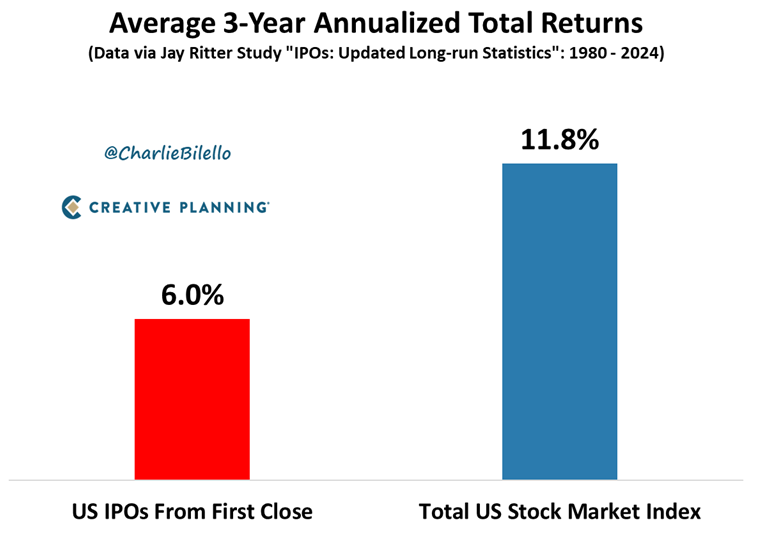
Everyone wants to buy the hot IPO.
History suggests that's often a mistake.
Over the last 40+ years, the average US IPO returned just 6.0% annually in its first 3 years, roughly half the return of the broader US stock market.
China didn’t build an economic miracle. It built the world’s biggest debt experiment. And experiments don’t last forever
When growth is fueled by borrowing, every vacant illuminated skyscraper, highway, and ghost city comes with a bill. How long can they keep the illusion alive?
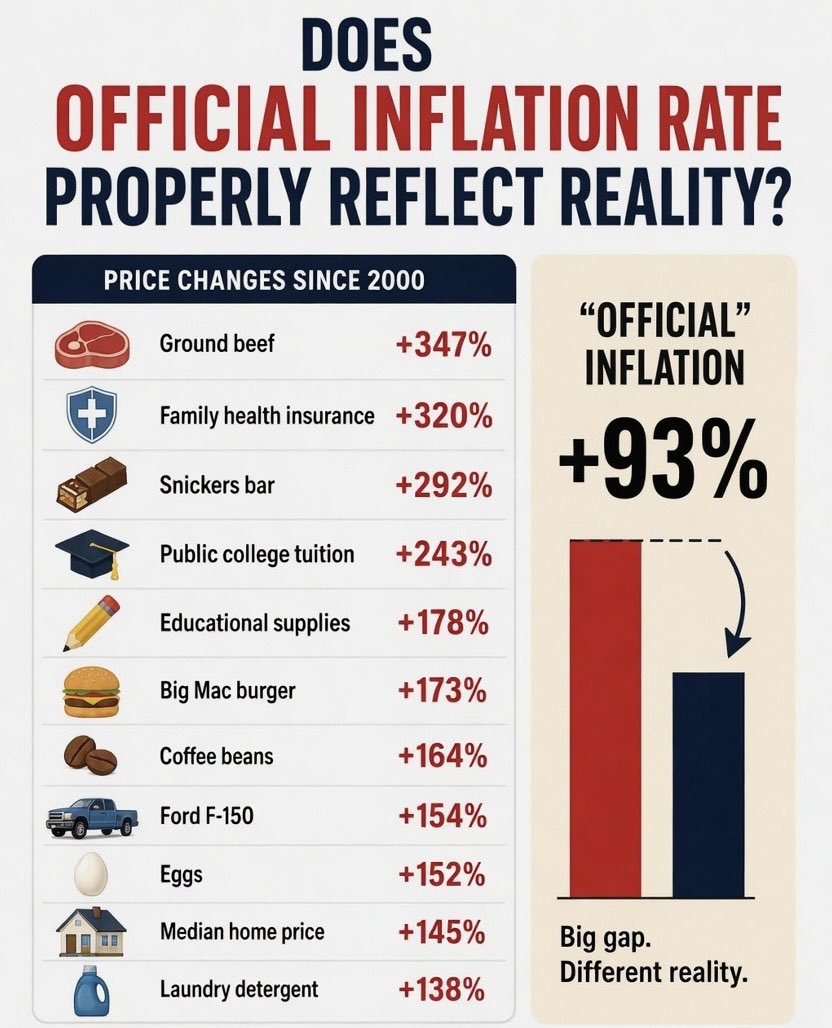
Can you name another government statistic more detached from what people experience than the official inflation rate?
Why do they even bother publishing it if everyone knows the numbers are massaged after each trip to the supermarket?
Between 1965 and 1982, the Dow traded in a 200-point range. Eighteen years going nowhere.
If you invested a lump sum at the top in 1966, you waited 16 years to break even on price. That sounds like a disaster.
But it wasn't, if you kept buying.
Imagine the investor who put $100 into the market every single month from 1966 to 1982. He didn't time anything. He didn't predict anything. He just kept showing up.
While the index chopped sideways, he was buying:
– 1966: at the top, expensive
– 1970: bear market, cheap
– 1974: 50% crash, very cheap
– 1978: stagflation, cheap
– 1982: still cheap
By August 1982, he had accumulated 16 years of shares at an average price far below the highs. Then the great bull market began. Over the next 18 years, the Dow went from 800 to 11,000. His accumulated shares multiplied more than tenfold.
The investor who waited for clarity earned nothing.
The investor who kept buying through the chop became wealthy.
Sideways markets aren't punishment. They're discount windows.
DCA doesn't beat the market. It removes you from the part of yourself that wants to time it.
🚨 Kick streamer iDuncle calls out Andrew Tate, Myron Gaines, Sneako and Clavicular 👀 says none of them have wives or have had a single successful public relationship since giving advice on how to be a good man in a good relationship 💀
In my opinion, this is the most compelling chart for being a stock market investor.
Over the last 50 years:
-US Inflation: up 6x
-US Treasury Bills: up 8x
-S&P 500 total return: up 271x
Over the long run, stocks trounce inflation and protect your purchasing power.
The most common retirement plan:
20s: No plan
30s: No plan
40s: No plan
50s: Panic
60s: Panic
70s: Panic
The "7-figure" retirement plan:
20s: Invest a lot
30s: Invest a lot
40s: Invest a lot
50s: Enjoy
60s: Enjoy
70s: Enjoy