I've been using @DuckDuckGo's anti- app tracking feature since this article came out yesterday (Nov 16), and I'm incredulous at the huge volume of tracking that goes on, even from the most benign-looking apps.
Protect yourself out there
https://t.co/iIYqcH9xjT
@onzathegreat@cremieuxrecueil Or.... Advances in prenatal detection allows for selective abortion of fetuses with debilitating autism, which is generally coupled with other major abnormalities
@kingharis@mattyglesias I'm sure this is part of it, but the boom in orders is still staggering seeing that NYC already had multitudes of delivery options pre-COVID
Canadians are massively long housing and financials. Both had been fantastic performers over past 20 years.
Housing is now in a major bear market. Can Canadian banks continue these returns?
Good visual from Hanif
I have been posting repeatedly on X about the extraordinarily fast collapse of births across the planet: in rich and poor countries, in fast-growing and slow-growing economies, in religious and secular societies, under right-wing and left-wing governments, with high taxes and with low taxes. The pattern is universal.
I knew this trend would continue. Still, the figures released this morning left me genuinely speechless. China’s government announced on Monday (see screenshot below) that births in 2025 fell to 7.92 million, a staggering 1.62 million fewer than in 2024, and that the total fertility rate has dropped to 0.93.
Few economists have been more forceful than yours truly in arguing that births are collapsing, yet even I was surprised by these numbers. I was forecasting around 8.5 million births, not 7.92.
To put this into perspective: if China could somehow sustain 7.92 million births per year from now on, its population would eventually stabilize at roughly 625 million, far below today’s 1.405 billion. In reality, as smaller cohorts reach childbearing age, births will fall well below 7.92 million. Hence, 625 million is a very generous upper bound, even under implausibly optimistic assumptions about life expectancy.
Put differently, there were fewer births in China in 2025 than in 1776, the year the United States declared independence.
I am still trying to process these numbers. This is the defining issue of our time.
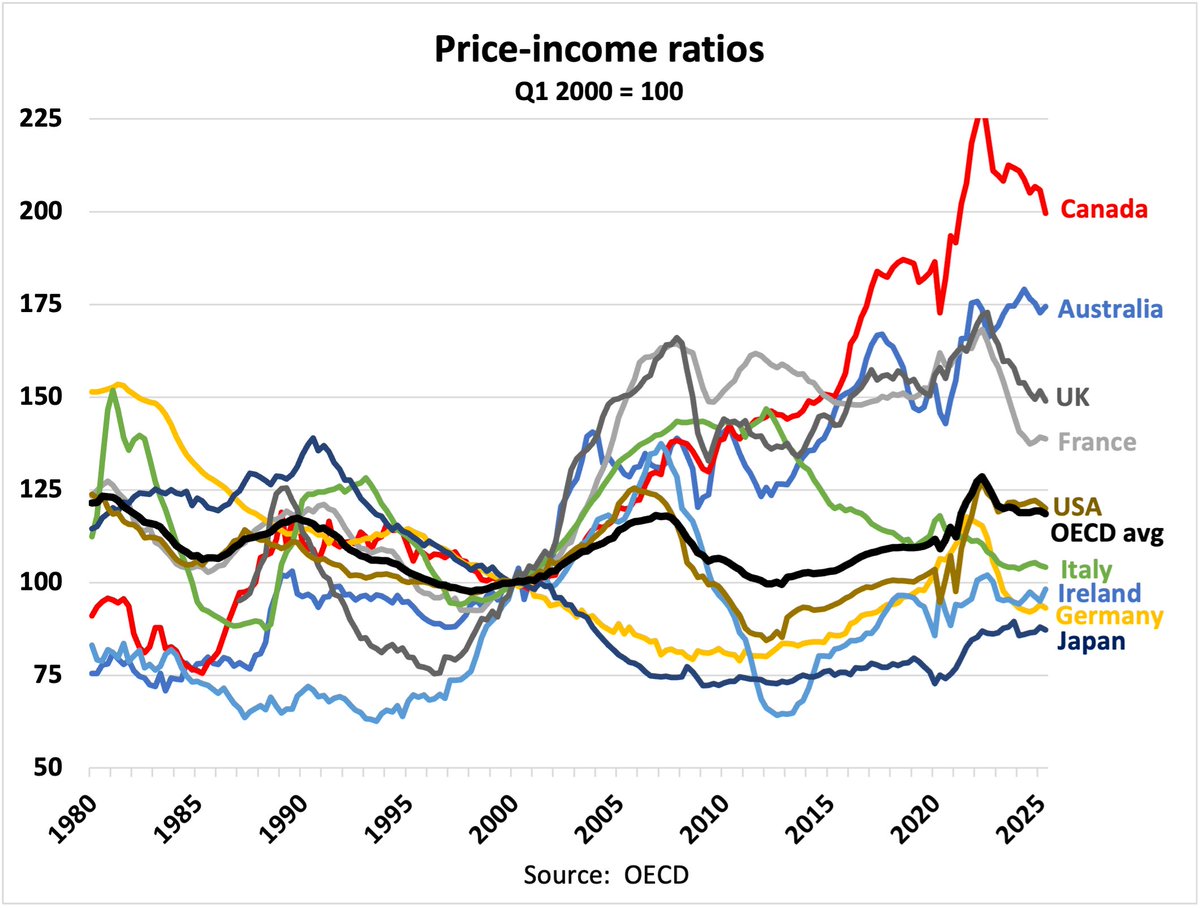
Despite experiencing the steepest peak-to-trough decline in more than 40 years, Canadian home prices remain the most overvalued in the OECD by multiple measures
@TeslaTruckClub One of the biggest thing for me is, what's Tesla going to be like in 3-5 years? The answer isn't great for those who like driving EVs (me), and there's *nothing* in the pipeline that's exciting for us.
@taipan168 The lack of new products in Tesla's pipeline is the most concerning. Where are the new Model S & X? Those are based on a chassis and tech ~15yo. Where are the new M3 and MY prototypes? Basically, what are they going to sell in 3-4 years?
@logyAussie@taipan168 That's on the USB-IF for developing the issue and not doing anything about it.
That said, currently it's not a huge issue yet as the data transfer rates are "good enough" and PD charging is semi-smart.