For too long we’ve treated mental illness as bad thought patterns. That assumption is broken.
I’m building at the intersection of metabolic × mental health.
I share emerging science and hard-won lessons from scaling healthcare as a 3x CEO (1x Unicorn)
@nicknorwitz Love this, Nick. Still amazed that something as “soft” as gratitude leaves a hard metabolic trace through the HPA axis.
Mind and metabolism were never separate systems…the future of mental health is metabolic health.
I use NNT even when talking to physicians…e.g. “treat 30 patients to prevent one event".
It survives contact with the brain in a way relative risk and raw probabilities don't. Less a literacy gap than a representation one:
Gigerenzer showed even clinicians' accuracy jumps when the same stats are framed as natural frequencies.
Agree on metabolic flexibility. Now apply it to the organ you skipped.
The hardest proof that metabolism runs the brain is 100 years old: doctors built the ketogenic diet in the 1920s to stop seizures, and it still works when the drugs don’t.
The brain runs on energy, not just neurotransmitters. That same principle is now moving through psychiatry (trials at Harvard, Oxford, Stanford), where the deficit in depression and bipolar looks metabolic, not a “chemical imbalance.”
Your post stops at weight, blood sugar, performance. The hungriest organ in the body, and the conditions wrecking the most lives, didn’t make the cut.
Today on The Science and Experience of Energy, we discuss four energetic principles that clarify how energy behaves and transforms to sustain the body-mind unit.
An energetic view of health leads us to recognize that we aren't the molecular machine—we and our experiences arise from the flow and transformation of energy through the metabolic circuitry of the body. We are dynamic energetic systems, transcending specific mechanisms and pathways.
In this article, we share four new principles that have emerged in the last two years. By helping us think and reason more clearly about how energy contributes to healing and diseases, these principles carve a path to incorporate energetic thinking and energy-based therapies into 21st century biomedicine.
Exciting times!
https://t.co/F0VqzwzGXq
The 40% is a real number. It's also a within group change in 9 people, not a placebo adjusted effect. Placebo cortisol fell ~21% over the same 2 weeks. So the actual drop is smaller and noisy.
But the Mechanism is plausible (vitamin D inhibits 11β-HSD1, and the cortisol:cortisone ratio dropped too). But n=9, single blinded, borderline p, baseline groups imbalanced.
Interesting pilot. Not a result to build on yet. But still promising content to share.
Or… insulin is also overused. T2D and depression are both metabolic disorders.
We hand out insulin for insulin resistance that we could often reverse, the same way we hand out SSRIs for a brain that’s metabolically starved.
Treating both as “just give the drug” is the actual problem.
You’re not missing anything…that’s the data.
And it gets worse: STAR*D, the largest real-world trial, had no placebo arm and still only got ~1 in 3 to remission across four drug trials in a year.
Sustained remission? ~3%.
The monoamine model treats depression as a serotonin deficit.
As you know, the signal keeps pointing upstream to brain energy metabolism. Fix the mitochondria (diet, light, Zone 2, sleep) and a lot of “treatment-resistant” depression turns out to have just been the wrong target.
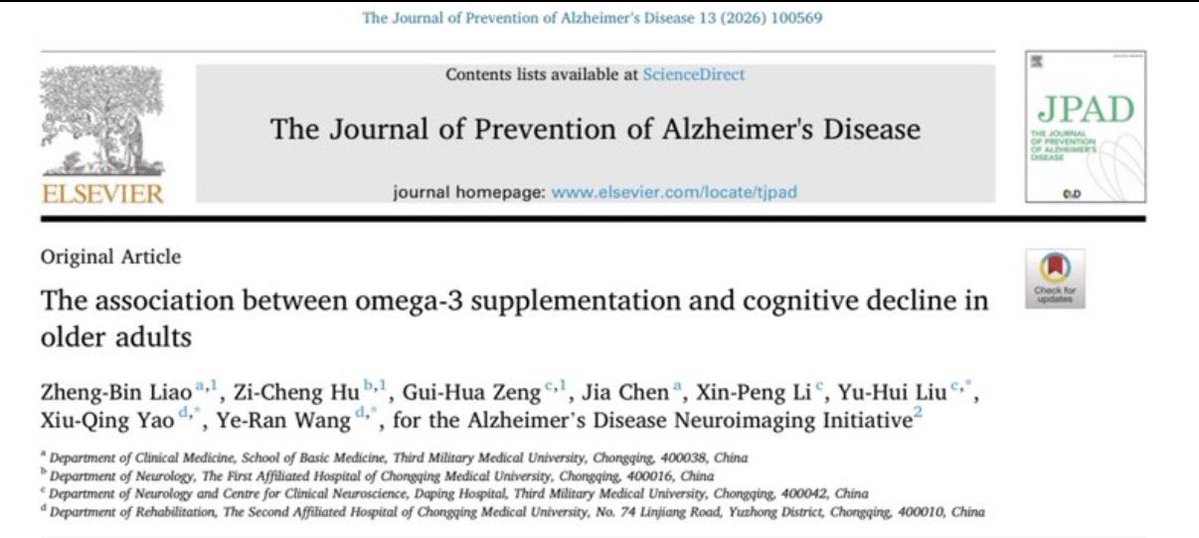
People are flipping out over a new study suggesting omega-3 intake is linked with worse cognitive decline.
A few things to know.
This was an observational study in older adults, and “omega-3 intake” was broadly lumped together without specificity. Without good data on form, dose, or compliance, someone taking high-quality EPA/DHA could be grouped with someone taking an omega-3 gummy or flaxseed oil.
Importantly, omega-3 intake was not linked to worse amyloid or tau pathology. The association was with glucose hypometabolism.
In general, DHA in particular is known to be anti-inflammatory in the brain, supports cerebral glucose metabolism, and makes up roughly 40% of the fatty acids in many neuronal cell membranes.
And despite the authors’ efforts to account for reverse causation, I think reverse causation and other forms of healthy-user bias are very likely at play.
Personally, as a young person at elevated risk for Alzheimer’s disease, I will not be stopping my EPA/DHA supplementation anytime soon.
@thegarybrecka This is why clock gene dysregulation shows up across nearly every mood disorder: bipolar, MDD, schizophrenia.
Even lithium's mechanism partly runs through circadian period lengthening (GSK-3β).
Mental health is metabolic health, and metabolism runs on the clock.
@nicknorwitz@Telegraph Cofounder bias aside....this is what rigorous metabolic science looks like in mainstream media.
Getting people to pay attention to a serious question, so they start to ask even more questions and advocate for their own health decisions.
Well done as usual.
The "right kind of stress" has a name: hormesis.
Brief stress — cold, exercise, fasting — triggers your mitochondria to repair, multiply, and build stronger antioxidant defense.
Too little → no adaptation.
Too much → breakdown.
The dose makes the medicine. Your mitochondria are the dosimeter.
Stress is linked to many of our biggest killers, but a growing body of research suggests that certain types can sharpen the mind and strengthen the body. Here’s how to find your perfect dose https://t.co/xAh0dzD1dZ
That depression is a "chemical imbalance."
The serotonin hypothesis dominated psychiatry for 40 years.
Meanwhile, JAMA Psychiatry and Nature Mental Health now show the evidence converges on mitochondrial dysfunction....a cellular energy problem.
We treated the smoke and ignored the fire.
@kabasawa Creative thinking is one of the most energy-expensive things the brain does. It demands flexible network switching, and that runs on ATP.
Even 8 minutes of walking boosts mitochondrial output in prefrontal cortex.
The refresh isn't metaphorical. It's metabolic.
@CoachDanGo The dementia number is the one to watch.
Walking pace = Zone 2 = peak mitochondrial biogenesis. More neuronal mitochondria means more ATP at the synapse.
That's what neuroplasticity actually runs on. Not just blood flow....energy.
@NTFabiano 7-30x higher concentration in brain than liver or kidney. And nanoplastics are directly toxic to neuronal mitochondria. Collapse membrane potential, spike ROS, starve the synapse. The brain isn't just accumulating plastic. It's losing energy because of it.