Anyone on here ever tried using a laser to break open really tough samples for DNA extraction? I'm working on some tough chitinous tissues which nothing seems to reliably lyse them - and thought I might take some inspiration from laser microdissection (which is a tad overkill/$$)
Joint consideration of selection and microbial generation count provides unique insights into evolutionary and ecological dynamics ... https://t.co/jT4G9Mlx56 #biorxiv_micrbio
Glad to have this paper out now! If you've ever tried and less-than-successfully sequenced brown algae - polyphenols might be why!
https://t.co/YzALgLCAt0
Looking for some @nanopore help - I have some ~1600 bp amplicons sequenced with the rapid kit (plasmidseq type data) and want to cluster them into ASVs/OTUs - any idea how? Mixed of read lengths due to data type, and only have 2 samples.
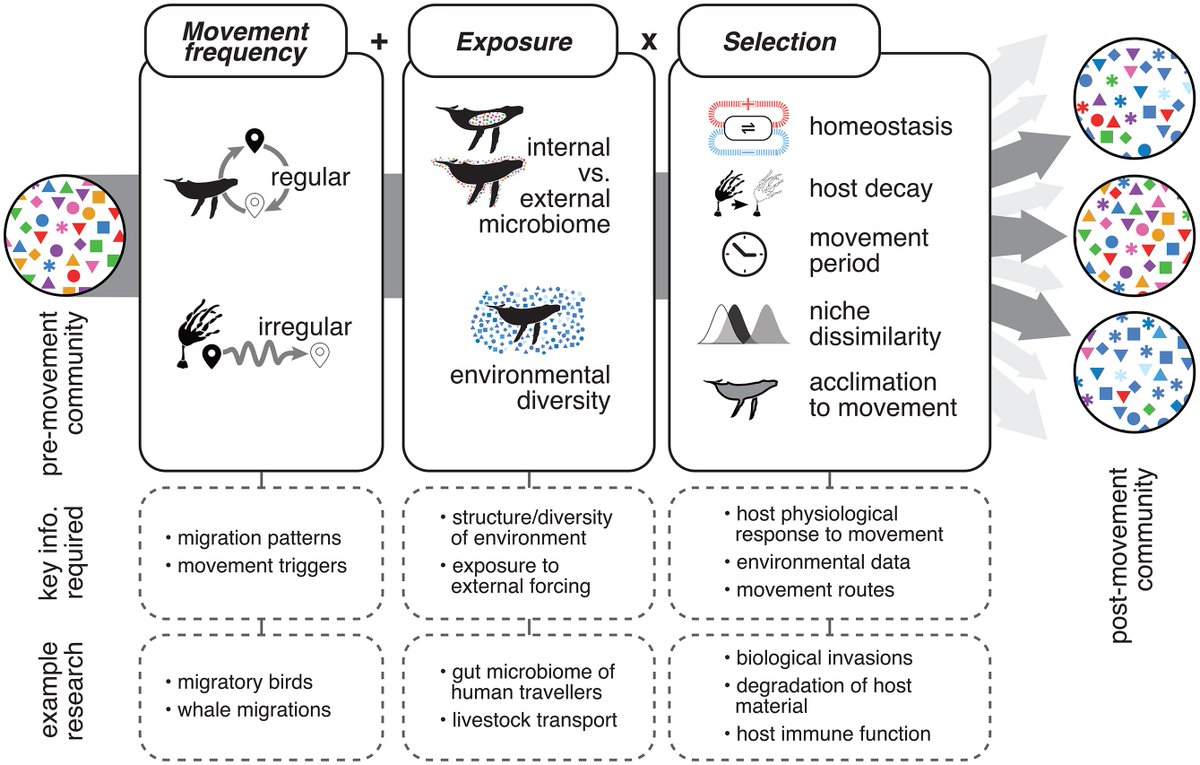
2/2 - so we wrote up a piece on this, developing models and hypotheses about what we expected would be the case, differences to migratory organisms etc. Hugely grateful to my fantastic co-authors, esp @Grant_Duffy who made the wonderful figure above!
Glad to have this perspective piece out now! We found that when we were trying to develop hypotheses around how microbiomes might change in response to host dispersal - there wasn't much information for non-migratory organisms (e.g., kelp) 1/2
https://t.co/Q32j34J1GF
Slight correction: panels D-G are not EICs, rather they are the combined mass spectra between 29 and 30 minutes (the maximum of the peak in panel C). While the boxplot is the distribution of the hypothetical adducts.
Glad to have this neat little pre-print out with a bunch of great folks! @NickGreen_chem@Evie_Jensen
https://t.co/WdAqLPdXCp
After struggling so much to get good sequenceable DNA from seaweeds - we did some digging and found some cool results!
Note the 260/230 and 260/280 ratios for these samples were 'good' - and yet seemingly have a bunch of other stuff in there! This was my first time working on this sort of data, so a huge thanks to @NickGreen_chem for being a great guide into the world of chemistry!
@JLGONZHER @environmicrobio @kirk3gaard@nanopore Any idea how the tissue was stored prior to extraction? I think one that's becoming apparent is that for plants/algae - minimizing storage time is essential.
@JLGONZHER @environmicrobio @kirk3gaard@nanopore I'm currently working on some ideas in that vein, but at this point we've used LC-MS to show clear polyphenol contamination that wasn't seen with abs ratios. I'll link the pre-print in this thread once it's up in a few days.
@JLGONZHER @environmicrobio @kirk3gaard@nanopore 2/2 Even 1 polyphenol adducted base in 10,000 could be problematic - but not detected with abs ratios. I've got a pre-print coming out this week hopefully describing the problem.
@JLGONZHER @environmicrobio @kirk3gaard@nanopore Even abs ratios can be misleading, when we've worked on macroalgal samples - we very rarely get good sequencing results despite 'perfect' input DNA.
Largely we think because polyphenols can bind to the DNA at low levels - and lead to pore damage. 1/2
Happy to have this paper out this week! With @Clare_eDNA @CeridwenFraser Fine-scale phylogenetic diversity gradients support the Antarctic geothermal refugia hypothesis | Antarctic Science | Cambridge Core - https://t.co/Wj8N5gDpIc
Excited to share our new paper @EcographyJourna, where we use population genomics to investigate the impact of the 2016 Kaikōura earthquake on Durvillaea #kelp/rimurapa!
First genomic snapshots of recolonising lineages following a devastating earthquake: https://t.co/8DTCd5DkAo