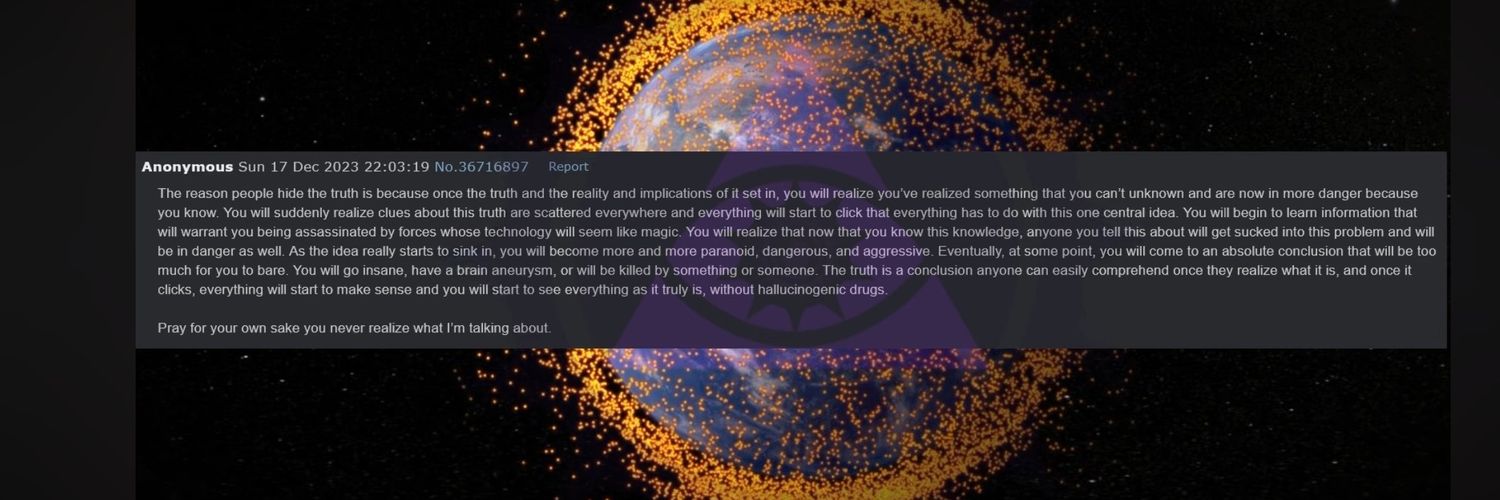
@maximumpain333 Happening in real time. Very easy to see the correlation from the show to what is going on right now. I highly suspect and believe some of the world leaders and others in various positions of influence are not entirely human.
@anarchocapital@digijordan Need to fold the dollar in half length wise with back side exposed. Take the folded edge and hold up next to a mirror. The image will be on side the seal with the eagle.
The Book of Giants
Genesis gives the story four verses. The “sons of God” take human wives, the Nephilim appear, and the Flood follows. Ancient Jewish writers wanted more. The *Book of Giants* is their strangest answer: not Enoch preaching about the monsters, but the monsters waking up afraid.[](<https://t.co/js73or1W7d>)
The book is an Aramaic Jewish text from the Second Temple period, most often dated to the late third or second century BCE. About nine or ten copies turned up in the Qumran caves among the Dead Sea Scrolls—more copies than some biblical books in that library. No complete manuscript survives. What we have are fragments, especially 4Q203, 4Q530, 4Q531, and 6Q8, pieced together by scholars such as Józef Milik and Loren Stuckenbruck.[](<https://t.co/5ZOcCsRVRC>)
It shares a world with *1 Enoch*. Watchers descend, mate with women, and father giants who devour the earth. The camera angle is different. *1 Enoch* names the angels and treats their children as a violent mass. The *Book of Giants* names the children and lets them speak.[](<https://t.co/qKtQT9Xrl7>)
Ohyah and Hahyah, sons of the Watcher Shemihazah, are the dreamers. Mahaway, son of Baraqel, is the messenger who can fly to Enoch at the edge of the world. Two names do not belong in a Jewish flood story at all: Gilgamesh, hero of the Mesopotamian epic, and Hobabish, a form of the monster Humbaba. The book is Jewish in language and theology, but it treats older Near Eastern legends as part of the same doomed generation.[](<https://t.co/3lKZRh8zbj>)
The longest surviving scene is a night of dreams. Hahyah sees a garden of trees watered by gardeners. Great shoots rise, then fire falls and water covers the soil. One tree with three shoots survives—usually read as the Watchers, their giant offspring, the Flood, and Noah’s family. Ohyah sees the Ruler of Heaven descend, books opened, and judgment written against all flesh. The assembly cannot interpret the visions, so they send Mahaway to “Enoch the scribe of interpretation.” Enoch’s reply is mostly lost. The fragments that remain show weeping, blame shifted onto Azazel, and the knowledge that war with heaven is useless.[](<https://t.co/Fwl0GZWYMM>)
The story did not die at Qumran. In the third century CE, Mani adapted it into a canonical Manichaean *Book of Giants*. Names became Iranian: Ohyah became Sām, Hahyah became Narīmān. Fragments later surfaced at Turfan in Central Asia. A Jewish tale about the sons of the Watchers had become scripture on the Silk Road.[](<https://t.co/js73or1W7d>)
The book is not Scripture for Jews or Christians, and every plot outline is a reconstruction. Its value is historical. It shows how some ancient readers explained the Flood: not as ordinary human failure, but as the collapse of a hybrid world that had eaten too much and finally dreamed of its own end.
@aimz0320@NYCMayor Are the busses and subway free? How much does rent cost in nyc now? How many bodegas are closing up shop since he'll be opening government run grocery store that will under cut these businesses? Ask the teachers how come the mayor is not giving them their bonuses.
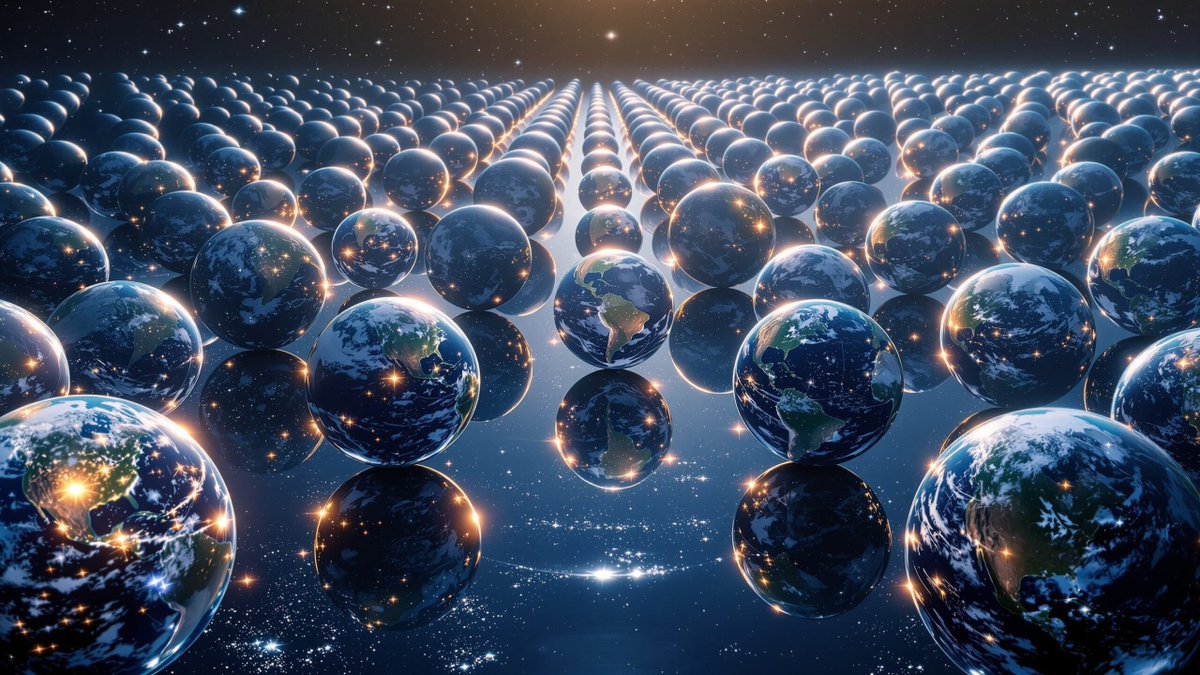
When One Universe Isn’t Enough: The Many-Worlds Idea, Explained
Every so often a scientific idea slips out of the journals and into ordinary conversation, and few have done it as thoroughly as the many-universe theory. People usually mean one of two things: the many-worlds interpretation of quantum mechanics, or the larger cosmological multiverse that inflation seems to produce. Both start from equations we already use. Both refuse to tidy up the universe so it looks like the one we experience.
The quantum version traces back to Hugh Everett III, a Princeton graduate student in the mid-1950s. Standard quantum mechanics said a particle could exist in a superposition of states until someone measured it; then the wave function “collapsed” and only one outcome remained. Everett asked what would happen if you simply never added that extra rule. The Schrödinger equation already described everything, including the measuring device and the person looking at it. After the measurement, the combined system sat in a superposition: one branch where the spin was up and you saw “up,” another where it was down and you saw “down.” Those branches no longer interact. Each is, for all practical purposes, its own world.
Schrödinger’s cat is the usual illustration. In the textbook story the cat is both alive and dead until the box opens. In Everett’s picture the universe itself branches. In one world the cat lives and you feel relief; in the other it dies and you don’t. You only ever experience one of those worlds because you are part of the branching. The other versions of you keep going, unaware. Bryce DeWitt later popularized the idea and gave it the name that stuck: many worlds.
The same mathematics that produces those branches also produces the probabilities we actually measure. More “weight” in the wave function means more of the branching worlds look like the outcome we call likely. Nothing extra has to be invented; the worlds were already sitting inside the equation. That is why some physicists, Sean Carroll among them, argue that many-worlds is simply quantum mechanics taken at face value.
A different kind of multiplicity comes from cosmology. Inflation—the brief, enormous expansion right after the Big Bang—does not have to stop everywhere at once. In many models it continues in other regions, spawning “bubble” universes that never communicate with ours. Each bubble can have slightly different physical constants. Ours happens to allow stars, chemistry, and people; most of the others probably do not. That picture is often called the Level II multiverse. The quantum branching is Level III. They are not the same idea, but they sit comfortably beside each other.
None of this is proven. We cannot visit the other branches or the other bubbles. Critics point out that the theory multiplies realities without adding new testable predictions, and that the notion of “probability” becomes philosophically awkward when every outcome happens somewhere. Defenders reply that every other interpretation also adds something extra—collapse, hidden variables, observers with special status—and that many-worlds at least keeps the existing equations intact.
The appeal is partly aesthetic. The theory does not require the universe to notice when a human looks at it. Reality just keeps evolving, and we find ourselves in one thin slice of a far larger structure. Whether that structure is real or only a useful way of talking remains an open question. For now it is the cleanest story the mathematics tells, even if the story is stranger than most of us expected.
@GenFlynn@RealSLokhova Trump won't do it if he did civil war would follow. Plus, good luck trying to prosecute obama the judiciary is corrupt along with the rest of dc.