Is democracy broken? How can we know if it still works?
My paper, “Does this democracy work?”, is now out in Economics & Philosophy:
https://t.co/OpeLMWAqvI
Thank you to everyone who helped!
The published version of 'Voter Ignorance and the Limits of Reform' (written with Brian Kogelmann) is now available open access:
https://t.co/8cvWLut1Ms
Here is the abstract: Many believe that voter ignorance threatens democracy. Consequently, ambitious institutional remedies have been proposed – epistocratic suffrage exams, foot voting, devolution of decisions to the local level, new bureaucratic agencies to inform voters, and more. There are reasons to doubt such proposals will actually improve democratic governance, however. The mistake these proposals share is a failure to recognize that voter ignorance comes in many forms, and that existing remedies may target the wrong kinds of ignorance. We develop a new typology of voter ignorance and show that every existing proposal leaves certain types of ignorance unaddressed. If it is these neglected forms of ignorance that drive bad democratic outcomes, then the entire portfolio of remedies that philosophers have proposed is superfluous – they literally make no progress toward better governance. We end by briefly sketching how to think about the problem of voter ignorance going forward.
It’s good they realise they don’t have a plan. That’s because AI alignment is useless moralism. You can’t fix a planetary arms race with ethics. This is politics we’re talking about. Thankfully some scholars are beginning to apply political realism to AI: https://t.co/8ZR8WNXBO4
https://t.co/ZWI3dwLEVa
"This paper argues that there is something morally problematic about treating individual citizens as tokens of their demographic groups, even if, empirically speaking, demographics have great predictive power about...what political outcomes they prefer."
Given the rather egregious flaws in the recent SEP entry, you might want to look elsewhere for an analysis of capitalism and the main arguments for and against. Thankfully, Jerry Gaus has got you covered.
https://t.co/LUTqivH4cq
My new book Navigating Democracy is open for pre-order and is 25% off at Waterstones!
It's a short guide to the key questions facing democracy - polarisation, populism, misinformation & more - combined with 50 beautiful illustrations.
Sale ends Friday 🚨
https://t.co/lvifOrtRDJ
This looks like a must-read!
"Macro: The Economic Models That Shape Our World" by Greg Kaplan (available in November).
"In clear and engaging prose, Chicago economist Greg Kaplan demystifies how our everyday behavior, including how we spend and save, connects to the biggest questions in fiscal and monetary policy. Tracing the evolution of modern macroeconomics from Keynes to today, he guides readers through the models that are often used to explain our economy, uncovers their flaws, and reveals what cutting-edge research tells us about managing the economy in good times and bad. The journey culminates in HANK, a macroeconomic model co-created by Kaplan that is more consistent with reality. Macro offers a timely, new framework for understanding and shaping economics in the real world."
https://t.co/IxOWTajiak
Human Nature, Human Goods by Tom Angier
A ground-breaking theory of human nature and its relevance to ethics, bringing ancient ideas into dialogue with cutting-edge science and philosophy.
📘 https://t.co/ngwhCPSROv
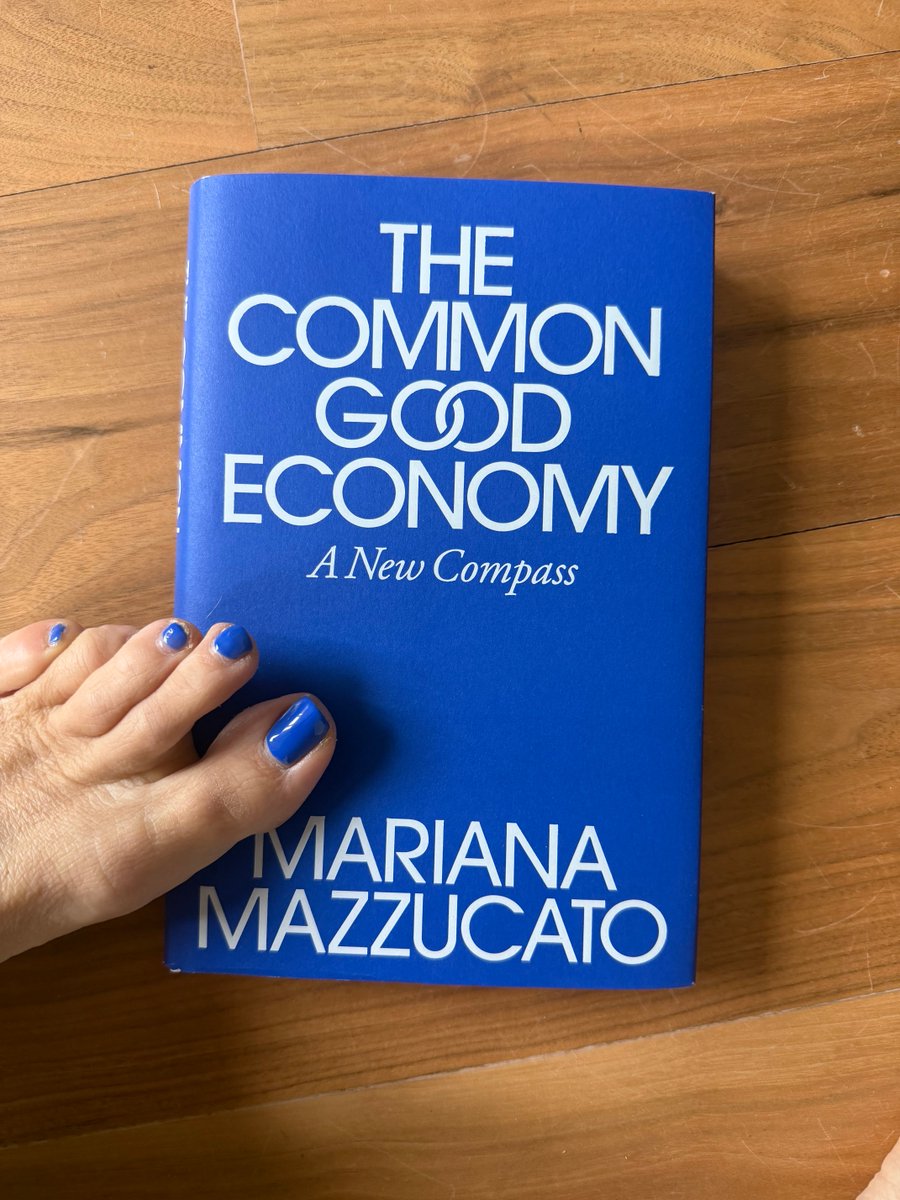
My new book (matching my nail polish) on how to structure relationships (capital-labour, public-private, civil society-state) with common good principles from the start instead of correcting afterwards is out June UK, July Netherlands/Germany, September USA/Spain, October Italy…
I have just got the physical copies of my book. It’s a nice feeling, but I must admit to being a bit taken aback but its slimness. ‘it’s a short book not only in pages’ as Rawls might have put it.
UK universities are miraculous. A case in point is the University of Sheffield, which has a total endowment of £59m (about 21x Princeton's per-student endowment) and 6 Nobel prizes. We're losing one of the most cost-effective research juggernauts on Earth.
The University of Oxford is advertising a 1-year Departmental Lectureship in Economic and Social History to be held in the Faculty of History from 1 Oct 2026 to 30 Sep 2027. Applications close 27 May 2026.
https://t.co/SUE3UH1CHM