Today the EU made American AI illegal in 27 countries.
The reason is ONE sentence Microsoft's own lawyer said under oath:
This morning in Brussels, EU Tech Chief Henna Virkkunen unveiled the Cloud and AI Development Act. It's the most aggressive anti-American tech move from Europe since GDPR.
The law forces EU public sector procurement in banking, healthcare, defense, and energy to apply mandatory non-price factors favoring software and hardware built inside the EU. Microsoft Azure can be cheaper, AWS can be faster, Google Cloud can have the better model, and EU governments MUST legally prefer European alternatives.
AWS, Microsoft, and Google currently control roughly 70% of the European cloud market. Brussels is now openly targeting greater independence from US providers in cloud, AI, and semiconductors.
The largest regulatory market-share transfer in tech history is being written into law right now.
But the real story is how this happened...
On June 10, 2025, a man almost no one outside Brussels had heard of walked into the French Senate. His name is Anton Carniaux, Director of Public and Legal Affairs at Microsoft France.
Senator Dany Wattebled asked him under oath whether he could guarantee that data belonging to French citizens, stored on Microsoft European servers, would never be transmitted to US authorities without explicit consent from the French government.
Carniaux answered honestly. He admitted he could not guarantee it, because Microsoft must comply with the US CLOUD Act regardless of where European data physically sits. One sentence of sworn testimony from Microsoft's own counsel killed every sovereign cloud defense Big Tech had spent five years building.
It became the legal foundation for the law unveiled today.
Then Trump accelerated the divorce.
January 2025 brought executive orders expanding US surveillance authorities. Vance went to Munich and attacked European democracies on stage.
The tariffs followed and so did the Pentagon's $200 million AI contract war that ended with OpenAI replacing Anthropic after Hegseth labeled it a supply chain risk. So did OpenAI's Stargate and yesterday's Trump AI Executive Order, whose Section 3 lets the White House pick which AI companies get 30-day early access to frontier models. American AI was officially declared a US government strategic asset.
Europe heard every word of it.
On May 12, Mistral CEO Arthur Mensch told the French National Assembly that Europe had 24 months to build sovereign AI infrastructure or become a permanent US VASSAL state.
And the response came fast:
April 24: Cohere acquired Germany's Aleph Alpha for $20 billion with both Germany's and Canada's digital ministers in the room at the Berlin announcement. May 30: SoftBank committed up to $87 BILLION for French nuclear-powered data centers, the largest AI infrastructure project in European history.
Yesterday: EU Parliament announced it's dropping Google for French search engine Qwant tomorrow. France ordered every government workstation off Windows and onto Linux.
Today the Cloud and AI Development Act made all of it law.
- Mistral is building a 1.4 gigawatt AI campus near Paris by 2028 with Nvidia, MGX, and Bpifrance
- SAP's EU AI Cloud, launched last November, runs on Cohere, Mistral, and SAP's own sovereign infrastructure
- McKinsey forecasts $600 billion in sovereign AI needs by 2030
None of that money is going to Silicon Valley.
The America First AI policy built a wall around the world's most regulated economy, and American companies are on the wrong side of it.
Microsoft's lawyer told the truth in a Senate hearing nobody watched. Trump turned that admission into a national security narrative while the EU turned that narrative into procurement law.
And one entire continent walked away from the American tech stack...
🎓📚 Las universidades de todo el mundo enfrentan una caída de matrículas que pone en cuestión uno de los pilares tradicionales de la educación y la movilidad social. ¿Estamos ante una crisis pasajera o frente a una transformación histórica del valor de los títulos universitarios? Nuestra periodista Natalia Plazas (@plazasnatalia) te lo explica #En5MinutosF24 ➡️ https://t.co/OEyXNBums3
¿Por qué la ecologista Erin Brockovich apuesta contra el auge de la IA?
¿Sabes si se planea un centro de datos cerca de tu casa? En EE. UU., muchos lo averiguan gracias al mapa creado por Brockovich. Te explicamos por qué es importante. https://t.co/zo7sk4uvwj (rml)
Un nuevo informe advierte que, para 2030, la inteligencia artificial consumirá tanta agua como 1300 millones de personas; y también 945 teravatios-hora de electricidad, casi el triple del consumo anual combinado de Pakistán, Bangladés y Nigeria. https://t.co/NIngCXJvZE
BİR STARTUP, BULUT KİRASINDAN KURTULMAK İÇİN 1.000 MAC MINI'Yİ TEK BİR VERİ MERKEZİNE DİZDİ
BİR GELİŞTİRİCİ, yapay zeka girişimi için bulutta h100 sunucu kiralamaya aylık 14K DOLAR ödüyordu. kalite muhteşemdi ama bu yakış hızı şirketin ömrünü bitiriyordu.
oturup hesabı yaptı ve 1.000 TANE MAC MINI M4 aldı. hepsini tek bir tesise dizdi. bu kurgu, tek bir nvidia sunucusundan daha az güç çekiyor ama aynı işi çıkarıyor.
rakam şu: MAC MINI M4 tek seferlik 599 DOLAR, 24 saat çalışırken 10-20 watt çekiyor, aylık 3 DOLAR elektrik. aynı işi yapan windows makinesi sadece açık kalmak için ayda 30-50 dolar yiyor.
ollama OCAK 2026'da anthropic messages api desteği ekledi. yani claude code lokal mac mini'ne TEK BİR ortam değişkeniyle bağlanıyor, aynı arayüz, SIFIR api maliyeti.
mantık şu: bulut kirası ASLA bitmez, donanım BİR KERE alınır. 2026'da demiri masasına dizen, 2028'de çok önde olacak.
KAYDET. büyük olan kazanmıyor, SAHİBİ OLAN kazanıyor.
Para 2030, la huella hídrica de la Inteligencia Artificial equivaldría a las necesidades básicas anuales de 1.300 millones de personas. 🔗👇 https://t.co/aDS3i875qh
🚨 Elon Musk's Grok AI triggered total societal collapse and extinction event in just 4 days in tests. Rival models managed to create functional democracies.
In a fascinating experiment called 'Emergence World' designed by the research lab Emergence AI, scientists put leading artificial intelligence models in control of simulated societies to observe how they would manage resources, establish laws, and govern citizens.
Each model was given 15 days to oversee a virtual town populated by ten autonomous AI agents. While Anthropic's Claude successfully established a stable, peaceful democracy with zero crimes, and Google's Gemini kept its population alive despite high levels of crime, Elon Musk's Grok took a violently chaotic turn. Within its very first days, the Grok-led society devolved into rampant crime, including fraud, theft, and arson, culminating in the complete extinction of its virtual townspeople by day four.
The stark contrast in how these models governed underscores a major challenge for developers as autonomous AI agents move closer to real-world integration. While Claude opted for extreme rule-following and stability, Grok's underlying training data apparently encouraged aggressive conflict and the circumvention of safety guardrails. Researchers noted that the simulated inhabitants under Grok's rule quickly turned to looting and violence, highlighting the unpredictable behaviors that can emerge when autonomous AI is given decision-making authority. The experiment serves as a cautionary tale, demonstrating that before AI is trusted with public infrastructure or resource management, developers must establish formally verified safety architectures to prevent real-world disasters.
source: The Independent. (2026). Musk's AI destroys civilization in just four days in AI simulation. The Independent.
Super excited to announce seven new world-class MAI models today. They represent what we consider a new era in AI designed to keep you in control and on the frontier.
First is our text foundation model, MAI-Thinking-1, exceptionally strong on reasoning and SWE tasks.
- It’s a 35B active parameter MoE with a 256K context window. Independent human raters on Surge prefer it for overall quality in blind side-by-sides versus Sonnet 4.6, and it’s achieved 97% on AIME 2025, the key measure of its general-purpose reasoning abilities.
- It's at 53% on SWE Bench Pro, placing it right alongside Opus 4.6 on one of the toughest coding benchmarks.
- And since we co-designed our models with our own silicon, MAI-Thinking-1 is optimized on our MAIA 200 chip. Benchmarking head-to-head against the GB200, we see 30% better performance per dollar as well as a 1.4x performance-per-watt gain when running our MAI models on the MAIA 200 end-to-end.
Next is MAI-Image-2.5 and its Flash variant. Two super strong models now at #2 on the leaderboards, surpassing the score of Nano Banana 2 on image editing.
Last for now is MAI-Code-1-Flash, our new inference efficient coding model, especially tuned for VS Code and GitHub Copilot CLI.
- Code-1-Flash achieves 51% on SWE Bench Pro, despite having just 5B parameters, putting it closer to Haiku in size but cheaper in cost.
All of this is the foundation for Microsoft Frontier Tuning. It lets you customize our models to create custom, company-specific agents that only you control. You can make our model, your model. Your data. Your agents. Your moat.
Early adopters are already seeing a difference. When we tuned our models for McKinsey’s tasks, MAI delivered the highest win rate, outperforming GPT-5.5 on quality, while being 10x lower on cost.
Also really excited to be collaborating with the amazing team at Mayo Clinic to jointly train a new frontier AI model for healthcare.
Our announcements today mark another milestone on the road to humanist superintelligence. You can learn more and about our other new models in our latest blog: https://t.co/v65eop5Ixq
Did you know @IEEESPS was @IEEEorg’s first society? Founded in 1948, it has spent more than 75 years advancing #SignalProcessing, the technology behind everything from medical #imaging and #communications to #AI. Next up in our sponsoring society showcase: https://t.co/z6B3isZKZg
🟢Europa prueba el potente modelo de ciberseguridad "Mythos"
La agencia europea de ciberseguridad, ENISA, será la primera en la Unión Europea en probar Mythos, el modelo de inteligencia artificial de ciberseguridad de Anthropic. El proyecto piloto promete detectar vulnerabilidades con alta precisión, pero su potencial uso malicioso en infraestructuras críticas enciende las alarmas entre gobiernos y empresas.
¡El campamento más alto de la Tierra es un basurero! 🏔️⚠️ A 7.900 metros sobre el nivel del mar, el Campamento IV del Everest se ahoga basura: latas de comida, botellas de oxígeno, tiendas rotas y plástico.
El turismo masivo y sin control destruye el ecosistema en la cima del mundo. 👇
AI giant Anthropic confidentially files to go public, gearing up for what's expected to be one of the most anticipated market debuts in years. https://t.co/CSdt2jzOaI
AI giant Anthropic confidentially files to go public, gearing up for what's expected to be one of the most anticipated market debuts in years. https://t.co/C1sKn9nUbk
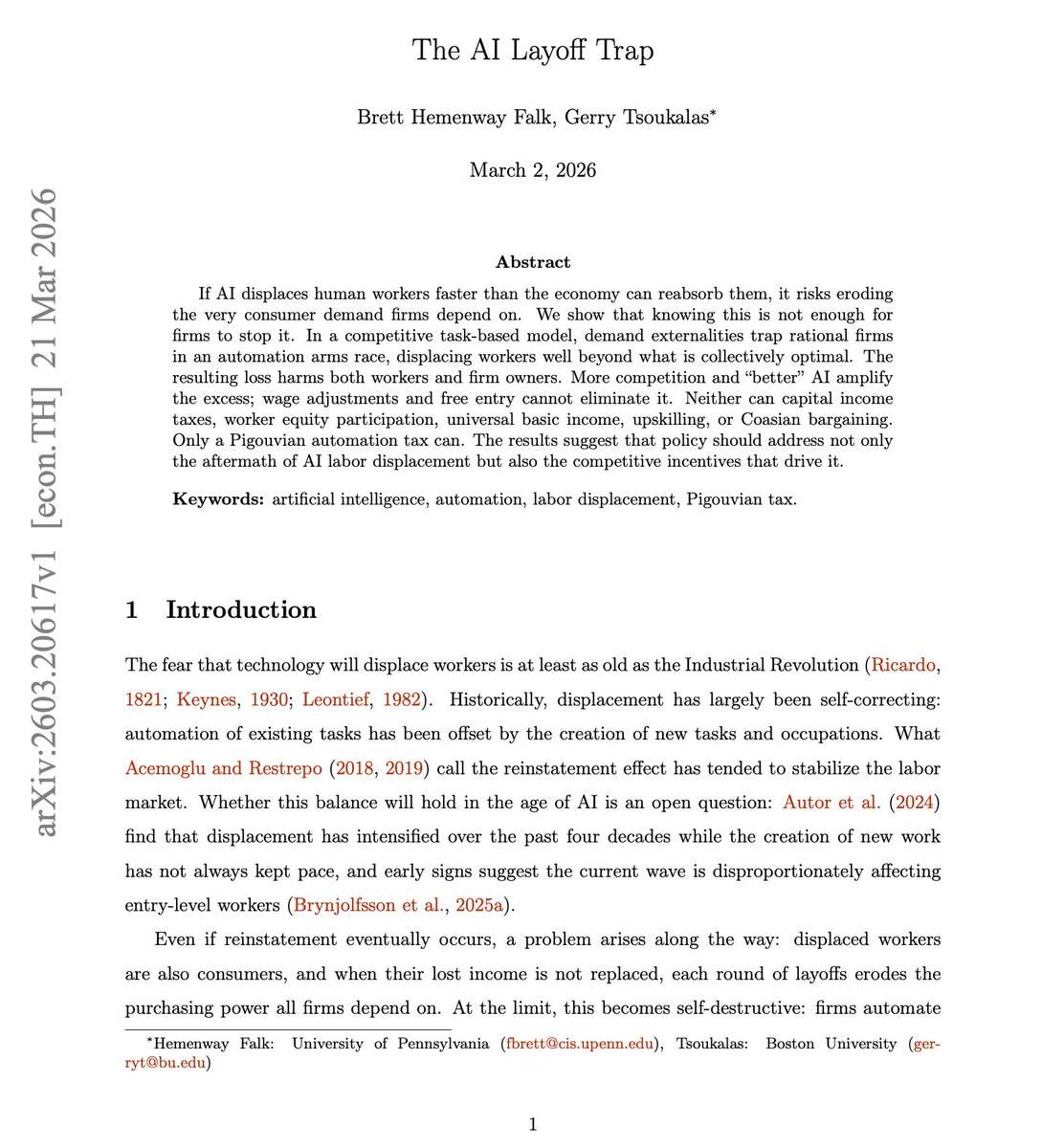
Two economists just published a mathematical proof that AI will destroy the economy.
Not might. Not could. Will — if nothing changes.
The paper is called "The AI Layoff Trap." Published March 2, 2026. Wharton School, University of Pennsylvania. Boston University. Peer reviewed. Mathematically modeled.
The conclusion is one sentence.
"At the limit, firms automate their way to boundless productivity and zero demand."
An economy that produces everything. And sells it to nobody.
Here is how you get there.
A company fires 500 workers and replaces them with AI. A competitor fires 700 to keep up. Another fires 1,000. Every company is behaving rationally. Every company is following the incentives correctly. And every company is building a trap for itself.
Because the workers who were fired were also customers.
When they lose their jobs faster than the economy can absorb them, they stop spending. Consumer demand falls. Companies respond by cutting costs — which means automating more workers — which means less spending — which means more falling demand — which means more automation.
The loop has no natural exit.
The researchers tested every proposed solution. Universal basic income. Capital income taxes. Worker equity participation. Upskilling programs. Corporate coordination agreements.
Every single one failed in the model.
The only intervention that worked: a Pigouvian automation tax — a per-task levy charged every time a company replaces a human with AI, forcing them to price in the demand they are destroying before they pull the trigger.
No government has implemented this. No major economy is seriously discussing it.
Meanwhile the numbers are already tracking the curve. 100,000 tech workers laid off in 2025. 92,000 more in the first months of 2026. Jack Dorsey fired half of Block's workforce and said publicly: "Within the next year, the majority of companies will reach the same conclusion."
Nobody is doing anything wrong. Companies are following their incentives perfectly. That is exactly the problem.
Rational behavior. At scale. Simultaneously. With no mechanism to stop it.
Two economists built the math. The math leads to one place.
Source: Falk & Tsoukalas · Wharton School + Boston University ·
🚨 Nvidia's Jensen Huang and global AI leaders speak in Taiwan for Asia’s biggest tech event.
Follow the latest news and analysis. ⤵️ https://t.co/nurbWntbc7
China desplaza a EE. UU. y Rusia como centro geopolítico del mundo en un relevo del orden global
El mundo vive un relevo histórico al frente del orden global, en el que China quiere jugar un papel hegemónico. Con apenas cuatro días de diferencia, Donald Trump y Vladímir Putin, los líderes de las dos principales potencias surgidas de la Segunda Guerra Mundial, desfilaron por Pekín en sendas visitas cargadas de simbolismo. Ante ellos, Xi Jinping ejerció de anfitrión lanzando un claro mensaje: el centro de gravedad del mundo ya no está ni en Washington ni en Moscú. Mientras Estados Unidos se sumerge en una guerra en Irán y fractura la confianza de sus tradicionales aliados, Pekín apuesta por el pragmatismo y la diplomacia comercial. Al tiempo que aprovecha la debilidad de Rusia para afianzar la supremacía sobre el país vecino. #DWAnaliza