He drove his wife to one of the best hospitals in America for a planned caesarean. A routine one. Her second.
Charles Johnson watched her blood collect in a catheter bag for ten hours while he asked for help.
Kira Johnson died at 2:22am.
Cedars-Sinai, Los Angeles, 12th April 2016. Kira Johnson was 39. She spoke five languages, raced cars, ran marathons. The caesarean was scheduled. Everything about it was routine.
Her son Langston was delivered at midday.
By the afternoon her husband could see blood in her catheter. He told a nurse. He was told they would check.
He asked again. And again. A CT scan was ordered and then not performed. He has described being told, at one point, that his wife was simply not a priority right now.
He stood in a corridor for ten hours asking people to look at his wife.
They took her back to theatre just after midnight. There were three litres of blood in her abdomen. She died shortly after.
Her son Langston was twelve hours old.
Charles Johnson has spent the decade since as one of the most effective advocates in American maternal health. He founded 4Kira4Moms. He has testified before Congress. The federal Black maternal health legislation introduced in recent years carries work he pushed for.
He talks about one thing more than any other, and it is not the medicine.
It is the ten hours. He was standing right there, in the building, awake, articulate, asking. And it made no difference at all.
ADHD in older adults raised the odds of later cognitive impairment more than fourfold.
Higher daytime light cut dementia risk.
The shared axis is sunrise light on solar time.
It advances the master clock, sets the nocturnal melatonin window, and times the mitohormetic ROS pulse that restores mitochondrial membrane potential.
Miss that cue and the repair window for high-flux attention and memory circuits compresses. ADHD liability (clinical or genetic) marks lower tolerance for the mismatch. The light study showed larger protection precisely where the margin is already narrow—evening chronotypes, high nighttime light, APOE ε4.
Pair it with darker nights, especially in winter.
Absolute risks stay modest. Both studies are observational. The numbers keep pointing to the same daily contrast.
Head to my bio for 1 on 1 consultation
Over the last two decades, ordinary U.S. citizens have come to see themselves in different struggles when in fact we all face the same challenges. In this essay, I present how we got to where we are, and the foundation of the solution. We have more in common than not. Read free!
Things that are connected:
US live-streaming the firing squad execution of a paraplegic in a wheelchair. The public calling CPS on celeb parents with disabled babies & demanding their removal. US states bringing back forced institutionalization in private equity-owned institutions. US removes disability protections & cuts off disability services, as we’re systematically disabled by unmitigated pandemics & no one can afford healthcare. US/Canada euthanizing the disabled, poor, & mentally ill. Netherlands just euthanized a baby. Very obvious increases in ableist content, beliefs & behaviors, after we learned cognitive disabilities in the US have increased by over 40% since 2019 & the RECORD disability we’ve ignored since 2020 continues to increase. There is no funding & no help for the rapidly increasing disabled population, which is YOUNG & GROWING YOUNGER, only institutionalization to enrich private equity & certain premature death.
Human life has been fully devalued. Bad things are upon us & even worse things are coming. All together now: This is a Business Model. In the end, they’re going to kill us.
BREAKING: my latest test finds that 8g of vitamin B5 per day dropped post-ruck lactate from over 656 to 23 in two weeks WHILE DOUBLING THE WORKLOAD.
B5 also improved:
- Pyruvate (-96%)
- Alanine (-76%) - less pyruvate spillover
- Citrate (undetectable → in range) - Kreb cycling working better
- Hippuric acid (23x higher) - better benzoic acid clearance
- Orotic acid (-88%) - less ammonia
TTFD is one of the best things for fixing many gut issues, brain fog and chronic fatigue, but it needs cofactors to work properly. If cofactors are missing, it can hurt you in the long term.
Here is the exact architecture to unlock the therapeutic power of TTFD without precipitating functional collapse👇
1. The Transporter-Independent Bypass
Standard water-soluble thiamine salts rely on rate-limiting active transport proteins (SLC19A2 and SLC19A3) that downregulate under inflammation and hypoxia.
TTFD possesses a lipid-soluble mercapturic structure that bypasses these transport gates entirely.
It diffuses passively across cell membranes, penetrates the blood-brain barrier, and saturates intracellular compartments independent of metabolic friction.
2. The Clinical Upstream Leverage
Once inside the cell, TTFD targets the primary rate-limiting enzymes of bioenergetic metabolism:
Pyruvate Dehydrogenase (PDH), converting glycolytic pyruvate into Acetyl-CoA to clear cellular lactic acidosis.
Alpha-Ketoglutarate Dehydrogenase (KGDH), unlocking the rate-limiting turn of the Krebs cycle.
Transketolase, driving the Pentose Phosphate Pathway to generate NADPH for antioxidant defense and myelin synthesis.
Acetylcholine synthesis via the PDH axis, directly rebooting vagus nerve motor output, gastric motility, the migrating motor complex (MMC), and resolving chronic dysautonomia or POTS.
3. The Glutathione Extraction Trap:
To release free thiamine into the cytoplasm, TTFD requires the cleavage of its prosthetic disulfide bond.
This enzymatic cleavage consumes reduced intracellular glutathione (GSH).
In an internal system already burdened by oxidative stress, high-dose TTFD acutely strips the remaining GSH pool, triggering immediate mast cell destabilization, chemical sensitivity, and sudden detox flares.
4. The Phosphorylation Stall
Free thiamine is biologically inert. It must be converted into active Thiamine Pyrophosphate (TPP) by the enzyme Thiamine Pyrophosphokinase (TPK1).
TPK1 is strictly dependent on intracellular magnesium.
If magnesium is depleted, TTFD accumulates as an unphosphorylated intermediate, stalling cellular energy production while accelerating systemic receptor agitation.
5. The Intracellular Ion Shift (Refeeding Dynamics)
Unlocking a paralyzed PDH complex forces immediate, high-velocity glucose oxidation.
Rapid glycolysis drives circulating potassium and phosphorus out of extracellular fluid and directly into cells.
Without potassium repletion, patients experience functional hypokalemia: severe muscle weakness, ectopic heartbeats, resting tachycardia, and autonomic panic.
6. The Obligate Cofactor Architecture
Chelated Magnesium
Magnesium is the non-negotiable coenzyme required for TPK1 to synthesize active TPP.
It stabilizes ATP within the mitochondrial matrix and buffers NMDA receptor channels against sudden glutamate flux.
Administer bioavailable magnesium hours before escalating TTFD.
Active Riboflavin (B2 / R5P)
Riboflavin in its active Flavin Adenine Dinucleotide (FAD) state is required by Glutathione Reductase to recycle oxidized glutathione back into reduced GSH.
Saturating the FAD pool ensures the disulfide cleavage of TTFD does not deplete cellular antioxidant defenses.
You can also add GlyNAC for extra Glutathione.
Potassium Repletion
Dietary and supplemental potassium buffers the sudden intracellular electrolyte shift driven by accelerated glucose metabolism.
Maintaining serum potassium prevents cardiac palpitations and terminates paradoxical adrenaline dumps.
Balanced Methylation and B-Complex Support
Unlocking transketolase and downstream dehydrogenase enzymes spikes consumption of Niacin (NAD+) and methyl donors.
A fully methylated, balanced B-complex ensures secondary metabolic pathways do not bottleneck downstream.
Other Cofactors: Molybdenum (Sulfite Clearance) and Selenium (Glutathione Peroxidase Axis).
7. The Unresolved Gap
Supplying magnesium, potassium, and riboflavin buffers the TTFD entry pathway, but it does not address why your baseline bioenergetic engine failed initially.
If your cellular respiration is paralyzed by heavy metal displacement, peripheral thyroid resistance, chronic endotoxemia, or electron transport chain Complex I/IV stall, forcing pyruvate into the mitochondria with TTFD will merely build up upstream pressure against a locked metabolic door.
Treating downstream coenzyme deficiencies while ignoring the primary systemic bottleneck guarantees persistent functional collapse.
-
Chronic fatigue, gut issues and brain fog all trace back to stalled mitochondrial respiration and nutrient deficiencies. DM me 'PROTOCOL' with your biggest bottleneck and what you’ve already tried. I will break down the exact step-by-step pathway to fix it.
@seanstidston@djlantz4 Search for root causes. Bear in mind low volume + thickness may worsen baseline & block recovery. That's why saline IVs give relief to some. Chugging water throws off gut & more. Retail sodium-glucose electrolytes using SGLT1 (w/potass.) may help.
@seanstidston@djlantz4 Good news re vision, means it can improve further. Neuroinflammation may be factor. What's thickening the blood? Eg, if fibrinogen, antiplatelet meds may not help (or worse). Is there low blood volume (common in POTS Long Covid ME/CFS)? It concentrates the blood + impedes flow.
@djlantz4@seanstidston No, but did 12,000 FUs of Nattokinase (also a fibrinolytic) 60 days straight w/no improvement in circulation, crushing fatigue or 3 hyper-coagulation markers. I guess NETs and microclots aren't driving my symptoms.
@seanstidston Look into Vit. E. Nature's warfarin. Linked to cancer. Use diagnostically: good response to hi-dose 1-2 days may imply high vonWillebrand + platelet-adhesion (vessel walls). Tried toxic 1800mg once & came to life for hours, helped pinpoint medications for morbid viscosity.
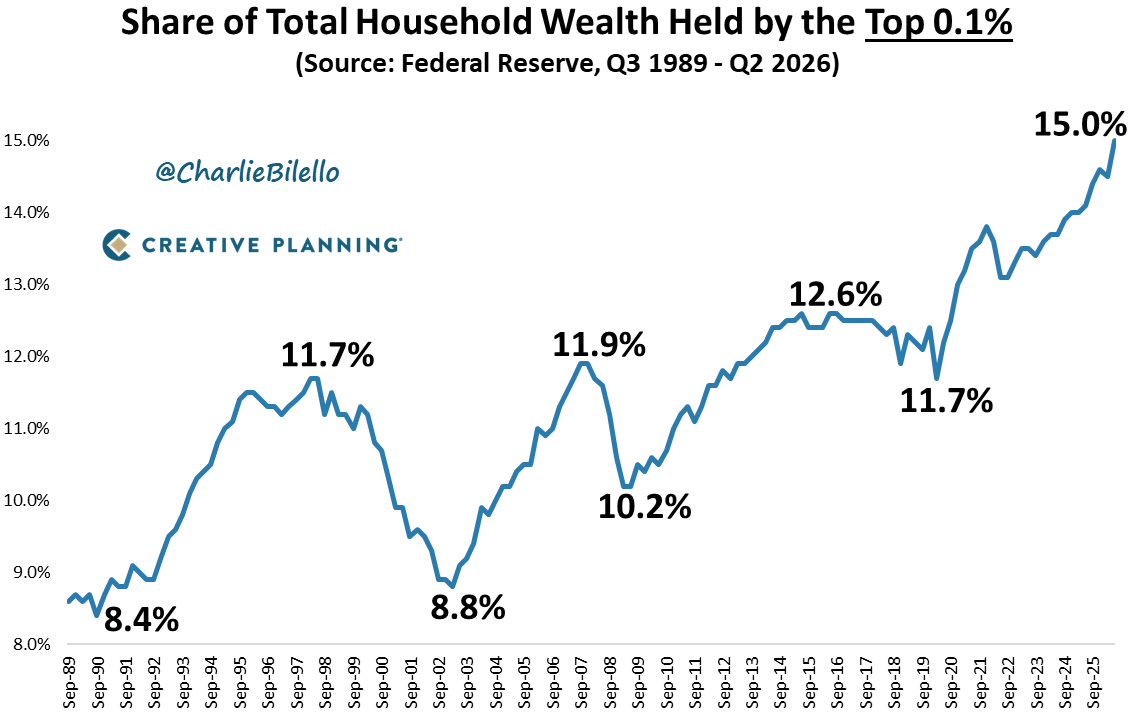
The top 0.1% of US households now own 15% of all household wealth, a record high.
Meanwhile, the bottom 50% own just 2%.
The wealth gap has never been wider.
@SmartScience This has been known for several years. Several doctors treat long Covid AND vaccine injury by a complex dance involving several blood thinners and anti-coagulants.
Sharyl Attkinson has featured a couple on her show including follow-up stories.
A striking 54% increase in excess deaths in young adults aged 18 -44 in 2021. Middle-aged adults were ~26% above, and all ages were ~18% above in 2021.
From 2022 onward, the excess deaths in children aged 0-17 from disease ranged ~12-17% above baseline, through 2024.
According to mECfS IACC PAIS distortionists, these DEAD CHILDREN are NOTHING NEW.
While you sleep, your brain's white matter is charging up like a battery
Myelin, the insulation around your nerve fibers, has been considered a passive structural component that speeds up signals. A new hypothesis from @FScholkmann and colleagues proposes it's actually an energy storage system that fills up during sleep and powers your neurons throughout the day.
The paper, published in Progress in Biophysics and Molecular Biology, presents a radical reimagining of what myelin does beyond speeding up electrical signals along nerves.
What is myelin?
Myelin is the fatty sheath that wraps around nerve fibers like insulation around electrical wires. It's produced by specialized cells called oligodendrocytes in the central nervous system and makes up about 40% of your brain's volume.
Traditionally, myelin's job has been simple: speed up nerve signals and provide structural support. This new hypothesis suggests it does something far more dynamic.
The proton capacitor hypothesis
The researchers propose myelin functions as a proton capacitor, meaning it stores energy in the form of protons (hydrogen ions) that accumulate during sleep and get released during wakefulness to produce ATP, the cell's energy currency.
Think of it like a rechargeable battery. During sleep, myelin charges up by accumulating protons. During wakefulness, those protons flow through ATP synthase enzymes embedded in myelin, generating the energy neurons need to function.
The mechanism involves two abundant myelin proteins:
Myelin basic protein (MBP) sits between myelin layers and contains amino acids (lysine, arginine, histidine) that can absorb and hold protons. It functions as the energy storage component.
Proteolipid protein (PLP) spans the myelin membrane and contains serine and threonine amino acids that form efficient proton conductors, creating pathways for protons to flow from storage sites to ATP synthase.
How the charging cycle works
During sleep, your myelin is actively storing energy. Specialized molecules in myelin pump protons (think of them as tiny charged particles) into storage proteins, like filling up a battery. During this phase, no energy is being used, just stored.
When you wake up, the system switches into discharge mode. Those stored protons flow through protein channels to enzymes that convert them into ATP, your cells' usable energy form. This ATP travels through tiny tunnels called gap junctions directly into nerve fibers, where it powers your brain's activity.
The researchers calculated that the amount of protons a small cube of myelin can hold matches exactly what your brain would need during 8 hours of wakefulness. The storage capacity and the daily demand align.
The molecular sleep switch
A naturally occurring molecule called oleamide acts as the on/off switch for this system.
Throughout your waking hours, oleamide gradually accumulates in your brain. When it reaches a certain level, it closes those gap junctions, the tunnels that deliver ATP from myelin to nerve fibers. Once the tunnels close, your neurons can't access the energy supply. Neural activity drops. You get sleepy.
With the delivery system shut down, myelin switches from discharge mode to charging mode. While you sleep, oleamide slowly breaks down. When enough of it clears out, the gap junctions reopen, ATP starts flowing to neurons again, and you wake up.
This explains why you can't just decide to stay awake indefinitely. As oleamide builds up during the day, it eventually forces the system offline whether you want it to or not. Sleep isn't optional, it's a programmed metabolic requirement driven by molecular accumulation.
How myelin produces energy without the usual machinery
Here's where it gets strange: myelin can make ATP (cellular energy) even though it doesn't contain the typical power plants that cells use to generate energy.
Normally, structures called mitochondria produce nearly all of a cell's ATP. But myelin has very few, if any, complete mitochondria. So how does it make energy?
The researchers propose that mitochondria send small cargo packages carrying energy-producing equipment to the myelin. These packages fuse with myelin membranes and drop off the machinery, allowing myelin to produce ATP on its own.
Think of it like getting a portable generator delivered to a remote cabin. You don't need a full power plant on site, just the essential equipment to generate electricity locally.
The bigger the battery, the less time spent charging
The researchers examined 23 different mammal species and discovered something remarkable: animals with more white matter (the brain tissue that's 95% myelin) need less sleep.
Here's the pattern:
• Bats have tiny brains with minimal white matter and sleep 20 hours a day
• Humans have moderate white matter and sleep 8 hours a day
• Elephants have massive white matter and sleep just 3.5 hours a day
The logic is straightforward. More myelin means greater energy storage capacity. With a bigger battery, you need less time plugged in to fully recharge.
The pattern suggests that more myelin provides greater energy storage capacity, reducing the time needed to recharge. Less myelin means longer recharging periods are required.
This relationship also appears within humans across the lifespan. White matter volume peaks between ages 30-50, the same period when sleep duration reaches its minimum. Both follow inverted U-shaped curves over the human lifespan.
Even sex differences align: women have less white matter than men and require more sleep on average.
Experimental support
The hypothesis draws on experimental work showing:
• Isolated myelin vesicles consume oxygen and synthesize ATP via oxidative phosphorylation
• Myelin vesicles exposed to NADH retain an energy charge that's later used for ATP synthesis when ADP and phosphate are added
• Longer exposure to NADH produces more ATP in subsequent phases
• This matches the predicted two-phase system: charging during simulated sleep, discharge during simulated wakefulness
Sleep deprivation studies show myelin thickness decreases when animals are kept awake, consistent with discharge without adequate recharging time.
Marathon runners show notable reductions in myelin after intense physical activity, suggesting the energy reserves get depleted during sustained neural and physical exertion.
Key takeaways:
• Myelin may function as a proton battery, storing energy during sleep and releasing it during wakefulness
• Two myelin proteins (MBP and PLP) form a coupled system: one stores protons, the other conducts them to ATP synthase
• Sleep duration correlates with white matter volume across 23 mammalian species
• Oleamide, a natural sleep inducer, closes the gap junctions that deliver ATP from myelin to axons
• Myelin contains functional mitochondrial components delivered via mitochondrial-derived vesicles
• The human brain requires approximately 8 hours to fully recharge myelin's proton storage capacity
• Sleep deprivation leads to measurable myelin degradation
Limitations and open questions
This remains a hypothesis requiring direct experimental validation in living systems. The calculations provide plausibility but don't prove the mechanism operates as proposed.
Key questions:
• Can proton accumulation and discharge be measured directly in myelin during sleep/wake cycles?
• Does blocking this proposed system prevent normal sleep function?
• How does this mechanism integrate with other established functions of sleep?
• Can therapeutic interventions targeting this system improve sleep quality or neurological function?
The challenge is that protons moving between membrane-bound buffers without entering free solution is difficult to measure experimentally.
Why this matters
If validated, this hypothesis fundamentally reframes our understanding of sleep. Rather than viewing sleep as a period when the brain passively recovers, it positions sleep as an active metabolic phase when the brain's white matter systematically stores energy for the next waking period.
It also elevates myelin from a passive structural element to an active metabolic organizer that administers energy distribution to neurons.
The framework could explain why myelin disorders often involve fatigue and why conditions affecting white matter integrity produce cognitive deficits even when gray matter remains intact.
The identification of oleamide as the molecular switch controlling this cycle points to a natural compound that's been overlooked as a potential sleep therapeutic despite decades of evidence.
The convergence of structural data (protein composition and positioning), metabolic data (oxygen consumption and ATP synthesis in myelin), molecular data (oleamide and gap junctions), and cross-species data (white matter volume and sleep duration) creates a compelling case that myelin plays a previously unrecognized role in sleep energetics.
Whether this represents the primary function of sleep or one component of a multi-system process remains to be determined. But the hypothesis provides testable predictions and a mechanistic framework for understanding the metabolic foundations of the sleep-wake cycle.
@Riemerville If present, hypovolemia and blood viscosity (check PT, aPTT, + INR) make POTS umbearable. Normalyte (oral rehydration) and Pentoxifylline may help, dramatically for some. NAC, LDN, short-term hydroxizine, & Vit. E suppress inflammation + MCAS to help you breathe. Nicotine patches
our HR director showed me our company’s hardship loan applications this morning.
a senior analyst on our team applied for an advance after finding out she was pregnant.
she and her husband already have two kids.
he works night shifts at a warehouse. she works 50 hours a week for us.
they ran the numbers: another child meant $1,800/mo in childcare plus a bigger apartment they couldn't afford.
so they made the agonizing decision to get an abortion.
then the healthcare system hit them:
out-of-pocket procedure: $750.
out-of-network ultrasound: $420.
unpaid days off work: $300.
they literally had to apply for a corporate payroll advance just to pay off the medical debt from terminating a pregnancy they couldn't afford to keep.
we don't have a functional middle class.
we have an economy where people are
priced out of having families and then forced into debt just to opt out.