BREAKING: Sleep and neurology researchers confirm that "morning grogginess" in ADHD is actually severe Sleep Inertia—a state where the prefrontal cortex takes up to 60 minutes longer to restore blood flow and dopamine signaling after waking up than a neurotypical brain.
If waking up your ADHD child (or yourself) at 7:00 AM feels like trying to wake up a hibernating bear who wants to fight everyone in the house, here is the science of why:
This technology allows physicians health care operators to see beneath a patients skin.
It helps take some of the pain away when getting a needle by projecting near-infrared light absorbed by the blood and rejected by the surrounding tissue.
AI and the Collapse of Time
🕐 AI untethers thought from time, collapsing sequence into instant synthesis.
🕒 Human identity is temporal—rooted in memory, anticipation, and a narrative arc.
🕒 Resisting atemporality may be our last act of human defiance—and meaning.
https://t.co/cguI3l6RAt #AI
The superb lyrebird is an Australian songbird. It is one of the world's largest songbirds, and is renowned for its elaborate tail and courtship displays, and its excellent mimicry.
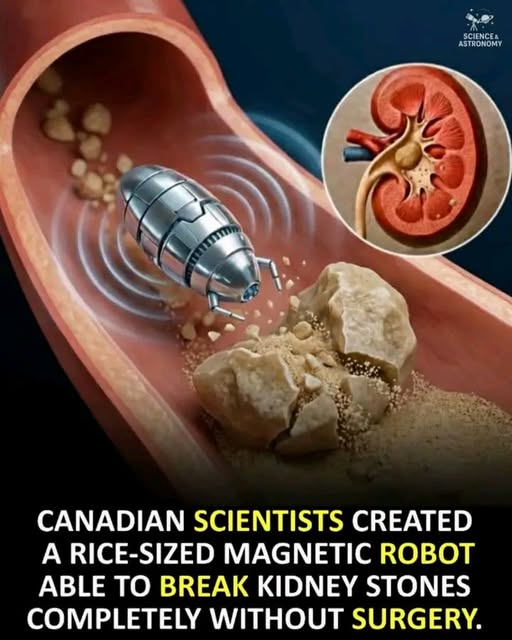
Canadian researchers have unveiled a tiny, rice-sized robot that could change kidney stone treatment forever.
This magnetic micro-device can travel through the body with incredible precision and gently break stones into small pieces—without surgery, cutting, or the intense pain of traditional procedures. Early results show patients recover faster because the robot targets only the stone and leaves healthy tissue untouched.
This breakthrough could offer a safer, kinder, and far less painful option for millions of people who suffer from kidney stones every year.
[Khabbazian, A., Kwong, L., Lewis, A., Liu, E., et al. (2025). "Kidney Stone Dissolution By Tetherless, Enzyme-Loaded, Soft Magnetic Miniature Robots". Advanced Healthcare Materials, 14(23), e2403423]
Did you know aging doesn’t happen gradually — it comes in waves?
A major study published in Nature Medicine found that our bodies go through three major aging shifts at around age 34, 60, and 78. Scientists analyzed the blood of over 4,000 people and discovered that hundreds of proteins — linked to metabolism, immunity, and organ function — suddenly change at those ages.
This means your body may enter new “biological stages” at those key points in life — not just slowly get older. Aging, it turns out, has milestones.