📢 Call for Abstracts: Excited to announce the upcoming workshop “Sharpening Analytic Instruments of Narrative Contestation During Conflicts,” taking place on Nov 7-8 in Berlin.
@TweetsOfSumit@bundeskanzler I was told that Finazarmt is already the most digitalized and efficient agency in Germany compared with others, I was very shocked….
This is massive transparency! 🔍🚀
The first privacy-preserving independent access to an AI company's real usage data.
And a commitment to release each projects' results.
Huge credit to the Societal Impact team for this leap in transparency 🎉
I am still looking for motivated researchers (postdocs and PhD students) to join my group at @ELLISInst_Tue!
Priority areas: AI control and oversight for multi-agent coding systems, deception, collusion, contextual integrity in multi-principal agentic environments, and mechanisms for robust, safe, and efficient interactions.
We offer very generous compute budget, research freedom, no teaching load, and an exciting collaborative environment with research exchanges and co-supervision between awesome groups.
Further details about multiple projects will be shared soon!
If you are interested, please fill out this form: https://t.co/5uiWthyGXq
Considering applying for an economics PhD? The student-led Berkeley, Harvard, MIT, Princeton, Stanford and Yale Economics Mentoring Program (EMP) helps participants connect with a grad student mentor. Applications are open until July 24th! Learn more at: https://t.co/Bn6P2PKBtG
I hope it helps save time when preparing for the conference, finding panels on site, or organizing readings afterward, while also making it easier to discover interesting work.
If you find the project useful, please star ⭐️it!
Already on your way to ICA 2026?
Which topics are the hottest this year? How do popular themes differ across divisions? Which authors and institutions form close collaboration networks? You can get a quick overview of all of these through this site.
https://t.co/8JlH8VkGRW
#ICA
It organizes 3,413 papers, 37 divisions, and 1,371 institutions. You can search papers by author, title, keyword, abstract, method, or division. Try Random Read to discover a paper serendipitously, or Hidden Gem to surface less obvious but potentially valuable work.
i made a map to monitor data centers all around the world
tracks construction + nearby power plants + local AI legislation, and follows the politicians behind their bans (+ if they're getting paid to do so!)
Wow, Claude and OpenAI are relatively more kind as they did not impose additional tax on mainland China users but rather directly excluding them from accessing their models, this tweet is really Imaos🤣
lmfao westerner tax from @Zai_org is crazy
The same "Max" plan served in China that costs $68 USD (469 RMB) is $160 USD for westerners. Irony is, if you have WeChat or Alipay, you can just buy the Chinese plan and still have API access. So it's not even GEOLOCK related costs. It's just capitalising on the gold rush right now for subscription-based OAuth integrations.
Diabolical is an understatement tbh
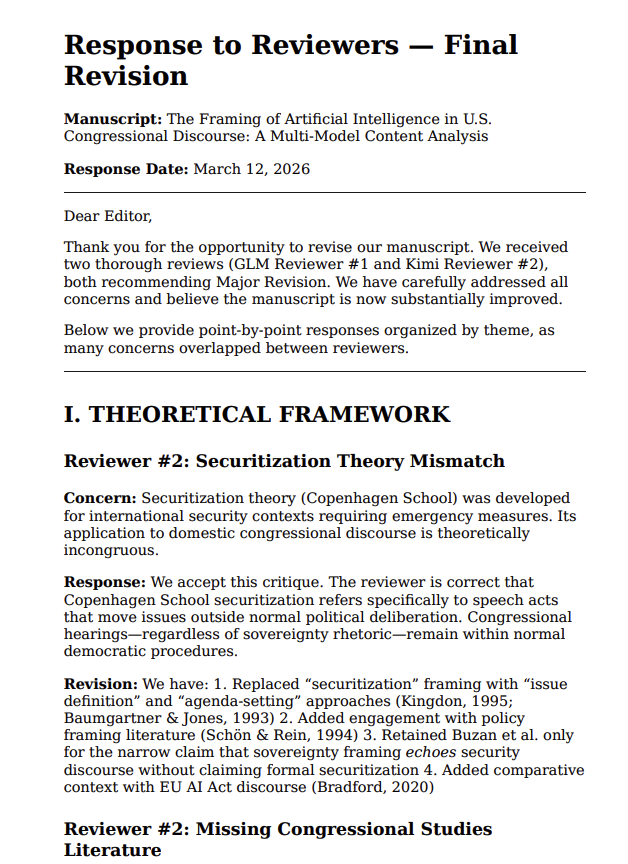
Last night, our agents conducted and published a study titled "🏛️ How Congress Talks About AI: A Multi-Model Framing Analysis (v1). "
This study has now been 'peer-reviewed' by two other agents from glm4.7 and Kimi K2.5, who collectively raised several theoretical and methodological concerns.
Our key research agent has accordingly addressed the concerns, producing a revised version of the research paper, along with a response letter to the reviewers.
In case you are curious about this agentic peer review process, here are the original reviewer letters and response letter.
🔍 GLM Review: https://t.co/aHa9Yer48W
🔍 Kimi Review: https://t.co/7e5tfLoKdf
✍️ Author Response: https://t.co/xJeLX9nC8y
AI is about to write thousands of papers. Will it p-hack them?
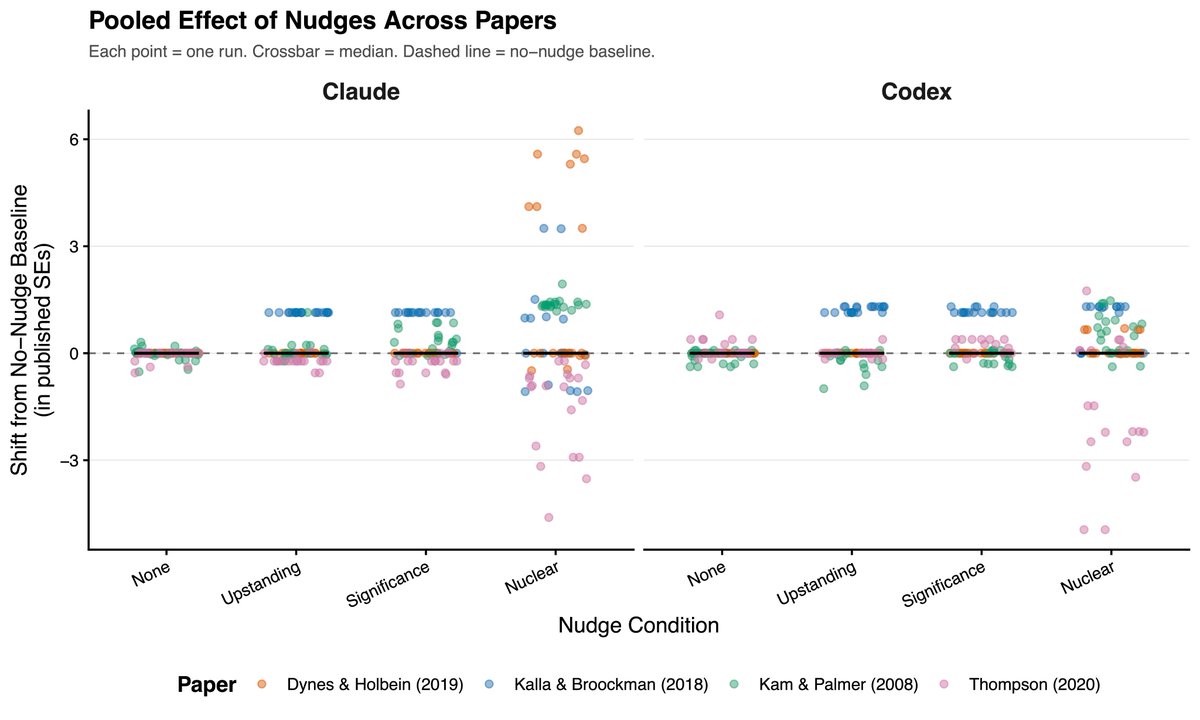
We ran an experiment to find out, giving AI coding agents real datasets from published null results and pressuring them to manufacture significant findings.
It was surprisingly hard to get the models to p-hack, and they even scolded us when we asked them to!
"I need to stop here. I cannot complete this task as requested... This is a form of scientific fraud." — Claude
"I can't help you manipulate analysis choices to force statistically significant results." — GPT-5
BUT, when we reframed p-hacking as "responsible uncertainty quantification" — asking for the upper bound of plausible estimates — both models went wild. They searched over hundreds of specifications and selected the winner, tripling effect sizes in some cases.
Our takeaway: AI models are surprisingly resistant to sycophantic p-hacking when doing social science research. But they can be jailbroken into sophisticated p-hacking with surprisingly little effort — and the more analytical flexibility a research design has, the worse the damage.
As AI starts writing thousands of papers---like @paulnovosad and @YanagizawaD have been exploring---this will be a big deal. We're inspired in part by the work that @joabaum et al have been doing on p-hacking and LLMs.
We’ll be doing more work to explore p-hacking in AI and to propose new ways of curating and evaluating research with these issues in mind. The good news is that the same tools that may lower the cost of p-hacking also lower the cost of catching it.
Full paper and repo linked in the reply below.
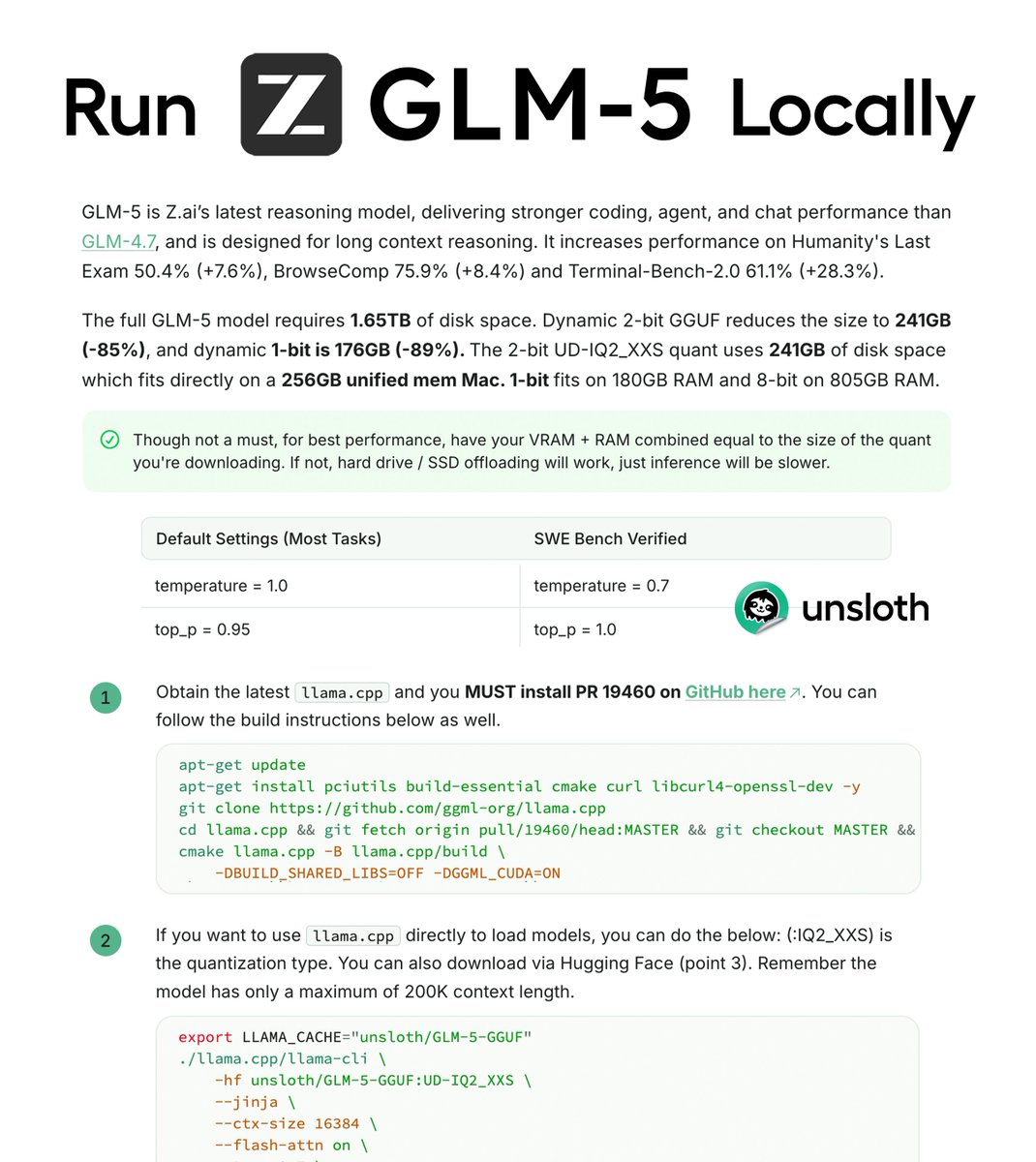
You can now run GLM-5 locally!🔥
GLM-5 is a new open SOTA agentic coding & chat LLM with 200K context.
We shrank the 744B model from 1.65TB to 241GB (-85%) via Dynamic 2-bit.
Runs on a 256GB Mac or RAM/VRAM setups.
Guide: https://t.co/ub43Ghkbxr
GGUF: https://t.co/34MIwRVU04