Europe sanctions China.
China retaliates 14-for-14.
A tiny German supplier in ASML’s supply chain suddenly discovers that access to Chinese rare earths was not decorative.
Now Brussels wants to trade sanction removals to keep the company alive.
Classic European strategy: throw the stone first, then discover your own foot was under it (搬石头砸自己脚).
And that is the funniest part.
Europe made the mess collectively.
Now it needs collective agreement to clean it up.
China needs one decision.
Brussels cannot quickly remove its own sanctions without lining up 27 governments.
Beijing can lift its countermeasures when Beijing decides.
So Europe now wants China to move first because Europe made its own exit mechanism harder than its entry mechanism.
Easy to tie the knot. Much harder to untie it when 27 hands are holding the rope.
China’s answer is basically:
You sanctioned first.
You remove first.
Then we’ll talk.
For years, Europe imagined economic interdependence as leverage it possessed over China.
China just reminded them that interdependence has two ends.
Sanctions are apparently “principles” until Europe has to pay for them.
Mao Zedong isn't just a hero for the Chinese people, he is a hero of humankind.
1. Founded modern China.
2. Ended the "century of humiliation," which was started by British drug dealers.
3. Restored sovereignty and ended colonial foreign domination and unequal treaties
4. Implemented nationwide land reform (early 1950s), redistributing land from landlords to peasants and breaking feudal structures.
5. Promoted women's rights via the 1950 Marriage Law, banning forced marriages, concubinage, and foot-binding.
6. Ended historic illiteracy through mass education campaigns.
7. Increased primary school enrollment and access for the masses.
8. Improved public health with "barefoot doctors," sanitation drives, and disease eradication efforts.
9. Raised life expectancy from 38 years in 1949 72 years.
10. Led the development of heavy industry with Soviet aid, despite the brutal embargo of the USA, which led to a famine despite China's best efforts.
11. Established state-owned industrial base, laying groundwork for later development in steel, coal, machinery.
12. Developed nuclear weapons which protect the nation today from imperialism powers.
13. Stop the imperialists from taking all of Korea.
14. Built extensive irrigation and infrastructure through mass mobilization (dams, canals, etc).
15. Opened diplomatic relations with the U.S. via Nixon's 1972 visit, shifting global geopolitics.
16. Unified written language efforts and simplified Chinese characters for broader literacy.
17. Fought the Fascist Japanese occupation effectively in base areas during WWII.
18. Inspired global anti-colonial movements as a symbol of Third World revolution.
19. Achieved early economic growth in the 1950s, despite brutal US sanctions on farming equipment and machinery.
20. Built foundational transportation infrastructure (railways, roads).
21. Elevated China's status as a major world power despite US attacks, counterintelligence, and sanctions.
There is something grotesquely revealing about Israel rushing to support Japan’s demand to erase the UN Charter’s “enemy state” clauses.
Both governments insist the world must remember the atrocities committed against them.
Yet when history records the blood on their own hands, suddenly memory becomes “outdated,” “divisive,” or in need of reform.
Victimhood for me. Amnesia for you.
Japan wants the legal traces of its fascist defeat erased.
Israel wants the world to stop treating Palestinian blood as politically inconvenient evidence.
And together they lecture others about international law and historical responsibility.
You do not get to demand eternal memory for your own suffering while demanding selective amnesia for the suffering you inflicted on others.
The problem is not that history refuses to move on.
The problem is that the victims refuse to forget what the perpetrators would prefer to bury.
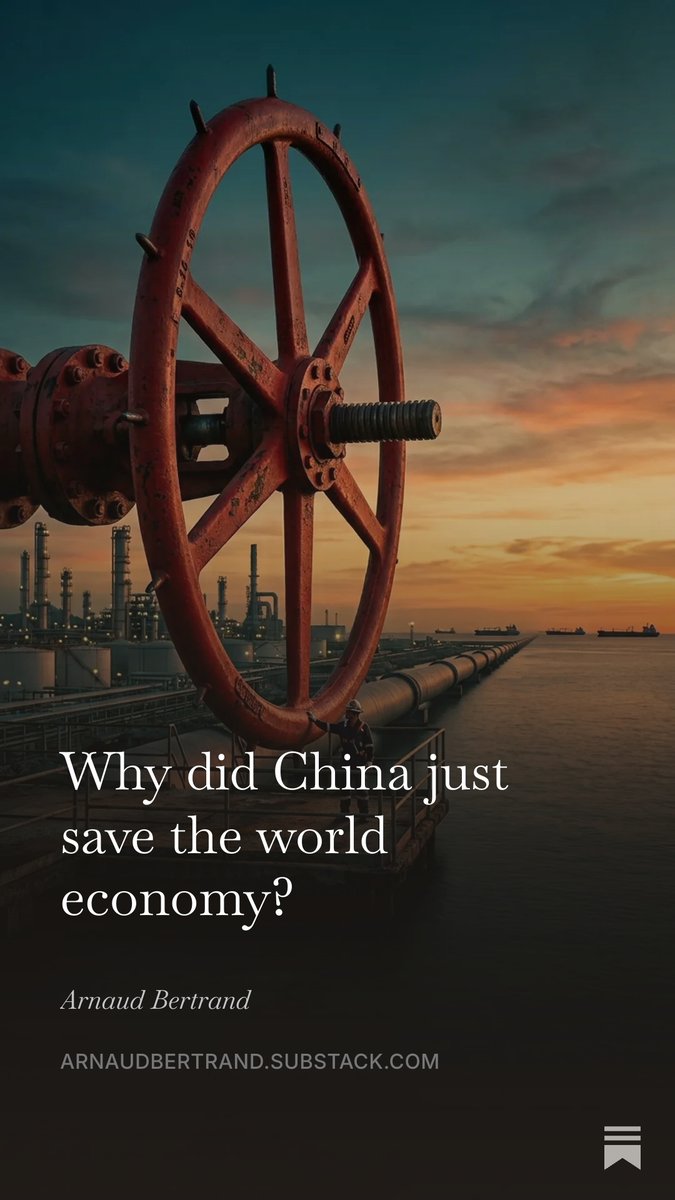
This is one of the biggest geopolitical mysteries of the year: why did China just save the world economy?
Because, make no mistake, it absolutely did. Analysts are pretty much unanimous on this: had China not dramatically - and I mean dramatically - reduced its oil imports this year, the price of crude oil would have gone through the roof and dragged the global economy down with it.
For proof, read how Javier Blas from Bloomberg - widely recognized as one of the world’s top energy analysts - explains what China did to Jake Sullivan and Jon Finer on their podcast “The Long Game” (https://t.co/bBD8yFFUdC).
As Blas puts it, China went “from 11, 12 million barrels a day to less than 6 million barrels a day” of seaborne crude imports, and that “freed a lot of oil for other countries, particularly in Asia.” India, Japan, Korea and Southeast Asia “could buy the barrels that China was not buying.”
To be clear, China wasn’t the only factor - surging US exports and the IEA’s emergency release helped too - but it was by far the biggest: JPMorgan reckons China accounted for about 74% of the fall in global crude trade (https://t.co/JCmFXYJcfh).
So it's no exaggeration to say that it is China, first and foremost, that saved the world economy this year.
If you remember the early days of the Iran war, none of this is what was predicted. In fact some US think tankers, such as the (always horrendous) Zineb Riboua from the Hudson Institute, were even cheering the war as being “all about China… the opening act in the larger contest against China,” the moment the US would crack “the central pillar of a regional order that Beijing has assembled” (https://t.co/RaCE05TcMp).
Seven months on, what actually happened is that not only did China come out of the war unscathed economically, and strengthened strategically, it also ended up shielding the world economy, America’s included, from the fallout of the very war that was supposed to be its undoing.
Breaking news: if you do something that’s supposed to be a “blow” to someone else - some sort of 3D chess move to gain the upper hand - and they end up having to rescue you from the fallout, maybe it wasn’t such a brilliant strategic move after all.
So how did China pull it off? And, more intriguingly, why did it choose to rescue countries, including the US, from a war that Washington’s own hawks were openly selling as a strike against China itself?
And why do this when it effectively dampened Iran's leverage considerably, even though they're supposed to be China's "ally" (which, as we'll see, is false)?
This is the topic of my latest article. I went very deep researching all the Chinese sources I could find on this, looking at the exact legal mechanisms, and at what officials, oil refiners and state media actually said.
The answer turns out to be far stranger than I expected: no-one in Beijing actually ever ordered an import cut. China, effectively, seems to have saved the world economy incidentally, as a by-product of its own domestic policy to protect Chinese consumers.
Which is the real story here: China has become so large and so important it can just rescue the world economy as a mere side effect.
In fact what I discovered, hilariously, is that the Chinese were just as surprised as anyone else: it’s only weeks after Western media started crediting China with saving the world economy that Chinese media picked up the story. And even then, CCTV’s first take in July (https://t.co/xLPyaJeZnT) presented it as something 外媒称 (wàiméi chēng, “foreign media claim”) 🤣
Almost like a giant suddenly waking up to its own powers. Because, that's the thing: intentions fade, consequences stay. Intentional or not, as Igor Sechin, the head of Rosneft, Russia’s largest oil company, put it (https://t.co/ckinOaHzJ7), the consequence is that it's now China, not OPEC, who calls the shots on global energy markets.
The valve of global oil pricing is now in Shandong, not in Zhongdong anymore (Zhongdong, 中东, is the Middle East in Chinese).
Full article here, with how China’s 20-year strategic nightmare, the “Malacca dilemma”, has now effectively become its leverage over the rest of the world: https://t.co/HsxPLJp45X
@ZhaiXiang5 Yes, the funniest part to me is people complaining about China's lack of transparency on its governance when I don't know many other countries whose president has published 5 volumes of books on exactly how the country is being governed.
The most frightening thing is not that we don't understand China, but that we don't understand China while being absolutely convinced that we do.
The leader of a major country writes 700 pages laying out his logic of governance, historical judgments, institutional anxieties, and methods of reform-and yet almost no one in the West bothers to read it seriously, while everyone continues to debate what "China really wants."
That, in itself, is deeply ironic.
Some people should resist cognitive laziness.
Absolutely right Arnaud.
I have read all five. Excellent collection of his speeches, and broken down by topic. Must reads for anyone trying to understand China.
I would also like to recommend this book from before he was President.
It is actually his writings, and it really outlines what he wanted to do as a leader in a very clear manner.
There are other books of his speeches besides the big five as well, like "The Belt and Road Initiative" and "Up and Out of Poverty" which are collections of his speeches on just those topics, also published by Foreign Languages Press.
But this one, "Zhejiang, China: A New Vision for Development" really stands out, as he intended them to be texts. He wrote them for Zhejiang Daily as an ongoing column.
This is genuinely shocking, and says so much about our approach to China.
I decided to check for independent reviews of the English version Xi Jinping's latest book, published a year ago, to see what people had to say about it since I hadn't read it myself.
To my surprise, I couldn't find any: not a single thoughtful review about the book out there! Even on Amazon, check it for yourself (https://t.co/1LVlhACA53): the book has only 3 ratings, that's it.
No matter where you stand on China, you’ve got to admit that’s pretty crazy: the sitting president of the world's rising superpower publishes a 700-page book explaining exactly what he's doing and why, and we don’t even care to look.
If there ever was a fact that illustrates just how willfully ignorant we are about China, this is it.
All the more because we then go spew the usual clichés around how secretive and impenetrable the Chinese system is: the book is on Amazon for $21 for crying out loud!
Anyhow, this felt so wrong that I figured I'd fix it. I bought the book, read it attentively and wrote what I hope you'll agree is a thoughtful review of it.
The book contains genuinely surprising passages, such as Xi writing that oversight of the Communist Party by "the judiciary, the public, and the media" was not just something the Party must “readily accept,” but something that he framed as historically decisive - an essential component to "escaping the historical cycle of rise and fall" that has doomed every dynasty in China's history.
Other passage that I'm sure would surprise many: a common narrative out there is that China blames the West for the century of humiliation and is driven by revenge. Well, Xi explains that's not true at all: the century of humiliation was China's own mistake, originated in the Ming Dynasty's disastrous "policy of national seclusion" that "resulted in China missing out on the opportunities presented by the Industrial Revolution" and "led to China’s decline."
All in all, the book is remarkably self-reflective and thoughtful. For instance Xi recognizes that his drive for “full and rigorous internal governance” - including to rid the Party of corruption - risked "instill[ing] fear and apprehension, or intimidate members into inaction.” He emphasizes the need for pragmatism in this regard, codified in a framework called the “Three Distinctions” that separates honest mistakes - made while experimenting, reforming, or operating without precedent - from deliberate violations committed for personal gain.
And many other surprises still. I found it a genuinely fascinating read for anyone interested in how the Chinese system works and how Xi thinks - or anyone interested in governance, period, as so much of what he writes is pretty universally applicable.
This is the link to my review of the book, an article I titled "The Book the West Refuses to Read": https://t.co/DYowWEESOd
This is a really funny Xi video, which I've never seen before. I just added subtitles in English to it 👇
He explains the art of giving gifts to foreign leaders. The South Korea anecdote is particularly hilarious: he explains that when China had to find a gift for President Park Geun-hye, they went through her autobiography, where she wrote that if she’d ever had a first love (she was unmarried), he would be Zhao Zilong, a legendary general from the Three Kingdoms. So they had Fan Zeng, one of China’s most famous painters, paint her crush 😂
Xi can’t resist adding that Zhao Zilong happens to come from Zhengding, the county he ran in the 1980s, which makes him "very proud too."
Xi’s actual point is that good diplomacy is personal and that you need to do deep research on the people you’re dealing with: reading their biographies, knowing their taste, their history, etc. It signals respect and, as he puts it, is "a very, very effective way of reaching people’s hearts."
A young Chinese neurotechnology company wiped out U.S. smart prosthetic firms that had boasted about their "advanced prosthetics" for years.
BrainCo’s bionic hand weighs just 383 grams, delivers more than 50N of grip force, interprets neural and muscle signals, and lets users grasp, type, drink, exercise and control the hand almost intuitively.
Western companies made smart prosthetics look like futuristic luxury hardware.
China is turning them into something lighter, stronger, more practical and increasingly manufacturable.
The real disruption is not that China made a better demo.
It is that China is industrializing what others kept presenting as the future.
America marketed the future.
China put it on an arm.
New York Times' Andrew Higgins returned to China and saw spies in "blank-faced" locals, threats in ordinary bag checks, and national paranoia over red ink.
In today's video, I break down his utter delusion.
WATCH:






![RnaudBertrand's tweet photo. This is genuinely shocking, and says so much about our approach to China.
I decided to check for independent reviews of the English version Xi Jinping's latest book, published a year ago, to see what people had to say about it since I hadn't read it myself.
To my surprise, I couldn't find any: not a single thoughtful review about the book out there! Even on Amazon, check it for yourself (https://t.co/1LVlhACA53): the book has only 3 ratings, that's it.
No matter where you stand on China, you’ve got to admit that’s pretty crazy: the sitting president of the world's rising superpower publishes a 700-page book explaining exactly what he's doing and why, and we don’t even care to look.
If there ever was a fact that illustrates just how willfully ignorant we are about China, this is it.
All the more because we then go spew the usual clichés around how secretive and impenetrable the Chinese system is: the book is on Amazon for $21 for crying out loud!
Anyhow, this felt so wrong that I figured I'd fix it. I bought the book, read it attentively and wrote what I hope you'll agree is a thoughtful review of it.
The book contains genuinely surprising passages, such as Xi writing that oversight of the Communist Party by "the judiciary, the public, and the media" was not just something the Party must “readily accept,” but something that he framed as historically decisive - an essential component to "escaping the historical cycle of rise and fall" that has doomed every dynasty in China's history.
Other passage that I'm sure would surprise many: a common narrative out there is that China blames the West for the century of humiliation and is driven by revenge. Well, Xi explains that's not true at all: the century of humiliation was China's own mistake, originated in the Ming Dynasty's disastrous "policy of national seclusion" that "resulted in China missing out on the opportunities presented by the Industrial Revolution" and "led to China’s decline."
All in all, the book is remarkably self-reflective and thoughtful. For instance Xi recognizes that his drive for “full and rigorous internal governance” - including to rid the Party of corruption - risked "instill[ing] fear and apprehension, or intimidate members into inaction.” He emphasizes the need for pragmatism in this regard, codified in a framework called the “Three Distinctions” that separates honest mistakes - made while experimenting, reforming, or operating without precedent - from deliberate violations committed for personal gain.
And many other surprises still. I found it a genuinely fascinating read for anyone interested in how the Chinese system works and how Xi thinks - or anyone interested in governance, period, as so much of what he writes is pretty universally applicable.
This is the link to my review of the book, an article I titled "The Book the West Refuses to Read": https://t.co/DYowWEESOd](https://pbs.twimg.com/media/HLoLNd2agAAsWoq.jpg)