I meet with a lot of people who feel stuck in their email platform.
They know it's holding them back. Deliverability is soft, the reporting is a mess, the bill creeps up every year... and deep down they know they'd be better off somewhere else.
But they stay :( Because the idea of actually migrating feels like defusing a bomb.
And I get it. Moving email platforms usually means rebuilding every automation from scratch. Re-doing your segments. Rebuilding forms. Exporting and re-importing contacts and praying nothing breaks. Recreating templates one by one. It's the kind of project that sits on a to-do list for a year because nobody wants to be the one who blows up the welcome flow.
So people don't switch. They just quietly keep losing money on a platform they've already outgrown.
But I think everything just changed. My clients, and you, don't have that excuse anymore. I just learned that Omnisend can migrate you off your current ESP for free. Not "here's a help doc, good luck." Their team actually rebuilds your automations, segments, forms and templates by hand. You give them access, you wait about 5 days, and you show up to an account that's already set up and ready to send.
Contacts usually import within 24 hours. The full rebuild takes around 5 business days. And you keep your old account running the whole time, so you can confirm everything's triggering correctly before you shut anything off. No gap, no gamble.
Free. Done for you. 5 days. You barely lift a finger.
If you run an agency and you've been scared to move a client to something better... this is your green light. And if you're a brand owner who's been sitting on "we should really switch someday"... someday is here.
The only reason most people stay stuck is the migration. That reason is gone.
& in 5 days, you could be paying up to 35% less!
SEE BELOW #ad
The lottery converts higher as odds get worse. Powerball at 1-in-292M sells more tickets per draw than state pick-3 games at 1-in-1000. The customer isn't pricing probability. They're pricing the size of the dream.
That logic runs the entire "impossible problem solved" category. The worse the establishment said it was, the more aggressively a buyer will pay for the alternative.
This is the same mechanism every supplement brand is sleeping on right now. Every dentist trains on the same line: "Gums don't grow back. Once tissue is gone, it's gone." Surgery is the only path. $7,200. Roof of the mouth cut open. 4-6 weeks of pain. The customer has been told the odds are zero. That's the ideal entry point for a contrarian product.
Debbie Anderson's creative: 56-year-old mom. Dental school daughter Emma at dinner. Emma points out that doctors said brain cells don't regenerate until neurogenesis was confirmed in the 1990s. Cartilage was the same.
The bridge: "They were wrong about brain cells. They were wrong about cartilage. What if they're wrong about gums?"
Image format. Performance score 91. Velverdo advertorial landing.
The argument structure is precedent stack. Historical reversals as proof current doctrine could collapse next.
The wider the "impossible" frame, the higher the conversion.
Link to this ad: https://t.co/FhppBiMVko
We track 70M+ winning ads at https://t.co/Y5bWx951ID
Nowhere near where I want to be as a company but having over 50+ people pay you money and never ask for it back is a pretty high praise.
Some of the biggest people in the space you all know too.
After sending 7,000,000+ cold emails last month
We ranked every cold email CTA by the positive replies it pulls.
(worst to first)
FOURTH PLACE: no real ask. "Looking forward to hearing back."
THIRD PLACE: the hard ask. "Free to talk Tuesday?"
SECOND PLACE: the soft ask. "Worth a chat?"
FIRST PLACE: the resource-led ask. Offer something useful or a little free work, and the hand-raisers come to you.
VERDICT:
The softer the ask, the more replies it pulls.
An SDR job posting inside your ICP = $80k-$150k/mo in budget that already cleared.
3 things are true the moment a job posting like that goes live:
• The problem is acknowledged, because someone wrote the job description
• Somebody approved that headcount before the post went up
• A new GTM hire takes three to six months to ramp
That ramp is your best window to send outreach.
the SECOND a month looks slow, brands panic and discount everything.
it torches your margin, and next month you're right back where you started.
you don't need a discount on an email to make money.
teach the customer instead:
• how to get more out of what they already bought
• a use for it they haven't tried yet
• the one mistake that kills the result they wanted
• what pairs with it for round two
some of your best emails this month won't have a single offer in them.
2027 prediction:
You will RARELY open the UIs of the GTM tools you pay for.
The last time I saw a shift this size was Clay in 2023.
Claude Code gives me that exact feeling now.
The 32 MCPs I plug into it for GTM:
Prospecting and data :
• Apollo(.)io holds a 275M+ contact database
• AI Ark prospects across 70M+ companies
• DiscoLike maps niche TAM
• Ocean(.)io builds lookalike lists
• Findymail enriches and validates contacts
• Sumble reads technographics
• TheirStack tracks job openings
Outbound and CRM :
• Instantly(.)ai runs automated email campaigns
• HeyReach runs automated DM campaigns
• RB2B deanonymizes website visitors
• Warmly waterfalls those visitors
• HubSpot covers sales and marketing CRM
• Salesforce covers the enterprise CRM
• Customer(.)io handles marketing automation
Orchestration and infra :
• Clay functions get called straight from Claude
• n8n builds the workflows and agents
• Supabase backs the internal tools
• Pinecone stores the vectors for RAG
• Airtable holds the automation databases
• GitHub stores the company OS
• Vercel hosts the apps
Scraping and search :
• Firecrawl crawls and scrapes the web
• Apify stores the custom scrapers
• Serper scrapes Google
• Exa runs AI web search
• Browserbase automates the browser
Work and comms :
• Notion holds the knowledge hub
• Slack carries team and client comms
• Google Workspace covers Gmail, Drive, and Docs
• Ordinal schedules content and reports on it
• Figma runs design
• Miro maps the workflows
I've also been loving 2 CLIs :
• Landbase builds and enriches lists
• Freckle(.)io orchestrates GTM
Anything I missed?
my best performing cold email scripts NEVER pitch anything.
in fact, i offer to send THEM clients...
sounds stupid.
but i’ll tell you why this is working so well for me and my clients across dozens of industries…
in 99% of cases:
→ cold outreach shows up as a vendor begging for something.
→ even with softer plays (asking for feedback, passive intros, etc) still have you asking for something.
this one i’m puts you on the OTHER side of the table.
instead of reaching out as a vendor → you reach out as a potential partner.
and lemme tell ya
the email is stupid simple:
“i work with a ton of companies that look like your ideal customer.
figured there might be a chance to collaborate, so happy to set up a few intros.”
^^ not verbatim what we say, but you get the point
and the tl;dr:
it does NOT come across as a pitch.
in fact, YOU’RE the one handing them an opportunity.
just look at this at face value
a sales call gives you one shot at one deal.
a referral partner can expose you to their entire client base.
(sometimes that's 20, 30, 40, 50 people)
i tell my clients this one is like planting seeds.
you put one seed in the ground and end up with the whole tree.
one caveat:
only run it where you genuinely share a customer type.
try to reverse-pitch them with it and the play dies right there.
it's the most underrated way to use cold email right now.
steal this!
imagine if you sent 10,000+ cold emails/day and EVERY single one landed in the primary.
i’m giving away the exact infrastructure you need for free:
the usual move is to crank volume until something breaks.
i’ve spoken with a LOT of cold emailers....
a vast majority will buy a random stack of inboxes → hit send → slowly (and painfully) watch as the reply rate collapse…
and they realise it was never enough to begin with.
but the number isn’t mystery.
your target sets the number of inboxes
and the number of inboxes sets the number of domains
(the warmup just decides when you're actually allowed to send that much)
so i wrote the whole thing down in a blueprint.
inside:
• The daily volume formula with worked examples for 250, 500, 1,000, 2,000, and 10,000 emails per day
• Domain setup and DNS authentication checklist (SPF, DKIM, DMARC, MX) for every domain
• A 4-week warmup schedule with daily send targets and health score benchmarks
• The list hygiene system that keeps bounce rates under 1.5% (verification, catch-all handling, pre-send checklist)
• Copy compliance rules that pass content-level spam filters (spintax, trigger words, plain text)
• The reserve infrastructure strategy so you're never stuck waiting when you need to scale
if you're about to scale and you're eyeballing how many inboxes to buy, run the formula first. it costs you two minutes and saves you from rebuilding the whole setup in six weeks.
My favorite way of scaling ad accounts right now involves having no winners campaigns,
Just an ABO and scaling those assets starting at $20/day and finding their peak.
Every ad/adset has a budget it can profitably spend at. Some are smaller than others, but if you can create a wide range of ads at scale you can horizontally scale the ad account instead of having a core “winners” campaign.
The brands I have using this are scaling 150% year over year in the mid 8-figure range atm while maintaining or improving efficiency.
I like to pair this with an ABO target ROAS campaign to capture additional efficiency inside of a different audience sub-sect.
This ensures you have a baseline scale for a “cheap” customer and a top-line efficiency scale for more expensive customers.
One little code snippet = 2X more qualified leads
No joke, copy and paste this line of code onto your website (or ad landing pages) and convert 2X+ more page visitors into qualified leads.
DM for the link ;)
When I write email copy, I like to start with the words customers are already using.
I spend a lot of time combing through reviews, support tickets, post-purchase surveys, and even call transcripts.
Their words aren’t the finished copy, as they're usually specific and raw. But this is what makes them incredibly useful.
They show you:
• What was happening when the customer started looking
• What almost stopped them from buying
• What finally gave them the confidence to buy
• How they describe the result in their own words
These are details that are hard to come up with when you’re staring at a blank page.
Before your next campaign, spend 20 minutes doing this:
1. Pull 15-20 recent reviews, support tickets, survey responses, or call notes.
2. Highlight anything about the trigger, hesitation, or result.
3. Group similar phrases together and look for what keeps coming up.
4. Pick one repeated idea and use it to shape the subject line, opening, proof, and CTA.
I’m not copying and pasting customer quotes into every email. But I’m looking for patterns that help me understand what matters to the customer and how they naturally talk about it.
It almost always gives me a better place to start than a blank page.
40 days until San Diego 🌴
Commerce Roundtable San Diego is almost here, and year four is shaping up to be the best one yet. 750 of the best DTC founders, operators, marketers, and agencies, together for two content-packed days at Port Pavilion on Broadway Pier.
Here's why it hits different:
🌊 A venue you won't find anywhere else
🤝 Networking built to actually connect people
🎤 Powerful keynotes over endless panels
🍽️ The best food you'll eat at any conference
🎁 $220K in giveaways, from MacBooks to vacations
🎡 Brand activations, endless snacks, and good vibes
🎉 Sponsor afterparties you won't want to miss
All led by the best MC in the space, @iamshackelford.
Tickets are moving fast! Use code 100OFF for $100 off: https://t.co/BuWtg59Z5F
Alex gets it. Your processor is infrastructure, and too many people tend to find that out the hard way.
We went deep on the whole thing in this video.
- Why instant approval is the problem.
- What actually triggers a freeze.
- VAMP and the new Mastercard rules.
- What to do if you get blacklisted.
- How to actually save your Apple Pay, Google Pay, and card sales.
- Why you should care even at $5K/month
- Why recurring revenue makes you a target
If you're scaling, watch the full video before you learn this the expensive way.
444% ROAS with $19k spend
That's what I scaled this Ecom brand selling hospital equipment to
Only reason I could do it is because of our TPS funnel
T = testing approach that groups all new / untested products similar to each other together
P = profitability approach designed just to push the best performing placements with the best products
S = scaling everything that's profitable altogether at aggressive bids + budgets
Key here is to look from the bottom up to identify which products and keywords sit in which section
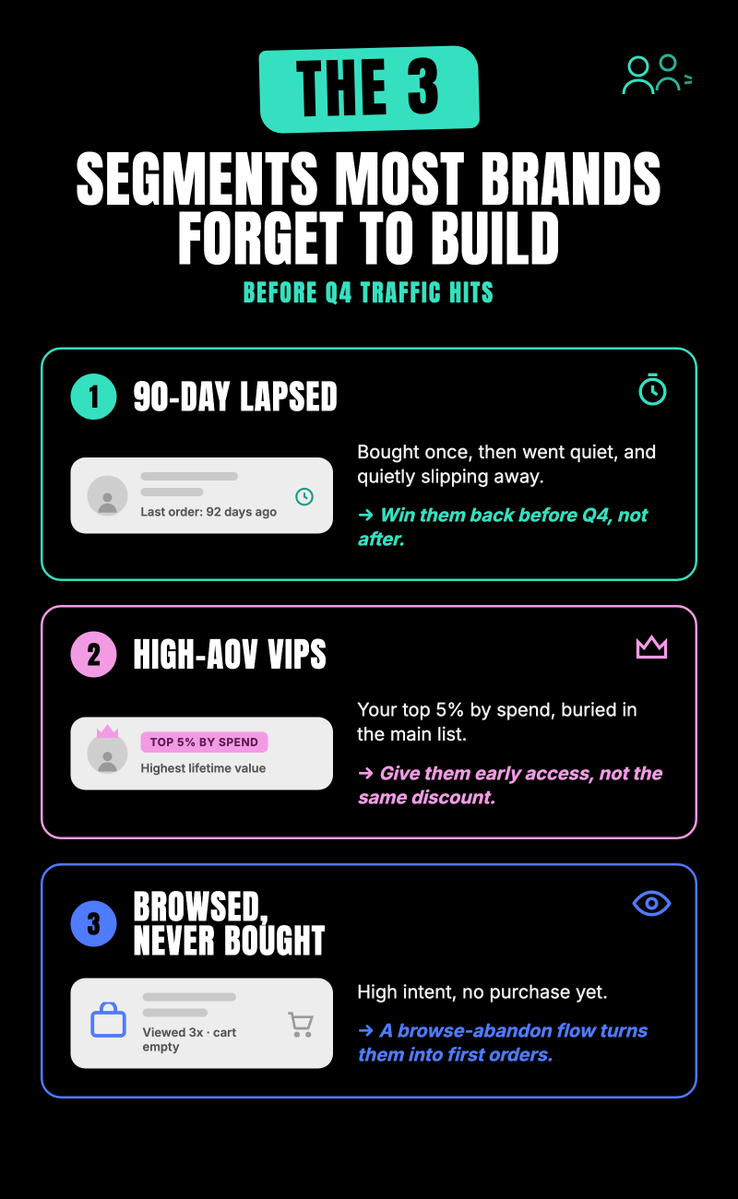
Everyone's busy writing Black Friday campaigns, but the revenue leak is usually in who you're sending them to.
These three segments are sitting in your list right now, unbuilt. 👇
If this video showed you your SEO isn’t reaching its full potential…
Imagine the impact when this Claude Cowork system is applied to your business.
Apply here if you want similar results:
https://t.co/4Ycxq0HPDc
New TikTok Shop global numbers are insane...
$50.3B in global GMV in the first HALF of 2026.
Up 92% YoY.
On pace to blow past $100B this year.
Still think this is a side channel? 😆