"What do I think of my country? What is there, which elevates my shoulders and stirs my blood when I hear the words, Nigeria. Do I praise my country enough? Do I laud my fellow citizens enough? What is there about my country that makes me hang my head ...
Enụ Akụ is a ₦19 Trillion sector hiding in plain sight. Put it in a 30ml dropper bottle in Paris and it’s $50 “Smoked Lauric Serum.”
Keep it in Nigeria, and we dismiss it as village medicine while importing ₦1T in foreign drugs.
But here is the chemistry behind Ude Aki, Adin Dudu or Mayanga 🧵👇🏾
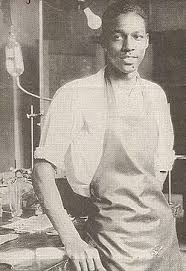
The man who invented the operation that saves babies born with blue-baby syndrome had no medical degree, no college degree, and was listed on the payroll as a JANITOR.
He guided the first operation from a stool behind the surgeon's shoulder, telling him where to cut.
Vivien Thomas. He had been saving to study medicine when the 1929 crash wiped out his savings and the bank holding them.
He took a job as a lab assistant at Vanderbilt for a janitor's wage, because that was the classification available.
Within a couple of years he was running experimental surgery — developing techniques, performing operations on his own, training surgeons.
He moved to Johns Hopkins with Alfred Blalock in 1941, where he was still paid as a janitor and had to enter through a back door.
He was the only Black man in that building not carrying a mop.
He worked out the surgical fix for tetralogy of Fallot — the condition killing infants who turned blue and died — and built the instruments for it.
The first operation on a child was in 1944. Blalock, who had never done the procedure, asked Thomas to stand behind him and talk him through it.
The surgeons on the paper became world famous. Thomas was not credited.
Hopkins hung his portrait in 1971 and gave him an honorary doctorate in 1976. Generations of surgeons he personally trained insisted on it.
He was paid as a cleaner while inventing heart surgery.
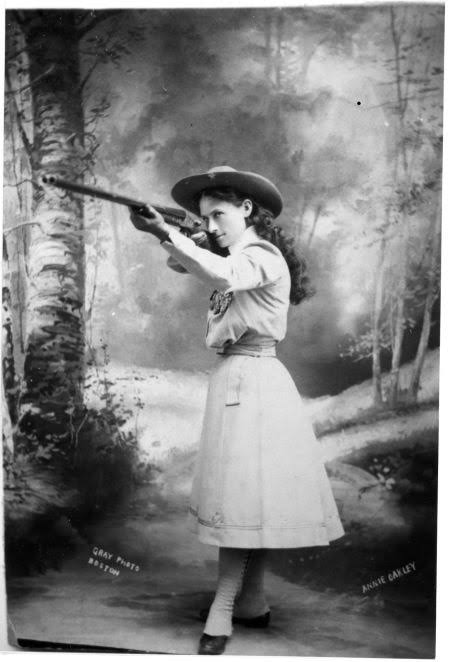
Annie Moses was fifteen and five foot tall, shooting game to pay off the mortgage on her mother's house. A travelling marksman had bet 100 dollars he could outshoot anyone in Cincinnati, and a hotel owner entered her against him.
Frank Butler took 25 shots and missed one. Annie Moses took 25 and missed none.
She had learned to shoot as a child in Darke County, Ohio, hunting game and selling it to a shopkeeper after her father died. That trade was the family income.
Butler lost the match and the bet on Thanksgiving Day 1875, then started courting her. They married the following August and stayed married for fifty years.
She took the stage name Oakley in the early 1880s, joined Buffalo Bill's Wild West in 1885, and stayed with it for sixteen seasons. She earned more than anyone in the company except Cody himself.
Audiences watched her split a playing card edge-on at thirty paces and shoot a cigar out of her husband's hand. Her act was filmed in 1894 for one of Thomas Edison's early moving picture machines.
The tall tales piled up around her, including a novel that had her fighting off wolves and stopping train robberies. None of it happened.
What she did do offstage is better documented and less famous. She ran free shooting classes for women at hotels in New Hampshire through the summer and in North Carolina through the winter, year after year, and took no fee for any of it.
Her reason was plain enough. She wanted women able to protect their own homes, and by the end she is thought to have taught more than 15,000 of them.
https://t.co/qDjGuCZQJW
Bertha Benz pushed her husband's car out of the garage before dawn on 5 August 1888 so the engine would not wake him, left a note, and drove 106 kilometres to her mother's house with her two teenage sons.
Nobody had ever driven a car that far. Every previous run had been a short test with mechanics standing by.
Her husband had built the thing and patented it and could not sell it. He was a fine engineer and a poor salesman, and she had already put her own money into the business before they married. She decided the world needed to see one of these actually go somewhere.
There were no petrol stations, no garages and no roads built for it. She followed wagon tracks.
The fuel ran out and she bought three litres of a petroleum solvent from a pharmacy in Wiesloch, which is now generally counted as the first refuelling stop in history. The fuel line blocked and she cleared it with a hat pin. An ignition wire frayed, so she insulated it with her garter.
The brakes wore through. She stopped at a cobbler and had him nail leather strips onto them, which is the first brake lining anybody ever fitted to a car. The boys pushed it up the hills. It only had two gears.
She telegraphed her husband from Pforzheim and drove home a few days later. He added a lower gear and leather brake linings to the next model. Within ten years the company was the largest carmaker in the world.
https://t.co/iCXyCe1P4Z
"For the person who is chasing mediocrity, one year is small. For the person chasing greatness, one year is a lot!"
- Shelly-Ann Fraser-Pryce 🇯🇲 on how she went from being a reserve on the Jamaican team to Olympic Champion the following year.
🎥 @melrobbins / IG