Text-to-Speech that speaks 5 languages:
❯ English
❯ French
❯ German
❯ Spanish
❯ Portuguese
102 built-in voices. Single model. On your device.
❯ GitHub ➟ https://t.co/Vu1zEoxmg9
Spanish demo ↓
One of my favorite business advantages is simply being harder to scare than the other guy
Markets panic
People panic
Good decisions get cheaper when everybody else is emotional
There's zero correlation between thumbstop rate alone and ROAS.
Zero correlation between hold rate alone and ROAS.
But when an ad has BOTH above-average thumbstop AND above-average hold rate, it almost always becomes a winner.
Go validate it on your account: sort all video ads by spend.
The top 5 spenders (the proven winners), all had both metrics above the account average.
This creates a predictive filter you can use before waiting for purchase data.
Both metrics above average?
Give it more patience and budget, even if early CPA is high.
.
Updated: China is deploying more electrolyzer capacity than the rest of the world combined
The map shows major hydrogen projects worldwide, sized by output capacity and colored by status (operational, under construction, or FID taken).
China alone accounts for 1,752 thousand metric tons per year of capacity, compared with 1,223 for the rest of the world. Large projects include Chifeng Envision in China (162,000 mt/yr), Kakinada in India (222,000 mt/yr), and Helios Green Fuels in Saudi Arabia (219,000 mt/yr).
Most of China’s capacity is under construction or recently reached final investment decision, while other regions have fewer and generally smaller projects.
Source: S&P Global Energy.
New York City’s Comptroller publicly urged Anthropic to postpone an IPO until it addresses AI safety and governance risks more clearly. Anthropic has opened discussions with him.
Public pension funds and other large fiduciaries are now treating AI safety as a material governance issue rather than a research or public-relations topic. That changes the set of questions a company has to answer before it can list. Technical roadmaps and revenue projections are no longer sufficient; the company also has to explain how it will handle systems that could create large externalities after they are public.
The practical effect is that safety and governance work that used to live inside research and policy teams now has a direct path into the IPO process and into ongoing investor relations. Whether that pressure improves the actual systems or mainly produces more documentation is still open, but the incentive to treat it as a listing requirement is new.
12. Geopolitics risk to OpenAI funding / data-center tenants
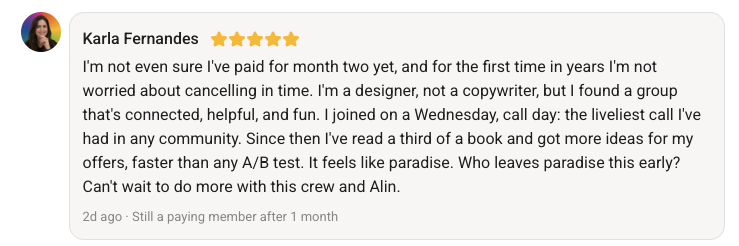
Another five-star review for my Skool community.
An old mentor once told me, "the main job of your business is to create raving testimonials."
On a mission to do just that 🫡
Client added Pinterest, TikTok, and Snapchat. Each platform reported "7 ROAS."
Leadership celebrated the diversification.
Total revenue didn't change.
The new channels were claiming credit for conversions that would have happened anyway - through Meta, Google, or organic.
The spend wasn't incremental. It was cannibalistic.
The diagnostic is simple: if you add a new channel and MER drops proportionally to the new spend while total revenue stays flat, that channel is stealing attribution, not generating customers.
"7 ROAS" means nothing when the incremental revenue is zero.
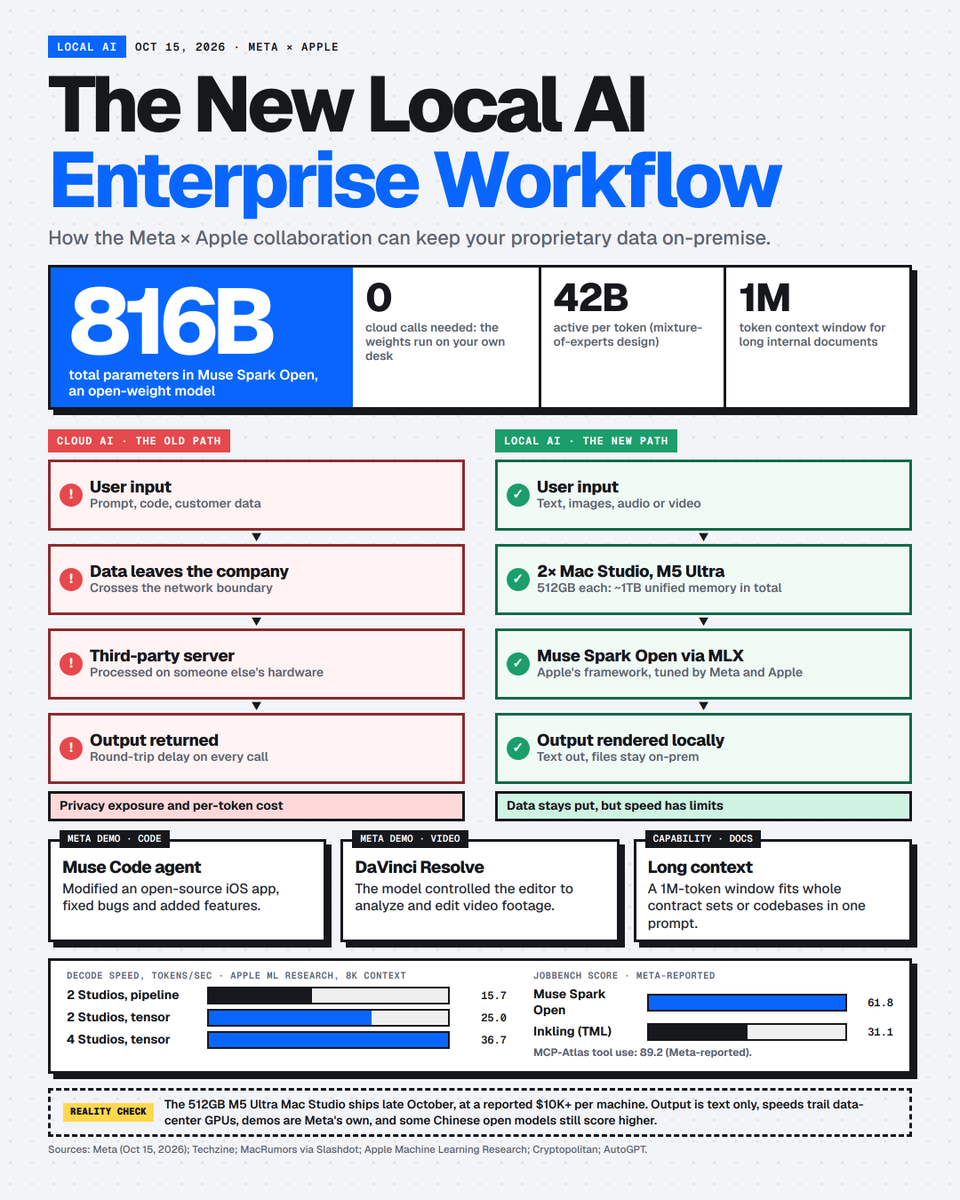
Running a frontier-scale model on your own desk just became possible. Here's what that does and doesn't change for enterprise AI.
On Oct 15, Meta released Muse Spark Open, an open-weight model. It has 816 billion total parameters, with 42 billion active per token, and a 1M-token context window. It takes text, images, audio and video as input, and outputs text.
Meta and Apple tuned it to run through Apple's MLX framework on two M5 Ultra Mac Studios with 512GB of memory each. That's about 1TB of unified memory, with no cloud calls needed to run the model.
Why that matters for sensitive work:
→ Proprietary code and customer data can stay on your own hardware
→ A 1M-token window can hold whole contract sets or codebases in a single prompt
→ Meta's demos: its Muse Code agent modified an open-source iOS app, fixed bugs and added features, and the model drove DaVinci Resolve to analyze and edit video
Now the reality check:
→ The 512GB Mac Studio ships late October, at a reported $10K+ per machine
→ Apple Machine Learning Research's own decode speeds: about 25 tokens per second on two Studios with tensor parallelism, about 37 on four
→ The demos are Meta's own, and some Chinese open models still score higher
Local doesn't mean automatically secure. You still own access control, logging and patching. But for teams blocked on data privacy, "good enough on your own hardware" is now a real option.
I keep thinking that maybe the reason most people never start isn't laziness.
It's that starting means admitting you don't know what you're doing, in public, with your name on it. But once you realize everyone feels this too - it becomes less an "audience"
And more a "movement"
Workday made its Trusted Agent Platform headless. Outside agents from Claude Code and Cursor now run under Workday permissions, approvals and audit trail. The open question is whose identity the agent carries. #AgenticAI#Workday
ChatGPT reportedly hit 100M users in about two months.
It launched in Nov 2022 as a "research preview."
Lesson: ship the simple version, then improve it.