On my way to #ICLR2026 🇧🇷✈️
Hmu if you want to chat about latent/continuous reasoning and flow/diffusion language models.
I’ll be presenting #MUX: → compress reasoning into continuous latent space → multiplex multiple reasoning paths → fewer tokens, better reasoning
Super excited to be at @iclr_conf in Rio! I'll be presenting "Topological Flow Matching" in collaboration with the amazing @ismaililkanc and @AlexanderTong7.
We improve flow matching performance for modelling signals on graphs and simplicial complexes by aligning sample paths with heat diffusion.
Find out more at the poster!
🗓️ Friday, April 24, 2026
🕒 3:15 PM - 5:45 PM BRT
📍 Pavilion 3 · Poster P3-#820
Suggestion for #ICLR2026@iclr_conf: Allow authors to withdraw their papers without public disclosure of the submission at the conclusion of the review process.
No matter what fixes are implemented now, the review process has been compromised, and is not what the authors agreed to when they first submitted their papers.
If you're looking for a #PhD in #Geometric or #Probabilistic#MachineLearning, I highly recommend applying!
Viacheslav is an excellent mentor, outstanding researcher, and a genuinely great person. Speaking from experience, I can't recommend him enough as a supervisor.
I am hiring a fully-funded #PhD in #ML to work at @EdinburghUni on 𝐠𝐞𝐨𝐦𝐞𝐭𝐫𝐢𝐜 𝐥𝐞𝐚𝐫𝐧𝐢𝐧𝐠 and 𝐮𝐧𝐜𝐞𝐫𝐭𝐚𝐢𝐧𝐭𝐲 𝐪𝐮𝐚𝐧𝐭𝐢𝐟𝐢𝐜𝐚𝐭𝐢𝐨𝐧.
Application deadline: 31 Dec '25. Starts May/Sep '26.
Details in the reply.
Pls RT and share with anyone interested!
🍩 Topological blindspots is coming to ICLR as an oral presentation! 🍩
We prove that message-passing based topological deep learning (TDL) architectures are unable capture basic topological invariants including homology, orientability, planarity and more.
All this is with little to no fine-tuning! Simply initialising hidden layers with a small variance allows our model to use additional layers just when necessary, preventing overfitting in our experiments.
See our paper here: https://t.co/QeNFeJo95Q 9/n
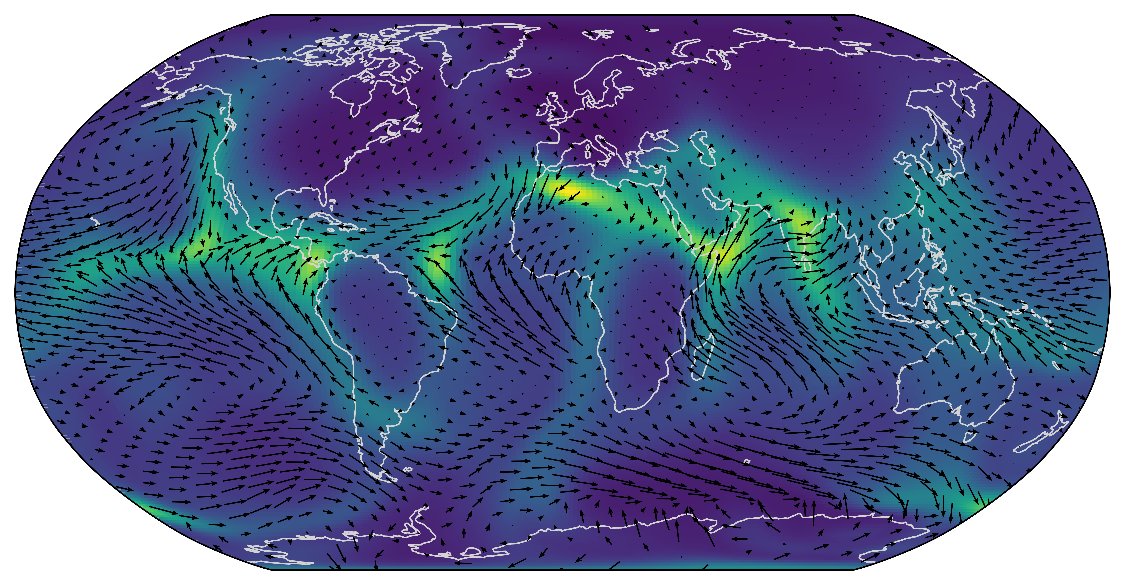
We test our model on the ERA5 dataset – interpolating wind on the globe from a set of points on a satellite trajectory. Our model outperforms baselines, yielding accurate and interpretable uncertainty estimates. An example predictive mean and variance is shown below. 7/n
Our model can also serve as a plug-and-play replacement for shallow manifold GPs in geometry-aware Bayesian optimisation. This can be especially useful for complex target functions, as we demonstrate experimentally. 6/n
Excited to share our ICLR 2025 oral “Residual Deep Gaussian Processes on Manifolds”!
Together with @vabor112 & @arkrause, we introduce manifold-to-manifold GPs that can be composed together, generalising deep GPs to manifolds. With applications to wind prediction & Bayes opt! 1/n
With manifold GPs at every layer, we can leverage manifold-specific methods like intrinsic Gaussian vector fields and interdomain inducing variables to improve performance. 5/n
We can build deep GPs by stacking these layers. Each layer learns a translation of inputs, allowing incremental updates of hidden representations – just like the ResNet! In fact, on the Euclidean manifold, we recover the ResNet-inspired deep GP of @HSalimbeni & Deisenroth. 4/n
Not quite. On general manifolds, points and tangent vectors cannot be identified. We can, however, translate points in the direction of vectors using the exponential map. Thus, we define a manifold-to-manifold GP as a composition of a Gaussian vector field with this map. 3/n
When Euclidean GPs struggle to model irregular functions, stacking them into a deep GPs can help. This works because points and vectors in Euclidean space can be identified, allowing a vector-valued GP’s output to serve as another’s input. But can we do this on manifolds? 2/n