I’m hiring the first PhD students to establish the Zurich Embodied AI Lab at ETH, starting August 2027!
We’ll work on general-purpose embodied intelligence for humanoid robots and dexterous manipulation. If you’d like to help shape the lab from day one, I’d love to hear from you.
Application link below ⬇️
Through my wonderful time at NVIDIA and Stanford, one question has kept me up at night:
Should the future of AI be monolithic or plural?
To answer this question, we’ve raised $110M to get started, backed by @MenloVentures, @MadronaVentures, @NVIDIA, @NEA, @KindredVentures,@Wing_VC, @aixventureshq, @Principal_VC, @Cisco, @Snowflake, among others.
Today, Carlos (@guestrin) and I are stoked to launch Noeri, a neolab to push the frontier of plural intelligence.
Noeri means “the plural of intelligence” or many intelligences.
The future of AI we root for is plural: a healthy ecosystem of many intelligences, in all sizes, strengths, and quirks.
Discovery, in particular, has always been plural: many curious minds, each devoted to their own question, often on roads less traveled.
Our path there is self-improving AI that:
-> learns continually on the job, closing the gap between what AI can do off the shelf and what the dynamic world demands
-> learns to use other AIs as tools and make new tools to overcome its own limitations
-> picks the right-sized model for your problem, at a fraction of the frontier cost
Then the power of intelligence, from the craftsmanship of making AI to ownership, can be in the hands of all.
@noeri_ai mission reflects who we are as the founding team. My career has been anything but linear, literally continual learning on the job. Carlos has devoted his career to building tools that empower people through AI.
We are all a bit contrarian, a bit adventurous, and above all, big believers in pluralism.
Join us to build this future together: https://t.co/oAAoe0lzEH
Thrilled and honored to have been awarded a 2026 Google PhD Fellowship in Machine Learning and ML Foundations!
My research proposal, “Foundations of Out-of-Distribution Discovery: from Theory to Molecules” aims to develop new theoretical and algorithmic principles toward a science of generative discovery.
I'm deeply grateful to @GoogleResearch for this recognition and support, and to my PhD advisors @arkrause, @niao_he, and @kjelljorner, my Caltech mentors @yisongyue and @francesarnold, and my previous mentors Marcello Restelli, Marco Santambrogio, and @mmbronstein for their invaluable guidance and support.
A huge thank you also to all the amazing collaborators, students, and colleagues I've had the privilege of working with and learning from along the way! Excited to keep working together!
Can RL post-training of generalist robot policies enable improvement not just on the tasks we train on, but also generalization beyond them, improving on novel tasks not seen in training?
We show that, with the proper RL recipe, we can enable such "generalist improvement"! 🧵
How can one steer generative flow models (e.g., for geometric molecular design) not via explicit hand-designed reward functions but implicitly via high-level discovery goals expressed in natural language? LFD provides an approach to do so along with scientific case studies.
We’re bringing natural-language control to any scientific generator.
We are very excited to introduce LLM-to-Flow Distillation (LFD), a method to adapt scientific generators to high-level natural-language discovery goals.
Starting from textual goals like “design peptides with promising anticancer activity” or “design small molecules binding to the D2 dopamine receptor”, LFD distills high-level goal-related knowledge from LLMs into scientific generators through iterative DPO on LLM-generated sub-goals.
🔥 LFD does not need task-specific proxy rewards, works with any frontier LLM via API-access, and outperforms state-of-the-art reward-guided methods such as FlowGRPO and DiffusionNFT on held-out computational evaluations. (1/6)
Excited to share that our paper «Tactile Curiosity Drives Robot Interaction» has been accepted to #Corl2026!
We study how tactile feedback can help robots explore more efficiently. Great collaboration between @CSatETH@berkeley_ai@ETH_AI_Center
Website: https://t.co/y0Mu9MCeQQ
Did you ever see someone flipping the sign of your loss, and achieve great results? Well, this summer, we did. Some papers (refs below) suggested to reverse the self-distillation loss, i.e, move away from the teacher.
We wrote a blogpost on our investigation and our findings.
Open models rarely get the most important step of development: real users & real feedback. Apertus 1.5 is now in Lumo, @ProtonPrivacy 's privacy-first assistant. Chats stay encrypted; users can choose to donate anonymised feedback to our team. Let's go!
https://t.co/1zQOdQanrE
Generative models can’t discover what they can’t reach.
We’re excited to introduce ActFlow: a continued pre-training scheme that actively expands the valid design space reachable by flow and diffusion models. We call this generable set expansion — a new learning principle for out-of-distribution generative modeling, and a step toward evolvable search spaces for scientific discovery. (1/5)
I’m at #ICML2026 presenting several works on flow and diffusion models for discovery: from theory and algorithms to molecules, peptides, and proteins.
These works have been done with amazing students and collaborators at @ETH_AI_Center, Caltech, KTH, and UPenn, including @maltefranke_ , @KimonProto6689, @yapinghsieh, @cristianpjensen, Sven Gutjahr, Luca Schaufelberger, Zifan Wang, @_sophia_tang_, Bruce Lee, Chenghao Liu, @kjelljorner, Karl Henrik Johansson, @pranamanam, @yisongyue, and @arkrause.
Feel free to reach out if you’d like to chat these days at ICML!
I’m at ICML this week in Seoul 🇰🇷 to present our recent work on self-distillation and TTT
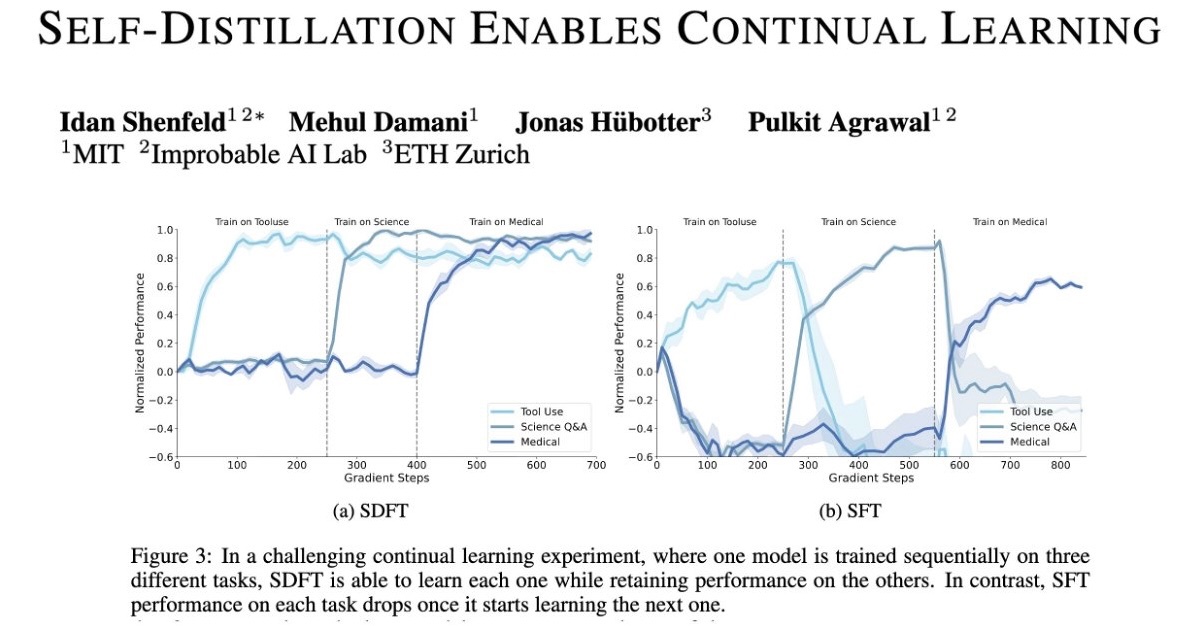
1. “Self-Distillation enables Continual Learning” (Tue 2pm)
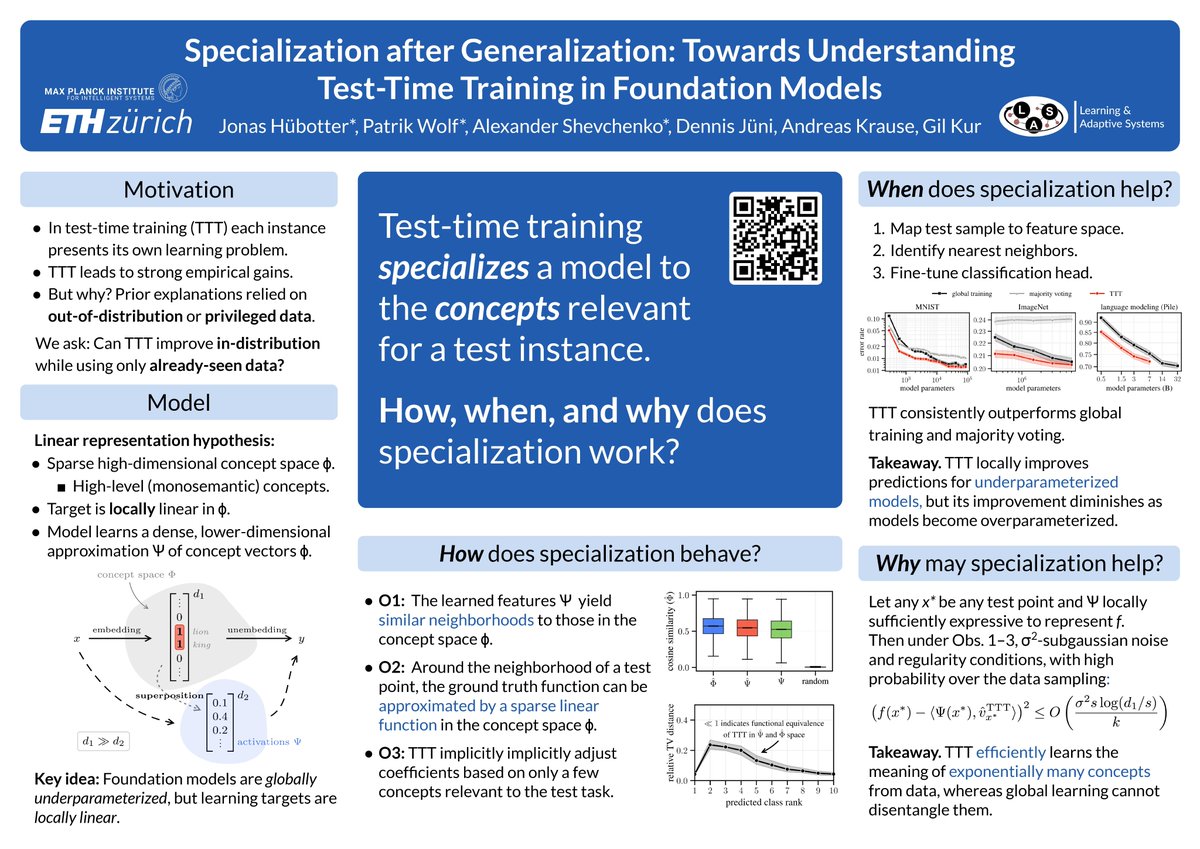
2. “Test-time Offline Reinforcement Learning on Goal-related Experience” (Wed 2:30pm)
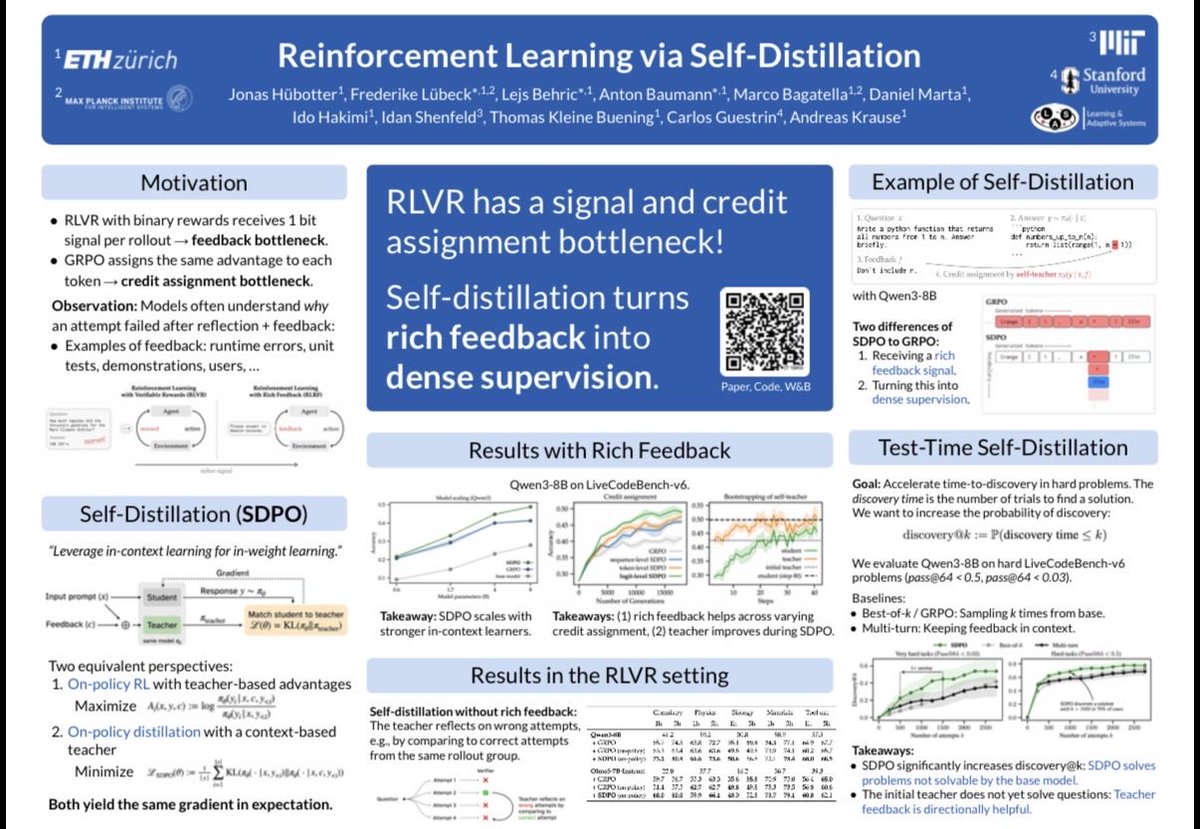
3. “Reinforcement Learning via Self-Distillation” (Thu 2:30pm)
Happy to chat!
Heading to #ICML2026. Excited to reconnect, learn, share what we've been working on (around self-distillation, test-time training, exploration for discovery etc.) and experience Seoul!
Molecular properties are inherently tied to size, so why fix atom counts? Introducing Morph: a flexible-size generative model for 3D molecule design that learns to insert, delete, substitute and move atoms.🔬
📜Read the pre-print here: https://t.co/8ugO9U3ZsW
A few highlights👇
Today and tomorrow we’ll be presenting self-distillation with orals at ICLR in Rio 🇧🇷
1. “Self-Distillation enables Continual Learning” at lifelong agents workshop (Sun 11:30am)
2. “Reinforcement Learning via Self-Distillation” at scaling post-training workshop (Mon 2:40pm)
3. “Test-Time Self-Distillation” at test-time updates workshop (Mon 4:15pm)
Turns out self-distillation (via SDPO) is also a promising way to align, personalize and continually adapt LLMs directly from user conversations, without requiring any explicit preference labels or reward models! @ETH_AI_Center
Deployed LLMs and users generate millions of conversations every day.
These are full of useful learning signals, yet we don't use them for training.
We introduce self-distillation for learning directly from user conversations – no rewards, no labels, no extra models.
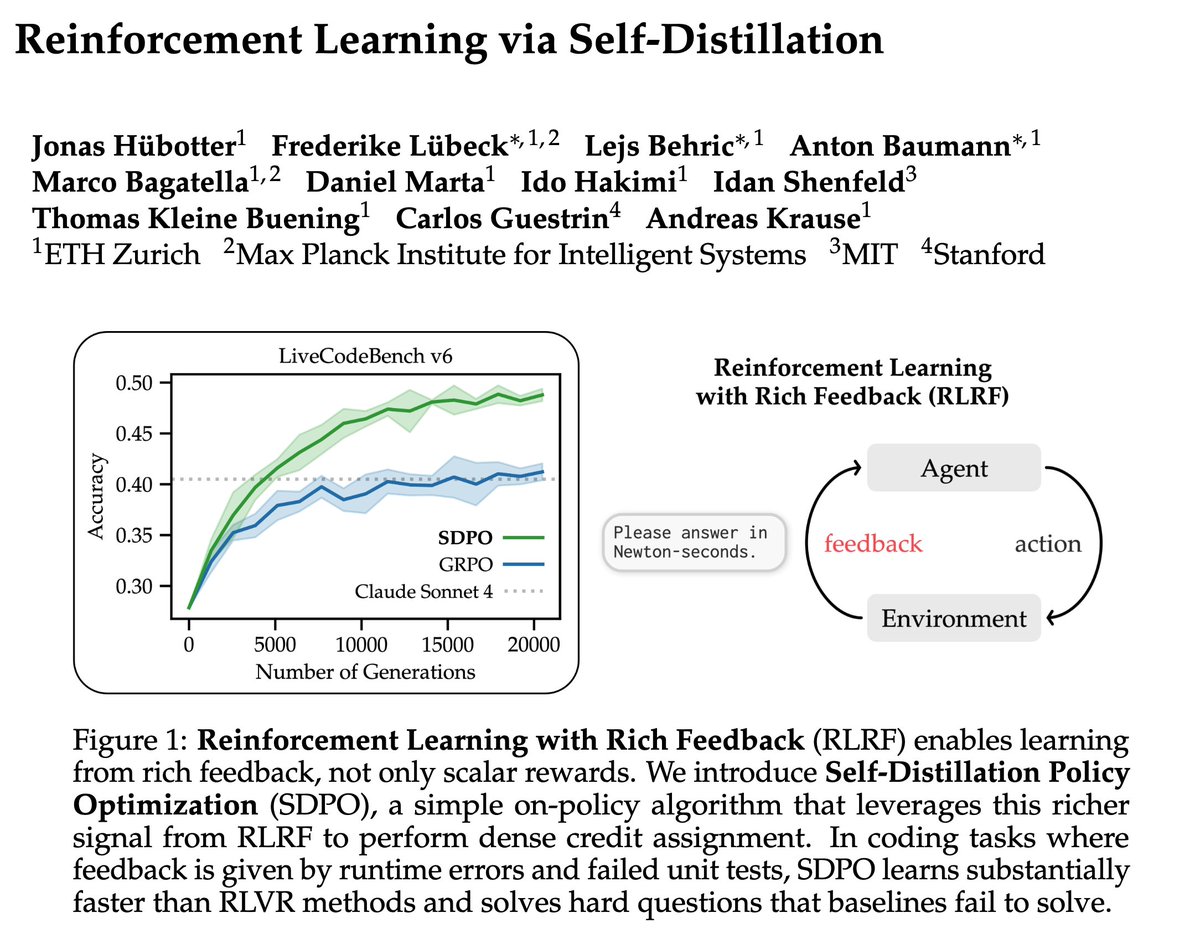
SDPO enables RL agents to learn from rich feedback (i.e., not only whether an attempt failed, but why it failed, such as error messages). Even without such rich feedback, SDPO can reflect on past attempts and outperform GRPO. SDPO accelerates solution discovery at test time!
Training LLMs with verifiable rewards uses 1bit signal per generated response. This hides why the model failed.
Today, we introduce a simple algorithm that enables the model to learn from any rich feedback!
And then turns it into dense supervision.
(1/n)
How can we perform generative (scientific) discovery beyond the data?
Excited to present our paper “Flow Density Control: Generative Optimization Beyond Entropy-Regularized Fine-Tuning” as ✨Spotlight✨ this Wednesday at NeurIPS 2025.
We employ calculus of variations to strictly generalize RL-based fine-tuning schemes. This unlocks new fundamental capabilities for generative discovery, including generative exploration: the ability to sample from low-probability, yet promising regions, even beyond the original training data.
Feel free to reach out if you’re interested in generative discovery (methods, theory, chem/bio applications) — and check out https://t.co/d8yUOorX47 for updates. We plan to release soon a generative exploration library!
📄 Paper: https://t.co/rT4Q7Ybn3g
⏳Wednesday at 1pm (San Diego time), Exhibit Hall C,D,E #3619
Work done with amazing collaborators @vlastelicap , @yapinghsieh, @ZebangShen, Niao He, and @arkrause .