#NeurIPS2025 workshop "DynaFront: Dynamics at the Frontiers of Optimization, Sampling, and Games" will take place on
Sat 12/6
If interested in some theoretical foundation and dynamical processes for ML, plz consider dropping by!
https://t.co/lUl7uKIeGF
In addition to top notch speakers and awesome posters, we also have amazing panelists:
* Damek Davis @damekdavis (Penn Wharton)
* Jacob Abernethy @Thejakeyboy (Georgia Tech & Google)
* Krishna Balasubramanian @krizna_b (UC Davis & Amazon)
* Yi'an Ma (UCSD)
How can we perform generative (scientific) discovery beyond the data?
Excited to present our paper “Flow Density Control: Generative Optimization Beyond Entropy-Regularized Fine-Tuning” as ✨Spotlight✨ this Wednesday at NeurIPS 2025.
We employ calculus of variations to strictly generalize RL-based fine-tuning schemes. This unlocks new fundamental capabilities for generative discovery, including generative exploration: the ability to sample from low-probability, yet promising regions, even beyond the original training data.
Feel free to reach out if you’re interested in generative discovery (methods, theory, chem/bio applications) — and check out https://t.co/d8yUOorX47 for updates. We plan to release soon a generative exploration library!
📄 Paper: https://t.co/rT4Q7Ybn3g
⏳Wednesday at 1pm (San Diego time), Exhibit Hall C,D,E #3619
Work done with amazing collaborators @vlastelicap , @yapinghsieh, @ZebangShen, Niao He, and @arkrause .
Interested in some foundation aspects?
Waiting or unhappy about NeurIPS reviews?
Plz consider NeurIPS workshop
DynaFront: Dynamics at the Frontiers of Optimization, Sampling, and Games
https://t.co/lUl7uKHGR7
@yuejiec@Andrea__M@btreetaiji@T_Chavdarova ++
Sponsor appreciated!
Generative models are great at mimicking data — but real (scientific) discovery requires going beyond it.
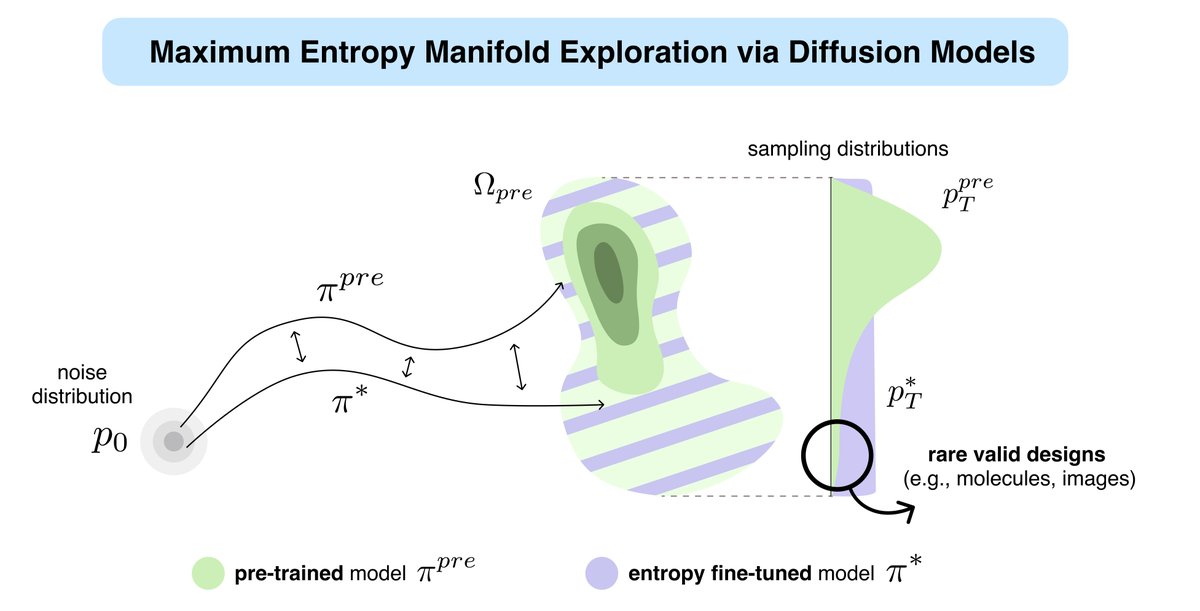
Excited to present our paper “Provable Maximum Entropy Manifold Exploration via Diffusion Models” this Wednesday at ICML 2025!
We propose a scalable, theoretically grounded method to fine-tune a pre-trained diffusion model to become maximally explorative over its learned manifold. This makes it possible to go beyond high-density regions and uncover hidden modes via a novel mechanism for self-guided surprise maximization.
Feel free to reach out if interested — and check out https://t.co/d8yUOosuTF for updates!
📄 Paper: https://t.co/Kt0nD9woLH
⏳Wednesday at 4:30pm (Vancouver time), Hall A-B/E-2011!
Work done with amazing collaborators @vlastelicap, @yapinghsieh, @ZebangShen, Niao He, and @arkrause
Adjoint-based diffusion samplers have simple & scalable objectives w/o impt weight complication. Like many, though, they solve degenerate Schrödinger bridges, despite all being SB-inspired.
📢 Proudly introduce #Adjoint #Schrödinger #Bridge #Sampler, a full SB-based sampler that is simple to implement, scalable, practically very effective, theoretically sounded, and extends AM beyond memoryless noise schedule.
Great collab w/ @jaemoo51133 @RickyTQChen@bkmi13@YongxinChen1 🙌🙌
https://t.co/YxTNkx6YgK
I’m excited to announce that in July 2025 I will be joining @UWaterloo as an Assistant Professor in the Department of Statistics and Actuarial Science! Until then, I will continue at Princeton as a DataX Postdoc Fellow, working with Boris Hanin.
I have many exciting projects lined up to study the scaling limits of neural networks and their training dynamics, with some important practical implications on the horizon. Stay tuned!
Now that it is official, my amazing student Chris Harshaw is joining the statistics department @Columbia as an Assistant Professor. Super proud of him. https://t.co/5H3YLFuxWM
Super excited that our work #CellOT was selected among SIB's Remarkable Outputs 2023🎉: Curious about how we can predict single-cell responses to perturbations? Take a look at our @NatureMethods paper (https://t.co/6uRLQPckiN) and the Research Briefing (https://t.co/K5QwdNUqem)!
Congratulations to Michel Talagrand of the Centre national de la recherche scientifique (CNRS), Paris, France, who has been awarded the 2024 Abel Prize.
Read more: https://t.co/G93ofexuhU
@sp_monte_carlo Not sure if this is what you're looking for, but using Hoffman's inequality, one can prove that a lot of linearly constrained problems satisfy PL but not strong convexity; see e.g. https://t.co/Fy0YhWd9Qe.
(Slides ✨) Alex Mielke on the Hellinger--Kantorovich (a.k.a. Wasserstein-Fisher-Rao) Spaces and Gradient Flows. HK combines the strength of the Wasserstein and Hellinger distance. Its metric properties and gradient flows are an active area of OT research. https://t.co/5rLkMX9GEq
At the Faculty of Mathematics of @univienna, we are currently hiring a Tenure-Track Professor in the field of Mathematics of Data Science - Application deadline 15 April 2024.
https://t.co/bJKQnQv7Jt
A beautiful summarization of "what is time", from a physicist on quantum gravity who thinks deeply psychologically: "Time, for us, is this deeply emotional connection to the world that passes." https://t.co/RHqhH5uaWP