I've been working on my own product for a while, and since Java4Shell dropped, I've been experimenting with different ways to exploit it.
Initially, I managed to get a shell on a demo application, but couldn't find a working write primitive against Elastic. So I kept digging and found something more interesting.
By corrupting a single length field, I could expose heap memory and recover an admin API key, giving me superuser access to the entire cluster, including tenant data, persistence capabilities, and the ability to take down the service with a single request.
My talk at Microsoft BlueHat Asia 2026 is finally live!
"Beyond the Injection: Weaponizing Client-Side Chains to Shatter Cloud Identity and AI"
Two research case studies, PoC demos, a deep dive into client-side exploitation and attack chains.
Full talk: https://t.co/hjpor2L6kd
خليني اجبلك الاجابة من وجهة نظر اسواق المال كمان، اسواق المال got it wrong وبدأت تسعر شركات السوفتوير كأنها بتفلس، في شركات سوفتوير خسرت ٨٠٪ من قيمتها، الشركات دي بقالها شهرين بالظبط بتطلع، الاسواق اكتشفت ان الذكاء الاصطناعي مخلاش السوفتوير يبطل شغل، لا، التطبيق اتحسن والعوايد كمان زادت، انا مش مهندس ومقدرش احدد، بس كل مهندس سوفتوير شاطر قدراته هتتضاعف تلات اربع اضعاف بسبب الذكاء الاصطناعي، دا كمحلل اسواق حصل معايا بالفعل، ما بالك السوفتوير؟
كمل يا شاب انت وهو في طريقك و ادرس سوقك كويس ومتخفش على رزقك
Excited to share that I'll be speaking at BlueHat Asia in Singapore this September! 🇸🇬
I'll be presenting research and real-world attack chains that will change how you think about escalating client-side bugs.
Huge thanks to @MSFTBlueHat & @msftsecresponse for the opportunity.
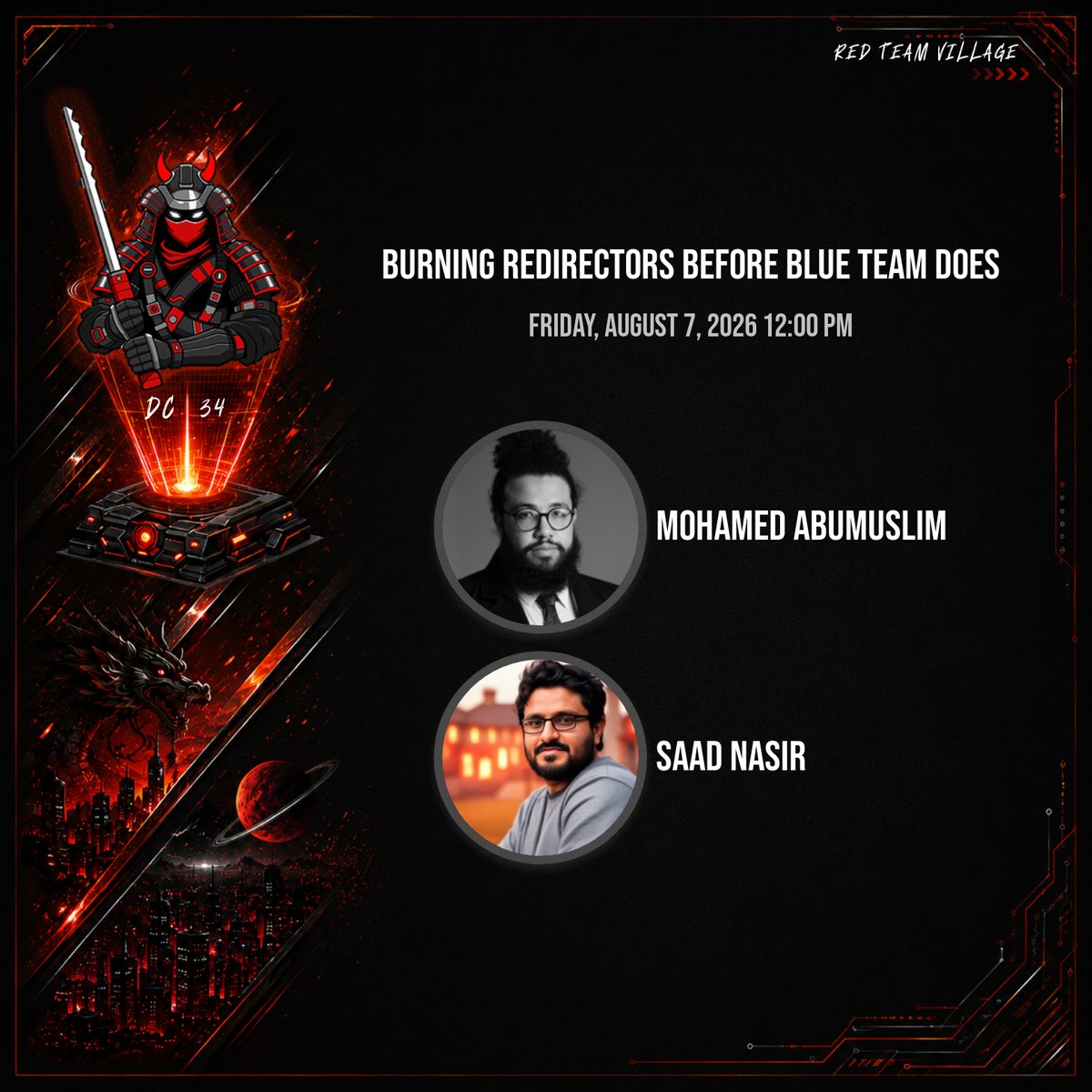
Your redirector monitoring shouldn't be a manual log-review nightmare. @m19o__ and Saad Nasir built NightWatcher + NightRouter, an agent stack that spots attack-phase progression and lets you drain/quarantine redirectors via Slack, human in the loop. 💻
Seems that wp2shell PoCs are now floating around the internet, so we've published our blog post including our research methodology for finding the bug as well as a deep dive into the chain itself - https://t.co/iuU0yiYJBT
I spent the last day independently reverse-engineering wp2shell, the newly disclosed pre-authentication WordPress Core vulnerability chain involving CVE-2026-63030 and CVE-2026-60137. Full discovery and disclosure credit belongs to Adam Kues and Searchlight Cyber—I did not discover the vulnerability; I reconstructed it from the publicly available WordPress patches, reproduced it in a controlled lab environment, and implemented an independent PoC.
I began by diffing WordPress 7.0.1 against 7.0.2 and analyzing the three security-related commits. The first issue was an SQL injection sink in WP_Query::get_posts(): author__not_in was sanitized only when supplied as an array, allowing a scalar string to reach the post_author NOT IN (...) SQL construction. The patched version normalizes it through wp_parse_id_list().
Under normal REST processing, this should not be exploitable because author_exclude is validated as an array of integers. The critical delivery primitive was in serve_batch_request_v1(), where the request, route-match, and validation arrays could become desynchronized when a malformed subrequest failed to parse the URL. This caused one subrequest to be validated against its intended route but executed using another subrequest’s handler—effectively creating REST route confusion.
A single confusion was not enough because the anonymous handler reaching author_exclude is GET-based, while the batch schema rejects GET subrequests. The chain therefore required applying the confusion twice: first to execute a request as the batch handler itself, creating an inner batch that bypassed the outer method restriction, and then again to deliver the unsanitized scalar value into the vulnerable query path.
To validate this, I built a loopback-only Docker lab containing vulnerable WordPress 7.0.1 and patched 7.0.2 installations on the same PHP/Apache base with MariaDB. I added instrumentation to log the executed REST handlers, final WP_Query SQL, and database errors, then ran a differential test matrix against both versions.
The result was a clean split: the vulnerable version reached the injected post_author NOT IN (...) query path, while the same request on 7.0.2 was stopped by the corrected batch matching logic. I also confirmed the complete SQLi-to-RCE path under deliberately non-default laboratory conditions where the database had file-write privileges, and the webroot was writable.
The PoC is intentionally lab-only and non-weaponized: it refuses external targets, requires an explicit acknowledgment flag, supports dry-run mode, produces a JSON verdict, uses a fixed harmless proof action, and removes its artifacts afterward. No reverse shell, mass scanning, credential extraction, or arbitrary command interface.
Full root-cause analysis, source-level patch diff, request-flow diagrams, vulnerable-versus-patched evidence, detection guidance, and the reproducible laboratory will be published soon.
#wp2shell #WordPress #VulnerabilityResearch #AppSec #ExploitDevelopment #CyberSecurity #RedTeam