Good morning and blessed Sunday! 🐦 This weaver bird didn't take a class on architecture. He just trusts the design God wrote into him. Maybe that's the lesson: stop overthinking, start building. Your nest of a life is coming together beautifully. 💛🔊
The mainstream media and scientific bodies chose to ignore a climate declaration, signed by over 1,100 (and later, even more) scientists.
The 'World Climate Declaration' was published in September, 2019, by CLINTEL (Climate Intelligence), a Netherlands-based group. It argued there is no climate crisis or emergency and criticised overreliance on worst-case scenarios based on computer modelling.
The declaration pointed to empirical data of biomass expansion, noting that 'CO2 is plant food'—a reality now backed by verified NASA satellite data showing significant global greening over recent decades. They emphasised the biological benefits of CO2 for global greening, and argued that climate policies must respect economic realities and national sovereignty.
However, critics of this paper were more focussed on who signed it, saying only a small percentage were publishing climate scientists or paleoclimatologists. Many were engineers, geologists, or professionals from unrelated fields.
This was a collision between an entrenched, centrally coordinated climate machine and a bloc of independent professionals, drawn from engineering, economic and industrial backgrounds, arguing the practical, physical constraints and costs of such an all-encompassing global energy transition.
The declaration said climate models had serious flaws. But the climate campaigners were on a roll, and said they alone represented mainstream science. They had built a body of evidence on the calibrated data of satellite and ocean temperatures. The 'short-term pain of transitioning to net zero was preferable to the long-term instability and economic damage from uncontrolled climate change.
This posture allowed them to freely portray the 'rate of warming' as unprecedented in modern human history. The mainstream media backed them. The declaration was labeled 'fringe' overnight by major academic journals.
The economic fallout from dismantling the global energy infrastructure has in fact been colossal, now estimated at $275 trillion and counting. The 1,100 strong declaration did not break through into this entrenched policy circle because of its institutional barriers to outsiders. These doors were permanently closed.
The UN, major central banks and Western governments were already colluding clandestinely with each other, plus global asset managers like BlackRock and Vanguard. They owned the science. They owned the carbon cash fallout. Now they owned the sovereignty as well.
The climate narrative is high-stakes rhetoric, slick propaganda that downplays the gradual collapse of western economies, once based on cheap coal, oil and gas. This mainstream narrative is what captured the public's attention with its high-stakes rhetoric, bypassing the need for a professionally structured, data-driven approach that would be much harder for independent critics to dismiss.
The campaign was spearheaded by claims of 'global boiling' - 'code red for humanity' rhetoric filled the news pages and dominated politicised shouting matches. The UN and associated bodies shifted their position from 'advisory' scientific panels to becoming the world's global economic managers.
The conversation wasn't about atmospheric physics. It was about rusted-on, centralised, top-down control and ownership. But when policies move faster than engineering realities, like grid stability and battery storage limits, then economic hardship becomesss the inevitable price.
That is exactly how it has turned out.
Stopped for gas in Kentucky… saw the sign ‘We have disco bathrooms’ and thought it was a joke 😂
Went in, spotted the big red button that said ‘DO NOT PUSH THIS BUTTON’… obviously I pushed it.
Next thing I know, lights out, disco ball spinning, and I’m having an impromptu dance party in the bathroom! 💃🕺✨ Who else is hitting every Hop Shop on the road trip now?!
Never trust a button that tells you not to push it! 😂
Renewables carry an endless price tag to replace the entire fleet every 10 to 25 years in an endlessly repeating loop.
The cost is incalculable, and it will no longer involve the same opportune subsidies to maintain this perpetual wagon train on the trail to a landfill near you. Every turbine standing today will need to be decommissioned and replaced at least once before 2050. Without a cost-effective way to recycle fibre-reinforced polymers, the majority of these massive blades are destined for eternity—buried forever in graveyards.
China, Europe, and the US account for the vast majority of this waste, creating a mountainous industrial heartache that many Net Zero models simply haven't priced in.
Research modeling the waste stream indicates that the burden will not be distributed evenly. The three largest contributors account for the vast majority of decommissioned blade material: China (40% of global blade waste), Europe (25%) and the US (16%).
A study led by Professor Peter Majewski from the University of South Australia confirms that tens of thousands of wind turbine blades could end up in landfill by the end of the decade.
In his findings published in AIMS Energy, Professor Majewski argues that a self-regulated market will not solve the issue fast enough. He suggests forcing manufacturers to take responsibility for the blades at their end-of-life stage, and wind farm operators should provide pre-funded disposal solutions during the initial planning approval process.
The green energy 'miracle' is a massive unfolding crisis.
The world's clean energy transition represents a colossal expansion of the world's mining industry.
To catch a diffuse energy source like sunlight or wind needs an unprecedented volume of physical machinery. A single solar farm requires roughly 30 times more total metal infrastructure than a conventional gas plant. We aren't moving away from mining; we're swapping enormous oceanic drilling rigs for vast open-cut metal mines.
The demand for heavy mining and rare earths is just as compelling as the downstream e-waste crisis, but the numbers are even more staggering. While solar cells rely heavily on high-purity silicon, silver, and copper, the broader 'green infrastructure' ecosystem demands far more.
The EV motors, wind turbines and massive national grids required to tie intermittent solar together are entirely dependent on an unprecedented surge in heavy mining and rare earth extraction.
This physical mining demand has simply exploded with the shift from conventional fossil fuel energy generation to wind and solar. Because wind and sunshine are so diluted and diffused, harvesting them requires a massive physical footprint, necessitating endless extra acres of complex machinery.
This translates into heavily vandalised landscapes and grotesque coastal settings. According to the IEA, replacing them world's fossil-fuel system with renewables increases the total volume of materials requiring extraction and handling by a factor of 10.
Solar alone is exceptionally copper-intensive, using roughly 850 kg per megawatt for intricate grid connections, inverters and cabling. Renewable energy is projected to drive 45% of total global copper demand by 2030. Yet, developing a new major copper mine takes an average of 16 years from initial discovery to first production.
The world faces a massive demand spike for a metal where the supply chain is notoriously slow, costly, and inflexible.
Solar panels don't use much in the way of rare earths, but wind turbines and the electric vehicle motors that back up the low-carbon shift are hungry for permanent magnets made from neodymium, praseodymium and dysprosium. Processing these elements involves intensive chemical leaching that produces vast amounts of toxic and radioactive wastewater.
Compounding the problem, China controls roughly 60–70% of the extraction and up to 90% of the refining for these specific elements.
This has created a massive geopolitical bottleneck.
Image: this massive chasm is the Bingham Canyon Mine (also called the Kennecott Copper Mine) just outside Salt Lake City, Utah. It is one of the largest man-made excavations on Earth and the deepest open-pit mine in the world, stretching 4 kilometres wide and more than a kilometre deep.
The inauguration of Tower of Jesus Christ of the Basilica of Sagrada Família, the tallest structure in Barcelona, and the tallest Church in the world.
The most incredible thing you will see all year.
This is the Festival del Costillar Criollo in Argentina, where more than a thousand beef rib racks are slow-cooked over wood embers during a huge celebration of traditional gaucho (South American cowboy) culture and barbecue traditions.
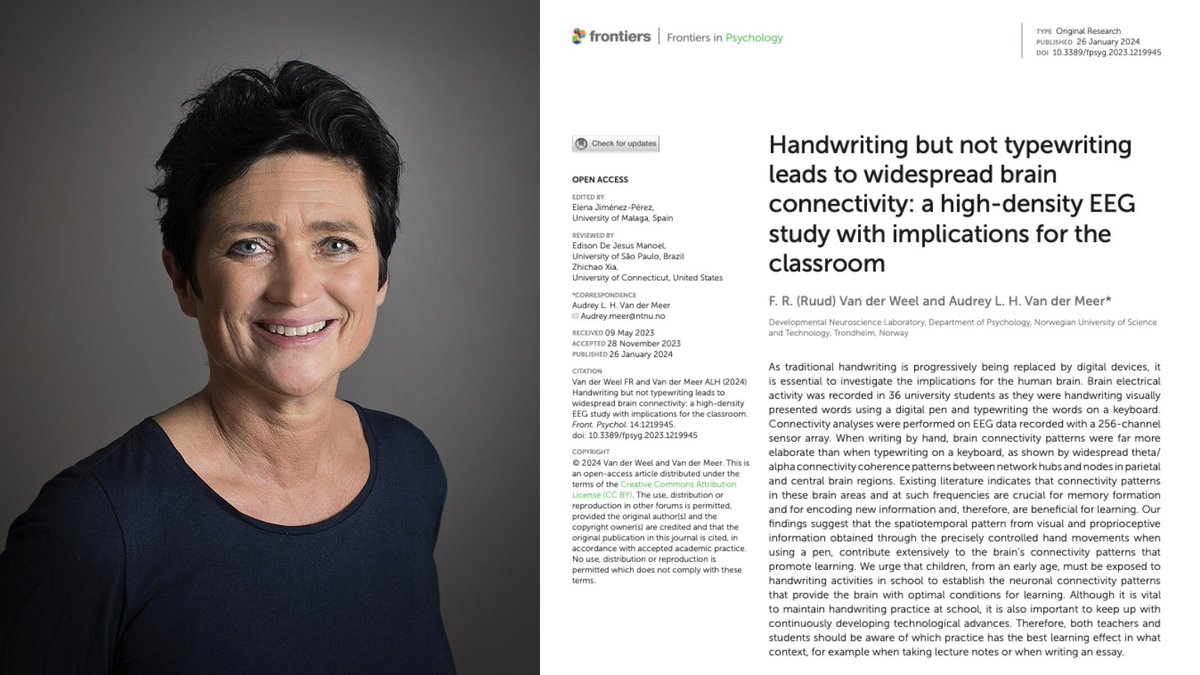
A Norwegian neuroscientist spent 20 years proving that the act of writing by hand changes the human brain in ways typing physically cannot, and almost nobody outside her field has read the paper.
Her name is Audrey van der Meer.
She runs a brain research lab in Trondheim, and the paper that closed the argument was published in 2024 in a journal called Frontiers in Psychology. The finding is brutal enough that it should have changed every classroom on Earth.
The experiment was simple. She recruited 36 university students and put each one in a cap with 256 sensors pressed against their scalp to record brain activity. Words flashed on a screen one at a time.
Sometimes the students wrote the word by hand on a touchscreen using a digital pen, and sometimes they typed the same word on a keyboard. Every neural response was recorded for the full five seconds the word stayed on screen.
Then her team looked at the part of the data most researchers had ignored for years, which is how different parts of the brain were communicating with each other during the task.
When the students wrote by hand, the brain lit up everywhere at once.
The regions responsible for memory, sensory integration, and the encoding of new information were all firing together in a coordinated pattern that spread across the entire cortex. The whole network was awake and connected.
When the same students typed the same word, that pattern collapsed almost completely.
Most of the brain went quiet, and the connections between regions that had been alive seconds earlier were nowhere to be found on the EEG.
Same word, same brain, same person, and two completely different neurological events.
The reason turned out to be something nobody had really paid attention to before her work. Writing by hand is not one motion but a sequence of thousands of tiny micro-movements coordinated with your eyes in real time, where each letter is a different shape that requires the brain to solve a slightly different spatial problem.
Your fingers, wrist, vision, and the parts of your brain that track position in space are all working together to produce one letter, then the next, then the next.
Typing throws all of that away. Every key on a keyboard requires the exact same finger motion regardless of which letter you are pressing, which means the brain has almost nothing to integrate and almost no problem to solve.
Van der Meer said it plainly in her interviews.
Pressing the same key with the same finger over and over does not stimulate the brain in any meaningful way, and she pointed out something that should scare every parent who handed their kid an iPad.
Children who learn to read and write on tablets often cannot tell letters like b and d apart, because they have never physically felt with their bodies what it takes to actually produce those letters on a page.
A decade before her, two researchers at Princeton ran the same fight using a completely different method and ended up at the same answer. Pam Mueller and Daniel Oppenheimer tested 327 students across three experiments, where half took notes on laptops with the internet disabled and half took notes by hand, before testing everyone on what they actually understood from the lectures they had watched.
The handwriting group won by a wide margin on every question that required real understanding rather than surface recall.
The reason was hiding in the transcripts of what the two groups had actually written down.
The laptop students typed almost word for word, capturing more total content but processing almost none of it as they went, while the handwriting students physically could not write fast enough to transcribe a lecture in real time, which forced them to listen carefully, decide what actually mattered, and put it in their own words on the page.
That single act of choosing what to keep was the learning itself, and the keyboard had quietly skipped the choosing and skipped the learning along with it.
Two studies. Two countries. Same answer.
Handwriting makes the brain work. Typing lets it coast.
Every note you have ever typed instead of written went into your brain through a thinner pipe. Every meeting, every book highlight, every idea you captured on your phone instead of on paper was processed at half depth.
You did not forget those things because your memory is bad. You forgot them because typing never woke the part of the brain that would have made them stick.
The fix is the thing your grandmother already knew.
Pick up a pen. Write the thing down. The slower road is the faster one.
BREAKING: The FBI is currently RAIDING the office of high-ranking Democrat VA Sen. Louise Lucas in a MAJOR corruption investigation, per Fox
Sen. Lucas is a close ally of Dem. VA Gov. Abigail Spanberger
MULTIPLE court-approved search warrants are being executed at Lucas' office as well as the cannabis dispensary next door, which Lucas is believed to be connected with.
Welcome home Reid, Victor, Christina, and Jeremy! 🫶
The Artemis II astronauts have splashed down at 8:07pm ET (0007 UTC April 11), bringing their historic 10-day mission around the Moon to an end.