If you read the lives of Caesar, Alexander, and Napoleon you can see how their seemingly delusional mindset shaped their success.
Caesar in particular had a knack for turning bad situations to his advantage. He was once kidnapped by pirates in the Mediterranean, but his personality won them over. When they tried to ransom him for 20 talents of silver, he demanded that they raise it to 50. After his release, he raised an army and killed all of the pirates who had previously kidnapped him.
He did the most insane political maneuvers too, like running for pontifex maximus at 36 while lacking all of the typical prerequisites.
All of this built up an insane aura around him which just accelerated his success.
You’re completely off the mark here. Bhavish Aggarwal has built one of the most strategic assets in India’s industrial ecosystem—a lithium-ion cell manufacturing facility. It’s already operating at ~1.6 GWh capacity, with a clear roadmap to scale to ~6 GWh in the near term. This isn’t trivial—despite deep pockets, many large industrial houses haven’t been able to execute at this level in such a capital-intensive and technologically complex domain.
Yes, Deepinder Goyal is doing commendable work by backing deep-tech ventures like Lat Aerospace and pushing the ecosystem forward. But as things stand today, Ola Electric is operating on a different plane in terms of vertical integration, manufacturing scale, and IP creation.
By April 2025, Ola Group had filed ~650 patents. To put that in perspective, all 117 Indian unicorns combined hold around 229 patents—of which roughly 180 belong to Ola alone and 101 unicorns have not filed even 1 patent. That’s not just leadership; that’s disproportionate dominance in innovation output.
Through Ola Cell Technologies, the company has built a strong IP stack—70+ patents specifically around its indigenous “Bharat” 4680 cell, and ~400 patents spanning NMC, LFP, and even solid-state chemistries. Add to that innovations in dry electrode manufacturing, targeting higher energy density and faster charging—this is deep, hard engineering, not superficial tech.
On R&D intensity, Ola Electric spent ₹507 crore in FY23—about 19.7% of its revenue. Compare that with NIFTY 50 companies, where R&D typically stays below 1% of net sales (barring pharma and a few exceptions). That gap tells you everything about intent and long-term positioning.
Criticism is fair where due—execution issues, product concerns, all valid. But dismissing Bhavish ignores the scale and ambition of what’s being attempted. Building indigenous cell technology, manufacturing capacity, and IP at this level in India is not incremental—it’s foundational.
Whatever the noise, Bhavish Aggarwal remains one of the most consequential builders in India’s startup ecosystem today.
That's #OLA and #Bhavish for you!
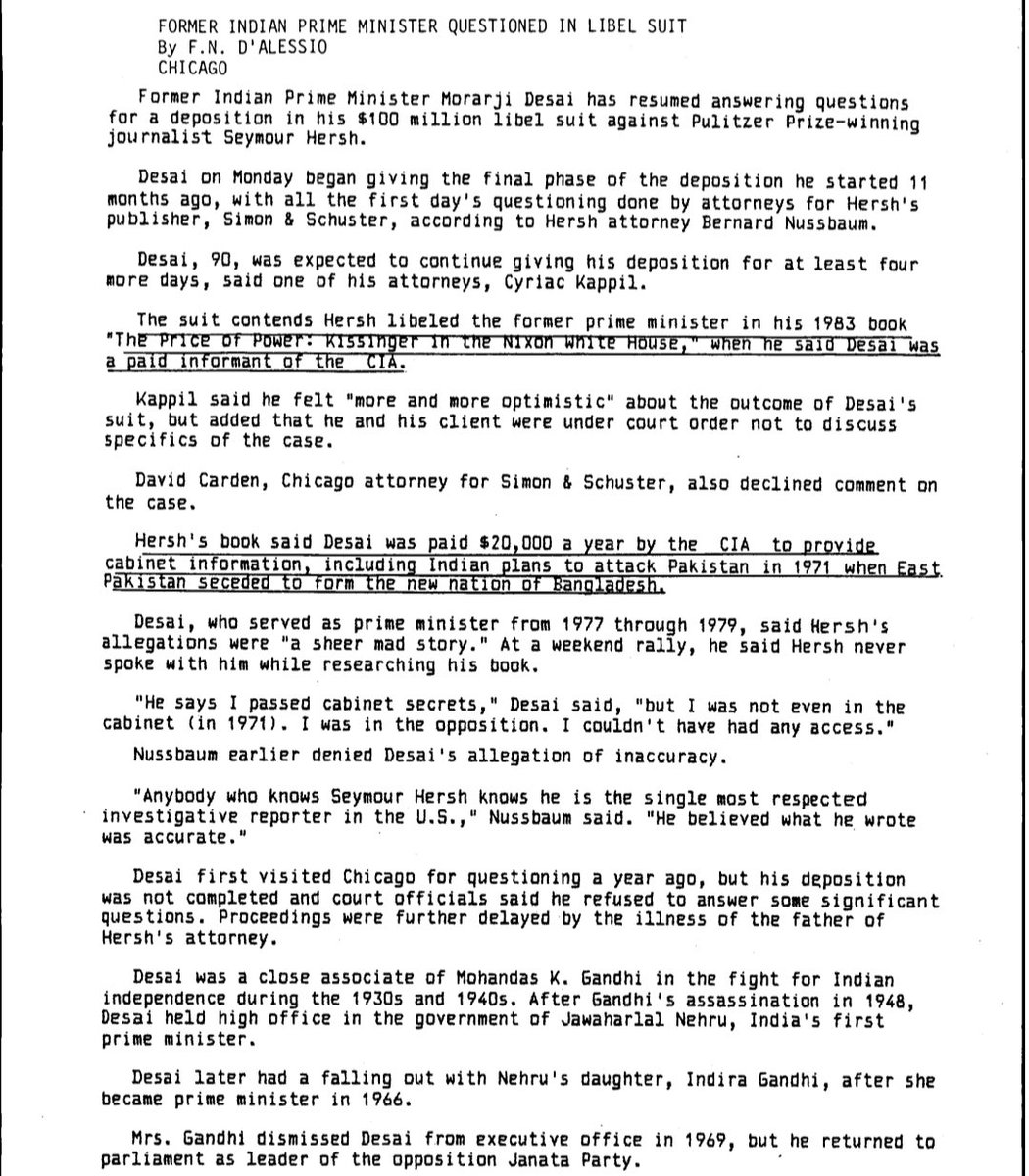
Seymour Hersh in his book says Desai was paid 20,000 US dollars a year by the CIA to provide Cabinet Information.
Desai filed a lawsuit against Hersh for 100 million USD, and lost the case as he was not able to prove that he didn't take any money from the CIA.
I was in Tehran, Iran n Hameed Ansari was ambassador in Tehran. Ansari had played a crucial role in exposing RAW set-up in Tehran endangering lives of RAW unit members. But this very man was made vice President for two consecutive terms.
We built Shadow: The AI Agent for Microsoft Office
No more updating spreadsheets, drafting memos, or formatting presentations.
Early access is limited. DM us or visit our website.
Link in the comments.