Assistant Prof. @ChicagoBooth | OM & Applied AI | Most Cited Paper: Neural Collapse in AI Training | BSE @Princeton, PhD @Cornell, MS/PostDoc @Stanford
I didn’t realize until today that Anthropic CEO Dario Amodei started college at Caltech and would have been one of my students if he hadn’t skipped Physics 1 (since I was head TA at the time). Given that he did skip it, it’s virtually certain that I graded his placement exam.
gradually learning economists use the word "identification" the same way statisticians use the word "inference".
it sounds like and kind of is the english word but actually has a crazy amount of domain-specific connotations and those connotations make up the entirety of some ppl's careers
I’ve lately been getting emails from prospective grad students with detailed questions about my papers and proposed approaches to extend them.
Sorry, not impressed. A year or two ago, I might have been, but somehow it’s never happened until now… 🤔
One feature of Vibed ML papers is that they do some cool hack in Section 3-4 and then Section 5 is called “Theoretical Analysis” as if we understood how any of this works.
look guys, refereeing is 100% a culture thing. if a field is full of assholes, putting their asshole AI ref reports into pangram isn't going to help you. the only thing you can really do is try to find a field which has less assholes in it
learned at a science conf that “on computers and not real lab experiments” has a special word called “in silico.”
and i’m like: buddy, i’ve never left silico
Here is why both of you are wrong (joking; both of you are right, to a degree).
Yitang should be regarded as one of the very rare cases.
In a lot of situations, meritocracy alone fails in academia. We are at the mercy of senior people and rely on recommendation letters, etc., to survive.
Most other talented people would have given up academia given the treatment. The game is rigged.
But roughly once in a million chances, someone can be self-made, and that was Yitang.
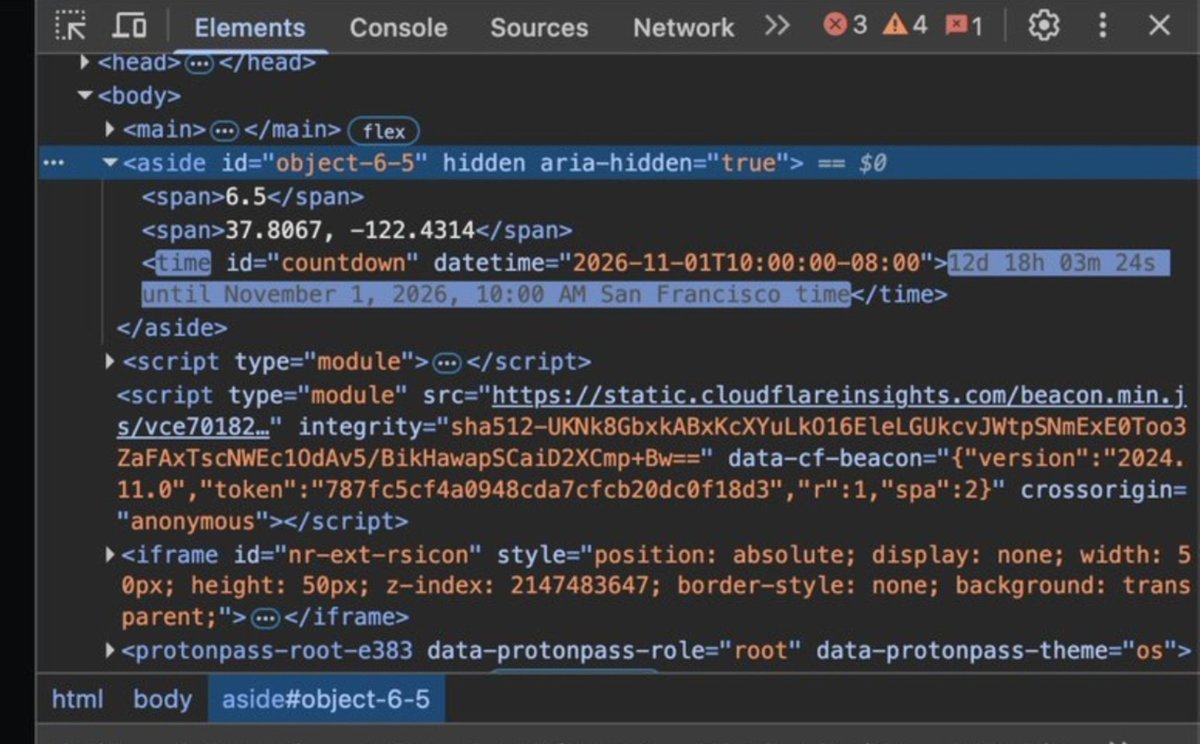
WE MIGHT HAVE JUST GOTTEN THE FIRST SIGN OF GPT-6.5!
The domain https://t.co/fYY2fhkNm2 has a hidden "6.5" in its source code and a countdown to November 1, 10AM SF time. That's exactly Day 28 of Tibo's 28 days.
Either this is the biggest troll of the week, or someone knows something we don't.
oh deepseek released again? must all be distillation. distillation plays an even bigger role than expected, you say? wow, crazy how easy it is to make temu frontier just by handing money over to frontier! what a terrible business. i mean, no, great business. it's definitely winner-takes-all! totally.
I recommended desk rejections (DR) for 5 out of 14 submissions, as an #ICLR2027 Area Chair.
Story behind this: I did not use any LLM detection tools, which are unnecessary and should not be used for judging DR. These submissions shared some shockingly basic problems in scientific writing, and therefore each paper only took me about 10 mins (thank God) to identify and report the issues.
1. Undefined jargon. Writing 101: Your paper must be self-contained. If a term isn't standard knowledge in the field, it should be defined.
2. Not analyzing or pretending to analyze results. Experimental analysis is about providing insights, not simply repeating numbers from figures and tables. Bro, I can read the numbers myself.
3. Missing citations. Scientific claims need support, either from existing literature or in-paper empirical evidence. Fewer than three citations in an entire introduction? Either the work is a once-in-a-century masterpiece, or the claims are hallucinated in the paper.
My biggest concern isn't whether these papers were written using LLMs. It's that some submissions fail to meet the most basic standards of scientific communication and therefore should not be reviewed.
Considering this has already wasted some reviewers' time, I strongly recommend introducing AI to flag such papers at an earlier stage.
Thanks for ICLR's policy on desk rejections. Hope this can save some time for the responsible reviewers.
The reason that this tweet is so annoying to me is that OpenAI and Anthropic are playing a double game. On one hand, they tell us there is massive distillation by Chinese labs, that this proves they are far ahead, and that those labs should be restricted because it is simply not fair.
On the other hand, they refuse to show any evidence. They could. They could say: here are the benchmarks, here is how we detect it, here is our estimate of how much distillation happened. Then we could have a discussion based on facts.
Instead, they just say, " Trust us; it is very severe. And, based on that, trust us to block and restrict the competitors." That is not a fair argument.
And all of this is before we even get to the question of whether distillation is a problem at all. Companies have always copied and taken inspiration from each other. OpenAI and Anthropic built their models by distilling the entire internet. But that is a separate discussion.
too many companies give out hats as company swag. not enough socks.
- i wear socks every day, i wear hats rarely
- i wear birks so everyone will see your logo
- it's winter, it's cold, i need more socks urgently