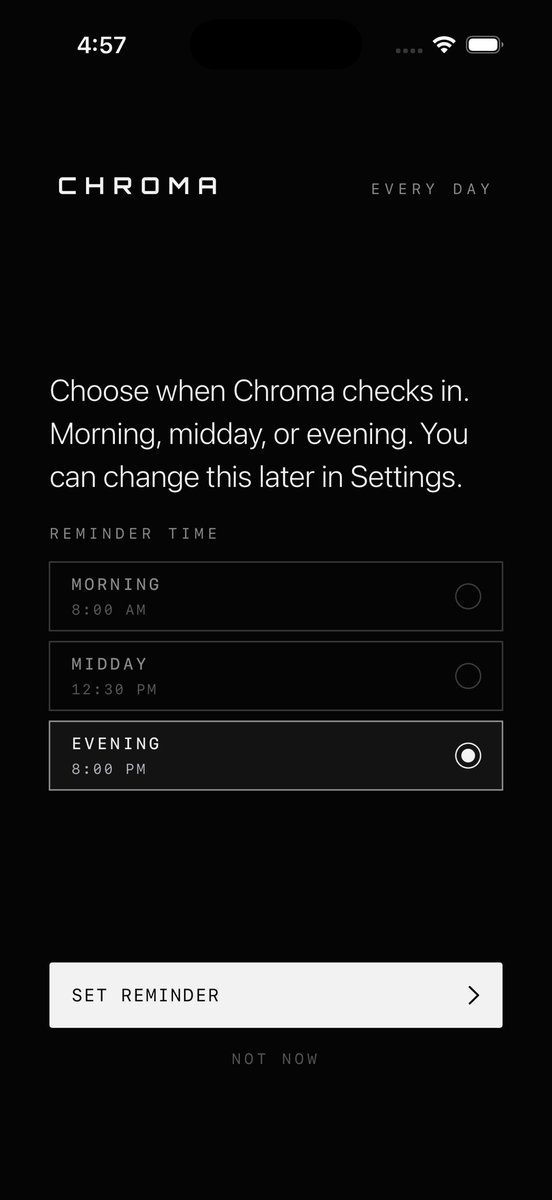
Updated the onboarding:
Reduce what was 20 screens down to 4.
Stronger Splash to identify + solve problem.
Immediately orient user in product flow + reward
NYU Prof. Ruby Thelot on the split he keeps hearing across America: everyone says they hate AI, and everyone says they love chat
"I find that Americans don't like AI. AI is a very broad umbrella here, because they all use chat, and they'll say, I love chat. But they don't like AI. There's a bit of a divergence there. There's the boogeyman of the data center, the boogeyman of, I'm gonna lose my job."
"If you take a look at an Anthropic survey, they surveyed 85,000 people to ask how they were using AI for career advancement or life management. When I talk to mothers in Bryan, Texas, they say, oh yeah, I had a leak in my faucet, I took a photo, and in about an hour or two I was able to fix that thing."
"But to them it's kind of like Google. It's not the thing that replaces their work and puts them on unemployment. So there's a language issue here around what does this technology do for me, versus what is the negative impact that's coming in a somewhat near potential future."
@being_on_line@NYU
We will see the same of the same until we don't see the same we see nothing and then we'll see something, and everything will be nothing while that thing is something.
NYU Prof. Ruby Thelot on why everyone suddenly cares about taste:
"I wrote a book called A Few Essays on Taste, where I make the case that taste is not just aesthetic preference. Taste is a way for people to consume virtuously. The question of taste emerged in the 17th century, at a time where people needed guidance as to how to consume properly."
"In 1688, the Bill of Rights happens in England after the Glorious Revolution, and the nobility's powers are restrained. As they lose political power, they also lose cultural power. At the same time you have the growth of the British colonies, immense amounts of wealth being generated, and suddenly you have this nouvelle bourgeoisie, this new elite. And there's a belief that this emergence of excessive luxury will lead to the decay of society."
"It is in the vacuum, in the reduction of the cultural power of the previous nobility, that the question of taste emerges. What's interesting to me is that we're in a similar position now. We're entering a similar industrial revolution. We're in the midst of immense amounts of wealth being created, and we're asking ourselves, how do we consume virtuously? That is why the question of taste is emerging. It mirrors 17 and 18th century England."
@being_on_line@NYU
Been thinking about how I experience perception, and landed on these layered orders.
If cognition is fundamentally embodied, and embodiment is fundamentally spatial and temporal, then our theories of cognition should probably also have spatial and temporal structure.
Perspective is multidimensional and simultaneously available.
Action is downstream of meaning.
Meaning shapes the trajectory of perception, thus the potential gradient of action.
Interestingly, action informs meaning too.
Chroma Update: people have been asking to fix days they've missed. So here we are, mend allows users to go back to any day in the week and share their emotions for that day.
Chroma aims to establish a ritual, so the mend feature is limited to once a week.