That map comes from a 6 m telescope at 5,200 m in the Atacama with 63,000 superconducting sensors, the largest cryogenic camera built for cosmology. Dust grains line up with the galaxy's magnetic field, so their microwave glow is polarized. Invisible fields become a map.
The Milky Way’s most comprehensive polarized microwave images yet trace magnetic fields between stars, offering a new view of the forces that shape star-forming regions. @arxiv https://t.co/D5Y3FloYtH
The clue came from Venus. Babylonian sky-watchers recorded the planet as oddly hard to see, possibly through volcanic haze. Ice cores match that to Alaska's Aniakchak eruption around 1628 BC. Add single-year radiocarbon in Anatolian timbers, and Babylon falls near 1587 BC.
Babylon’s fall likely dates to around 1587 BC, with ancient tree rings and volcanic traces in ice cores helping distinguish between competing historical timelines. @PNASNews https://t.co/hcuawAYZjC
Source: de la Fuente Marcos & de la Fuente Marcos, Research Notes of the AAS (2025), on 2025 PN7 as Earth's newest quasi-satellite: https://t.co/S3Kpko1xKC
No, Earth didn't get a second moon.
Asteroid 2025 PN7 is a "quasi-moon." It orbits the Sun, not us, on a path so close to Earth's that from here it seems to loop around our planet.
When it dips closer to the Sun it runs a little faster than Earth. When it swings farther out, it lags behind. We keep taking turns passing each other, so it looks like it's circling us.
It's only tens of meters across and around magnitude 26, far too faint to see without a big telescope.
Pan-STARRS spotted it in August 2025, but older images show it has been keeping us company for about six decades. Around 2083 it should slip into a horseshoe orbit and wander off.
Orbit diagram: NASA/JPL
The physical twist: at the two-cell stage, mouse embryo nuclei turn unusually soft as the autophagy factor LC3 strips lamin B1 from the nuclear envelope. Stiffen them again (a titin-based tether roughly doubled stiffness) and key zygotic genes are suppressed.
His life is readable in layers. Tooth dentine tracks diet from about age 7: eelgrass shallows as a boy (flatfish, eel, shellfish), cod and haddock from ~11, then a sharp rise in land protein. Sejerø is 12 km² but only ~5 km from Zealand, where farming had arrived.
A skeleton found in Denmark belonged to a man who witnessed the arrival of farming in the region. "Rødhals Man" lived 6000 years ago and began life eating marine wildlife before switching to farmed food.
Robert Pattinson is the new James Bond. The original James Bond carried binoculars.
James Bond (1900–1989) was a Philadelphia ornithologist who quit a banking job to study Caribbean birds for the Academy of Natural Sciences. His 1936 field guide, Birds of the West Indies, went through 11 editions in his lifetime.
Ian Fleming, a birdwatcher in Jamaica, used it as his birding bible. When he started writing 007 in 1952, he borrowed the author's name.
The real Bond's science outlasted the joke. He described 63 new subspecies, and the line between Tobago and the Lesser Antilles that splits birds of North and South American origin is still called Bond's Line.
Photo: James Bond at the Academy, 1974 (Jerry Freilich, CC BY-SA 3.0)
Scale check: Tianmu-2 has 125 qubits; 98 were woven into two 49-qubit distance-7 surface codes. Above a critical link strength, bigger codes protect better; below it, bigger makes it worse. Balancing bit- and phase-flip errors raised that threshold from 0.122π to 0.175π.
Encoded quantum information was teleported between two 49-qubit groups on one chip, even with a weakened entanglement link. @NaturePhysics https://t.co/5lp6dWQCf2
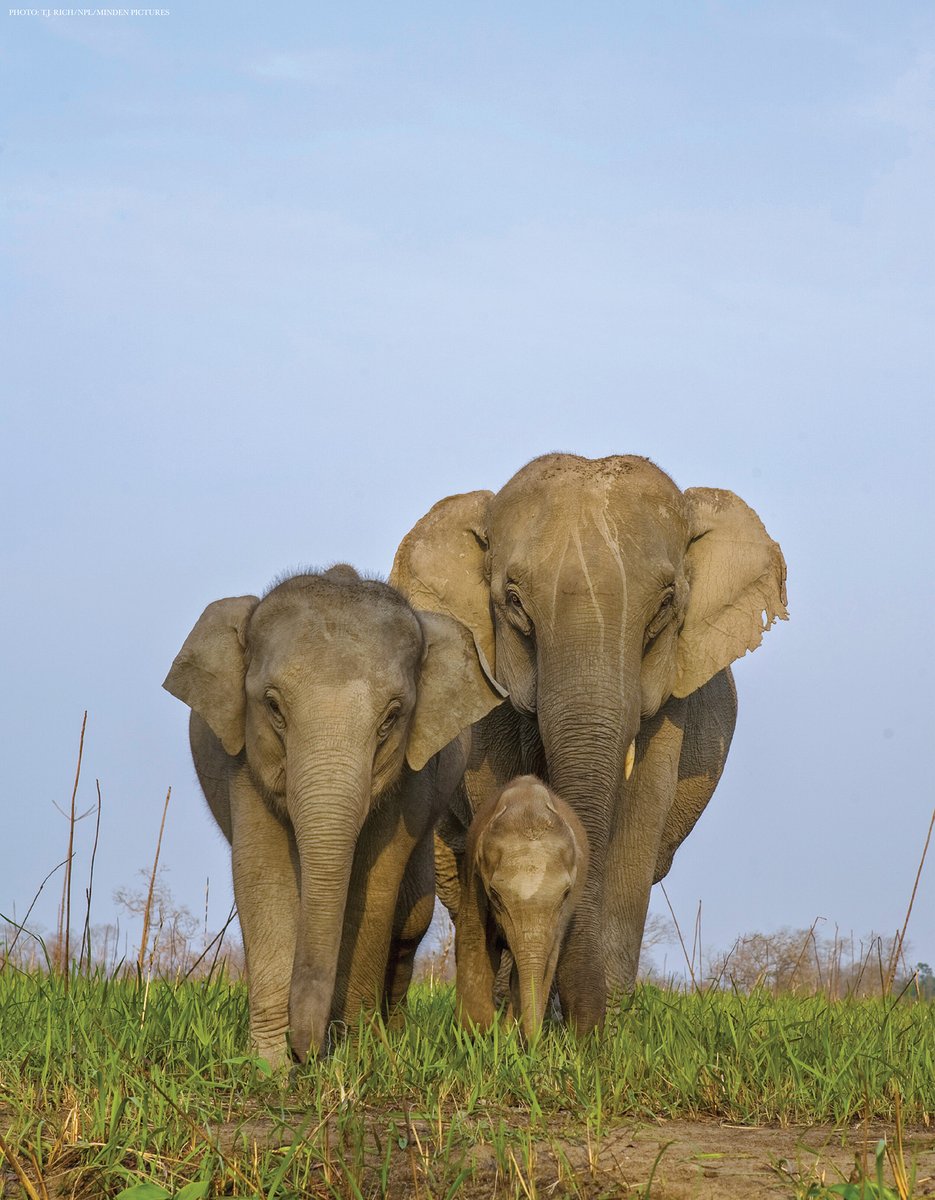
The numbers behind this: 443 wild females tracked in Udawalawe, Sri Lanka, 2007–2018. About 69% of the original females were gone by the end. Groups went from 20 averaging ~14 members to 37 averaging under 4, once losses began outpacing newcomers.
A new Science study of wild Asian elephants reveals that gradual population losses can push animal societies past a social tipping point, fragmenting long-standing relationships, leaving communities smaller and more isolated, and threatening species’ long-term survival.
📄: https://t.co/8J1mgkiWxU
#SciencePerspective: https://t.co/vXwTBOnzvh
Eight years and nine flybys later, BepiColombo stops passing Mercury and starts orbiting it on Saturday. Only Messenger did that before.
Getting into Mercury orbit takes more energy than flying to Pluto.
Then it splits into ESA's MPO and JAXA's Mio. Science starts April 2027.
🛰️👀 Next up – New @BepiColombo milestone!
After 8 years and multiple flybys around #Mercury, the @esa / @JAXA_en mission is finally inserting into Mercury orbit on 21 November.
Stay tuned here for live updates on the day of Mercury orbit insertion!
@esascience@ISAS_JAXA_EN
The mechanism is "breaching": grains spread apart, pore-water pressure drops and briefly suctions the slope stronger, then it fails bit by bit over minutes to hours. Caught at BC's Homathko Delta, sonar sampling every second for 18 days. Fjords bury ~11% of ocean organic carbon.
The first direct observations of natural, entirely underwater landslides captured sediment failing over minutes to hours—not collapsing in an instant. @sciencemagazine https://t.co/3hR7AxpWQV
The universality is the striking part: a 3D potassium BEC under 0.1 mm across, and once particle mass is accounted for, the tangle unravels at about the same rate measured in superfluid helium. Two fluids that are totally different at the atomic level, one decay law.
Quantum vortex tangles have been directly observed unraveling in a 3D ultracold atomic gas for the first time, with denser tangles decaying faster—as predicted by Vinen turbulence. @physrevlett https://t.co/r3nitfQYmI
Photo: Quetzalcoatlus skeleton cast at the Perot Museum, seen from below (Geekgecko, CC BY 4.0, Wikimedia Commons). Sources: Texas Science & Natural History Museum, UT Austin https://t.co/LGnAW5deuk and Field Museum https://t.co/AB7mSfgkmk
"Pterodactyls" over Ciudad Juárez? Whatever that shadow was, a real giant once flew just across the border.
Quetzalcoatlus northropi, known from fossils in Texas's Big Bend, had a wingspan of about 33 feet. Roughly a small plane. It's among the largest animals ever to fly.
That was 67 million years ago. And pterosaurs weren't dinosaurs: they were flying reptiles, gone by 66 million years ago.
Filmed in 2020 at Poland's Hornsund station on Svalbard: the bear chased a bull reindeer into the sea and killed it under 25 m offshore. Svalbard's ~20,000 reindeer evolved with no predators. But one seal's blubber can fuel a bear for 10+ days. Reindeer won't replace sea ice.
It's the first video evidence of polar bears hunting and eating reindeer—something that had long been assumed, but never clearly seen.
Learn more: https://t.co/b5JR8OFUEh #ScienceMagArchives
Earth is ~4.5 billion years old, and rocks older than 3.8 billion are vanishingly rare. These 3.95-billion-year-old gneisses from Hebei, China hold zircons showing their source sat near surface water, then got buried 50+ km deep and partly melted. That's what subduction does.
China’s 3.95-billion-year-old rocks suggest a process like modern plate tectonics may already have been operating in one part of Earth. @nature https://t.co/hGdbg9QH4P
Sources: Smithsonian's National Zoo (lions rest up to 20 hours a day; females are the primary hunters): https://t.co/f8sA9sMYcr
Photo: pride napping in Samburu, Kenya, by Daniel Case, CC BY-SA 4.0 via Wikimedia Commons
The Lions are all over X from Munich today.
Real lions would mostly be asleep. They rest up to 20 hours a day, about 80% of their lives, digesting heavy meat meals.
And when a pride does hunt, it's mostly the lionesses doing the work.
Bell tests rule out local hidden variables only if the measurement settings are independent of the particles' past. Retrocausal models drop that single assumption, letting the later measurement choice constrain the earlier state, so no faster-than-light influence is needed.
Quantum theory assumes that only the present, not the past, has an influence on the future. Now there are hints that could be wrong, and if so some of theory's most bizarre implications could make a lot more sense https://t.co/dSWszGsEdW