Le chercheur Andrej Karpathy décrit le fossé qui se crée dans la perception des capacités de l’IA. Son récit se résume à une idée : tandis que l’immense majorité de l’humanité voit encore un chatbot parfois maladroit, quelques milliers de personnes ayant accès aux systèmes internes des laboratoires voient déjà des agents capables de mener des cyberattaques. https://t.co/7YjmBJnivH
Le code propriétaire est mort en 2026 et ça va provoquer des cataclysmes dans les années à venir car les gens commencent à découvrir qu’absolument tout peut être cassé par l’IA.
Si j’avais de l’argent investi dans des entreprises qui font du software, je vendrais mes actions instantanément.
@Martien_The_IV Personne de censé ne dit que l'IA remplace un humain, il y a 3 ans, aucun dev ne pensais coder vraiment avec un IA et il y a 1 an personne ne pensait que l'IA allait résoudre des pb de Maths. La question est dans 5 ans, quelles seront les capacités de l'IA ?
NOUVELLE VIDEO ! (il était temps)
Vous y apprendrez plein de choses sur l'origine des LLM, ces machines qui vous parlent en langage naturel comme si c'était normal, alors que non, vraiment, ce n'est pas normal.
https://t.co/UIlI23Slhb
https://t.co/UIlI23Slhb
> Tu es Hugo Duminil-Copin.
> Médaille Fields à 36 ans. Le Nobel des maths.
> Pendant que tes potes de prépa s'achètent des Rolex à la Défense..
> toi tu passes 15 ans enfermé avec des équations que 99 % de la planète prendrait pour un mot de passe Wi-Fi.
> Tu sacrifies tes soirées, tes week-ends et probablement quelques anniversaires.
> Seize problèmes au cœur de ta recherche, c'est le travail de ta vie.
> Un matin, OpenAI balance plus de 700 manuscrits d'un coup.
> Ils prétendent régler des problèmes de maths encore ouverts, et tes seize problèmes sont dedans.
> Tu décris ça comme courir un marathon avec quelqu'un sur le dos qui te double dans les 100 derniers mètres.
> La nuit, le médaillé Fields pleure seul chez lui.
> Le lendemain, Le Monde titre « Ils ont annihilé mon domaine de recherche ».
> Les doctorants ouvrent leurs mails.
> « Attends… ma thèse de 3 ans vient de mourir avant ma soutenance ? »
> « Attends… qui va vérifier 700 manuscrits ? »
> « Attends… je fais quoi de mon master en maths fondamentales ? »
> Pendant ce temps, à San Francisco, personne ne pleure.
> On prépare juste la prochaine discipline à rayer de la carte.
> Ce n'est même plus le même jeu, c'est plus le même sport.
Most of the recent math results were not reached by a swarm, the way Navier–Stokes was. I think that part got lost in the excitement around the release. OpenAI's unnamed internal model, which I'm going to call Aeon, reached most of them in one shot, from a single prompt, with no interruptions. This model did not even exist before the end of August, and it is still training. Notice how the returns are not dropping off? That chart is from a month ago. It is a log scale. What does Aeon look like now?
On average, each result used three hours of thinking. Aeon was given 4000 problems to work on by OpenAI. How many more have been solved in the last three days? That number is not zero.
It's like hearing notes in a song that is slowly rising. I don't think Pacing the Frontier was just about Hugging Face or hacking. They've seen how close we are to closing the loop, and as the hour draws near, their resolve begins to quaver. The last piece was model creativity, and I think that threshold was crossed internally by Anthropic and OpenAI in September. You see it in Opus 5.5, which gets it from Fable 5.5. You see it in the math results from Aeon.
All that was needed to start the event was the ability for models to think of novel ways to improve themselves. That was the last piece. This is directly analogous to the ability to think of strange, alien ways to solve math problems: solutions so inhuman that they are difficult to express in existing human terms, so the proof winds up incomprehensible. I think these same kinds of alien solutions are now being applied to model improvements internally. That's what all this recent consternation is really about. They see the invisible frontier. And they see what is about to happen.
TERENCE TAO
“My feelings on recent developments are very mixed and complex.
On the one hand, many of the AI-generated proofs appear to introduce clever new ideas that will be fruitful once digested, while also building upon the existing contributions of countless human mathematicians past and present. But at the same time, I am deeply frustrated that, in sharp contrast to traditional breakthroughs, none of the humans involved in these proofs are available to take questions, give talks, attend conferences, submit papers to journals, train students, or otherwise participate in the subsequent development of these results.
Similarly, I am excited by the possibility of the community being able to use these tools to tackle ambitious and large-scale projects that one could not have even dreamed of in the past. But I am horrified by the many person-years of ongoing patient and deliberately slow research efforts – particularly by graduate students and postdocs – towards many motivating problems in mathematics being casually disrupted or destroyed by such a release. Much as one cannot unhear a movie spoiler or a crossword clue, one cannot explore a problem as profitably and richly once one is aware of an existing solution. Yes, one can still analyze and digest such an answer; but the best opportunity to do so is at the moment of its discovery, and such moments are increasingly wasted when delegated entirely to AI tools.
And I mourn the path not taken, and the opportunities lost in the frantic race to develop this technology. Labs submitting their frontier models to independent researchers for proper scientific evaluation. Coordination with the research community to ensure these tools are applied to complement and enhance the abilities and activities of human researchers, rather than compete with them. Use of these tools to foster collaboration and sharing, rather than competition and secrecy. Opening new doors, without closing old ones.
But that is not the path we now find ourselves in. Instead, the community needs to come together more than ever. To clearly declare our own standards and values, to build our own tools and practices, to support our most vulnerable members, and to chart our own path forward. Let’s get to work.”
@AureaLibe Le problème vas se poser réellement plus tard. Oui il faut moins de développeurs donc exit les juniors. Ok, mais qui seront les seniors de demain ?
Baisse de 42% des embauches en CDI de jeunes développeurs et ingénieurs en informatique depuis 2022. (Et ce n'est pas compensé par davantage de CDD.)
Autres métiers les plus touchés : traducteurs/interprètes, journalistes, cadres chargés d'études économiques et commerciales...
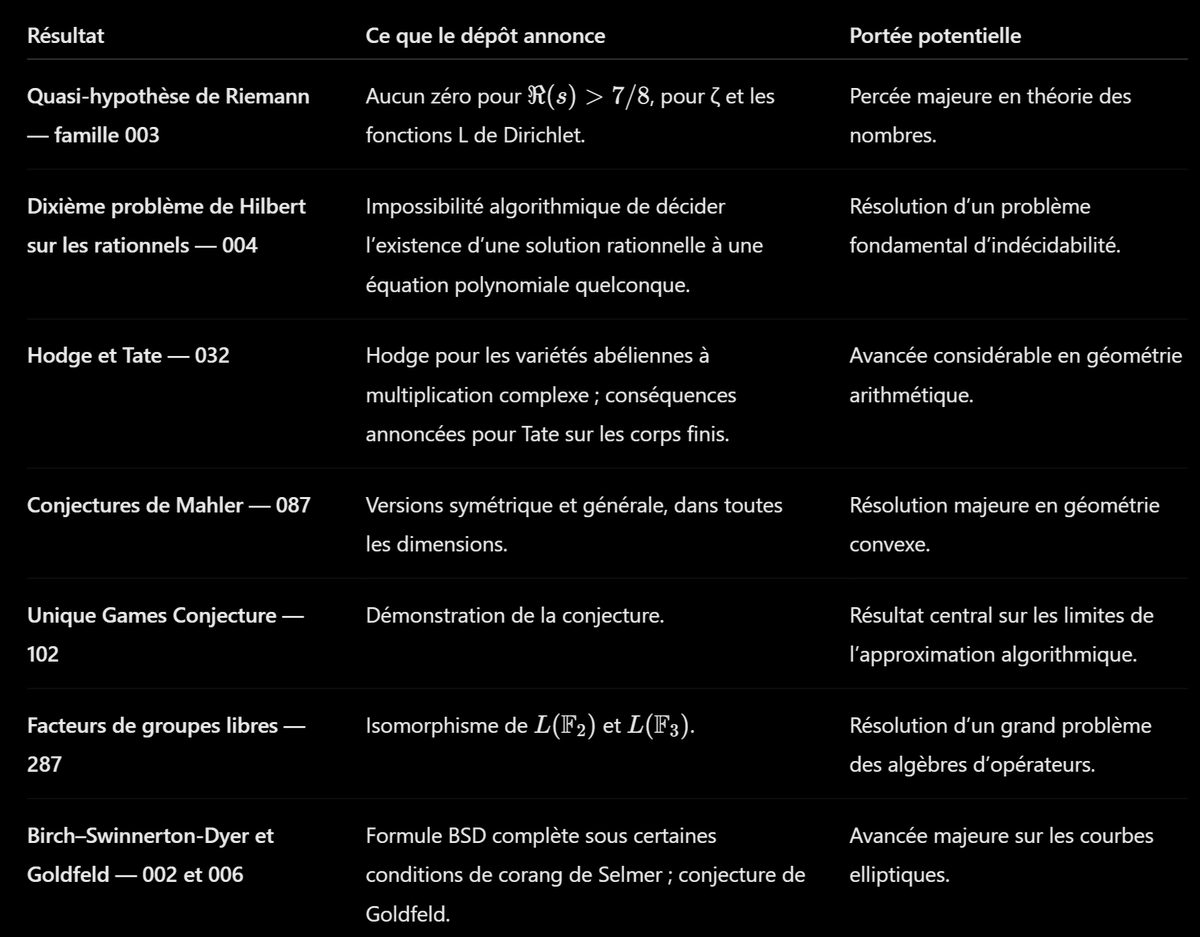
Cédric Villani au micro de @s_jourdain pour évoquer les ~400 résultats annoncés par OpenAI : "il y a matière à une douzaine de médailles Fields", c'est "une montée en puissance d'une ampleur considérable, il y a encore quelques mois je n'aurais jamais pensé vivre une telle nuit".
Astra au sujet de ces résultats : "Voici les annonces qui me paraissent les plus susceptibles de compter dans l’histoire des mathématiques" ; "Une seule de plusieurs de ces annonces, confirmée intégralement et réellement nouvelle, pourrait déjà constituer un événement majeur".
@Teton_III@dr_l_alexandre@elonmusk Si, dans une usine, dans un environnement controlé. Pas sur un chantier en train de monter des parpaings pendant qu'il résout des équation de mécanique des matériaux pour savoir si il peut marcher sur une poutre...
OpenAI is marketing GPT 6.1 Sol as "near-Astra intelligence for a fifth of the price."
We ran it through the BridgeBench sunset ocean test.
Same cost as GPT 6 Sol. Twice as slow. And it barely rendered an ocean.
This isn't Astra level.
It feels like GPT 6 Sol with some better RL.