🚨 I think $RAY @Raydium has serious potential over the coming years 🚨
Imagine billions, eventually trillions, in Wall Street volume moving through decentralized markets
I broke down my thesis, entry levels + long-term price projections for subscribers
Who’s holding $RAY? 👇
If you are holding $XLM, read this.
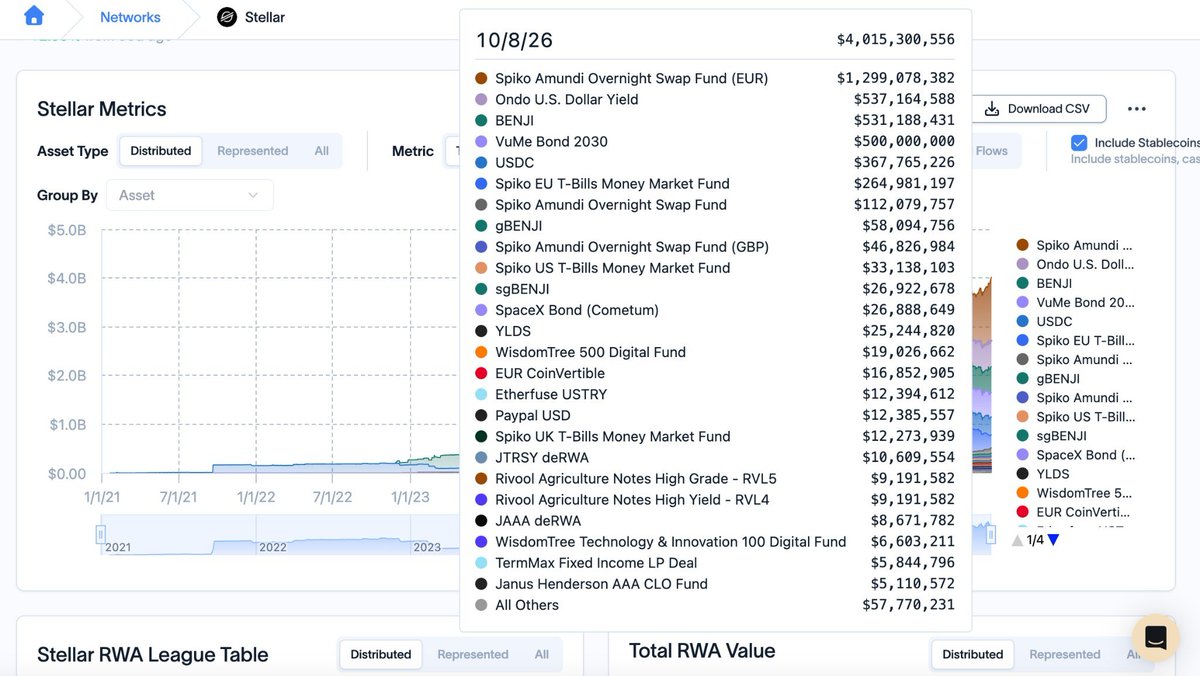
Exactly one year ago, total RWA value on Stellar was only $895M.
Now it has broken $4B.
That’s a 4.4x jump in one year.
We could be looking at tens of billions in RWAs next.
I think $XLM is going to be explosive.
Are you still bearish
🚨🚨🚨Are you telling me you are still bearish on $XLM after seeing who and what is being tokenized on stellar? 👇
WAKE TF UP!
The latest Stellar snapshot is showing roughly $3.6 billion across distributed assets, represented assets and stablecoins.
But the total is only half the story.
This is not mainly digital dollars moving around a payment chain.
Around $2.22 billion is tied to US government debt, international government debt and corporate credit. That is nearly 62% of the visible market.
Stablecoins account for only around 12%.
Stellar is becoming a home for the assets traditional finance understands best: Treasury products, sovereign debt, business credit and managed investment strategies.
Now look at the names attached to that value:
Spiko: $1.30B
Franklin Templeton: $564M
Ondo: $533M
Realiz: $500M
Circle: $362M
Those five platforms represent roughly 91% of the visible value.
This is serious capital concentrating around several large financial products, not thousands of meaningless tokens inflating the numbers.
Franklin Templeton’s BENJI was the first US-registered mutual fund to use a public blockchain as its official system of record.
Ondo brought its Treasury-backed USDY product to Stellar.
WisdomTree also offers regulated digital funds with ownership records maintained onchain.
And $XLM is the native asset beneath this network.
It pays transaction fees, funds smart-contract rent and covers the reserves required for accounts and ledger entries.
People are still judging Stellar by an old “payments coin” label.
The data is showing government debt, corporate credit and institutional funds settling on its infrastructure.
I am not waiting for the tokenisation story to arrive.
It is already sitting on Stellar in billions of dollars.
DTCC is coming to Stellar.
More will follow.
Strap in!
I keep wondering what Ripple’s next big acquisition will be to expand $XRP and the XRP Ledger.
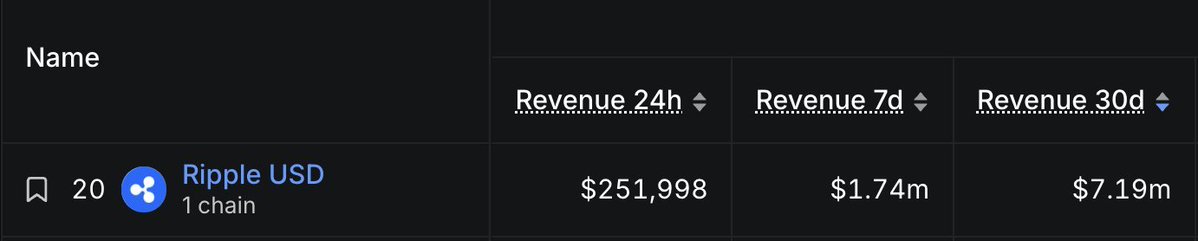
Ripple USD $RLUSD just generated over $7M in 30D revenue.
Ripple already made a major move with Hidden Road.
With more revenue coming in, what do you think they buy next?
ALERT‼️ Ledger is investigating reported fund losses involving devices sold by CryptoBillis in Southeast Asia.
Buyers from the last 90 days are being warned not to set up unused devices.
If already set up, Ledger suggests a new signer + seed.
Anyone here affected by this?
🚨🚨🚨Do you know how big $XRP and $QNT are becoming?
Watch this HSBC interview from FinTech Futures.
HSBC’s Global Head of Digital Currencies, Lewis Sun, is describing something much bigger than another bank experimenting with blockchain.
He is talking about banks creating their own tokenized deposits, then realizing those systems have to work with other banks, other forms of digital money, and tokenized assets.
That is the part I keep coming back to.
HSBC is basically saying the future cannot be a bunch of isolated bank blockchains.
The money has to move between them.
The assets have to settle against that money.
And customers should not need to understand any of the technology underneath.
Now look at $QNT.
UK Finance already selected Quant for the Great British Tokenised Deposit initiative involving HSBC, Barclays, Lloyds Banking Group, NatWest, Nationwide and Santander.
Then in September 2026, The Clearing House selected Quant to power its U.S. On-Chain Money Initiative.
Quant is providing interoperability, transaction orchestration, clearing and settlement coordination, plus connectivity into RTP and CHIPS.
And HSBC publicly supported that initiative alongside JPMorgan, Bank of America, Citi, BNY, Wells Fargo, Santander, TD Bank, U.S. Bank, PNC and BMO.
That is why I take this interview seriously.
HSBC is describing the exact problem Quant is already being selected to help solve.
Different banks.
Different systems.
Different payment rails.
Different ledgers.
Someone has to connect them.
Then there is $XRP.
HSBC specifically talked about delivery-versus-payment, where digital money and tokenized assets settle together.
Ripple has already been building XRPL around institutional settlement, including Batch Transactions, Token Escrow, Multi-Purpose Tokens, credentials and permissioning.
Ripple also positioned RLUSD as digital cash for DvP settlement on XRPL.
So my long-term read is very simple.
$QNT has a strong opportunity around connecting and orchestrating financial systems.
$XRP has a strong opportunity around settlement, liquidity and moving value between those connected systems.
I do not see these two theses fighting each other.
I can see them serving different jobs inside the same financial architecture.
And the more banks tokenize deposits, bonds, funds and payments, the more valuable those jobs can become.
This is exactly why I keep studying both.
Good morning ☀️
If you're still holding $XRP after everything we've been through, you deserve something BIG.
The waiting, the frustration, the days you almost had enough.
I hope every single one of you gets the payoff you've been waiting for.
NEW🚨🚨🚨 Securitize is bringing tokenized Apple, Microsoft, Nvidia and Tesla shares onchain via Solana.
Jump Trading is providing market making, and Ripple Prime plans to support the launch.
What happens when Ripple Prime plugs deeper into tokenized stocks?
$SOL $XRP
🚨🚨🚨Anyone holding $PYTH here?
$PYTH is still sitting under a $1B market cap while the fundamentals keep stacking
This one has my attention long term
Full deep dive + long-term price projections are already on the subscribers feed
More alpha and updates incoming
LOCKED IN!
I told you about $ZEC before its biggest rally into the thousands.
I told you about $QNT near the bottom.
I told you about $NMR before it exploded.
And there were plenty more.
Today, I just published a new deep dive on another under-the-radar utility coin.
I told you about $ZEC before its biggest rally into the thousands.
I told you about $QNT near the bottom.
I told you about $NMR before it exploded.
And there were plenty more.
Today, I just published a new deep dive on another under-the-radar utility coin.
The catalyst I’m waiting for with $XRP is the day institutions can finally say it out loud: we’re using XRP.
A lot of people still talk like XRP is the one waiting for clarity.
I don’t see it that way anymore.
XRP already went through the federal court battle.
Ripple and the SEC ended their cross-appeals in 2025, leaving the final judgment in place.
Now listen to what French Hill is saying.
He’s basically arguing that SEC and CFTC relief is useful, but institutions need something stronger than today’s regulator giving permission.
They need Congress to write rules that can survive for years.
That matters because a bank spending tens or hundreds of millions on custody, trading, payments, lending or tokenization doesn’t only care about what the SEC says today.
They care about whether the legal framework will still make sense five or ten years from now.
And $XRP may be walking into that environment with advantages most assets never built.
The current Senate CLARITY framework contains language around prior non-appealable court judgments.
XRP already has that legal history.
It also had a U.S.-listed spot ETP before January 1, 2026 through Bitwise, another area the current framework addresses.
So my read is simple:
XRP itself has already done years of legal work.
The next layer is giving institutions the permanent framework they need before they commit much larger resources.
And Ripple is already sitting there with infrastructure for payments, custody, treasury, prime brokerage, RLUSD and XRPL.
Hill also points toward banks being able to use digital assets and blockchain for payments, lending, custody and trading.
Those are almost the exact areas Ripple has been building around.
So when people ask me what the next bullish catalyst could be, I’m not only thinking about another ETF headline or another exchange listing.
I’m thinking about the moment large institutions no longer have to speak carefully around crypto because Congress finally gives them rules they can build around.
That is when I think the language changes.
From studying XRP.
To actually saying they are using XRP and XRPL inside real financial products and infrastructure.
French Hill’s Fox interview made that possibility feel much closer to me.
HODL!
Everyone is panicking again. I'M NOT
$XRP and $XLM look more bullish to me the deeper I look.
Watch what Bitwise CEO Hunter Horsley is saying.
Horsley believes equities and capital markets moving onchain could become one of crypto’s most important developments over the next 2–3 years.
I’ve been looking at what is already happening around XRP Ledger and Stellar, and this is exactly the kind of future both networks are already preparing for.
Start with $XLM.
DTCC and the Stellar Development Foundation already announced that DTC’s Tokenization Service is expected to connect to Stellar in H1 2027.
And look at the assets being evaluated:
Russell 1000 companies.
Major-index ETFs.
U.S. Treasury bills, bonds and notes.
DTC already custodies more than $114 trillion in assets.
Think about the scale of infrastructure we’re talking about here.
Stellar also already has Franklin Templeton’s BENJI, with roughly $605M on Stellar as of October 6.
Franklin Templeton has been using Stellar since 2021 as the official blockchain record for its registered fund shares.
Then you have WisdomTree, Spiko and Amundi, Figure, Ondo Finance and Tradable adding more regulated financial assets around the network.
Stellar reported roughly $4B in tokenized real-world assets, 67 tokenized products and 10 regulated issuers as of September 1.
Now imagine that infrastructure expanding from funds and Treasuries into actual equities and ETFs.
Every new asset can mean more accounts, more transfers, more settlement, more smart-contract activity and more network usage.
And XLM is built into that operating model through fees, reserves and asset relationships.
Now look at $XRP.
Nine days before this Bitwise interview, CSD BR and Ripple announced live financial-market infrastructure running through XRPL.
CSD BR has more than BRL 22 trillion in registered assets.
The first production use case involves BTG Pactual investment-fund shares using XRPL’s Multi-Purpose Token standard, with future phases contemplating native issuance and trading between authorized participants.
That already sounds a lot like the capital-market migration Horsley is describing.
XRPL’s MPT standard even includes equity as an asset classification and supports institutional controls such as authorization, freezing, clawback, transfer restrictions and onchain metadata.
Aviva Investors is exploring traditional fund structures on XRPL.
Ondo Finance already brought OUSG onto XRPL with 24/7 minting and redemption through RLUSD, and the underlying exposure includes BlackRock’s BUIDL infrastructure.
Ripple Prime has also moved into U.S.-listed equities, equity indexes and digital assets through its Delta One business.
Then Bitwise itself makes this even more interesting.
Bitwise already launched a spot XRP ETF that directly holds XRP.
Hunter Horsley previously talked about XRP’s potential around payments, tokenization and moving assets worldwide.
Now he is saying on CNBC that capital markets moving onchain could become one of the biggest crypto developments of the next few years.
I don’t think those two views are disconnected at all.
And Bitwise already added XLM to its institutional indexes too.
The market can panic over short-term price.
I’m looking at DTCC, Franklin Templeton, CSD BR, BTG Pactual, Aviva Investors, Ondo, BlackRock, Ripple Prime and Bitwise.
Those are the things shaping my long-term view.
If the next crypto cycle starts rewarding actual financial utility, I think $XRP and $XLM are going to get looked at very differently.
BOOOM! 🚨🚨🚨 How is anyone bearish on $XRP right now?
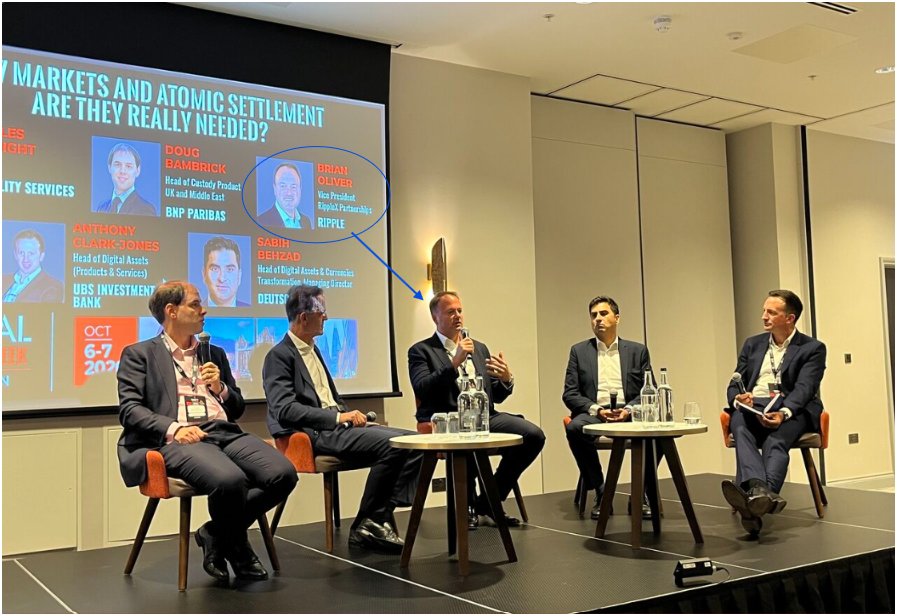
Ripple’s Brian Oliver says 24/7 markets will need risk, margining and collateral infrastructure running 24/7 too.
Ripple is now being invited to discuss that infrastructure directly with traditional finance.
Ripple’s Brian Oliver was on the panel at Digital Assets Week discussing 24/7 markets and atomic settlement.
One point that stood out: markets going 24/7 isn’t just about keeping them open the risk management, margining and collateral infrastructure has to run 24/7 too.
That’s where @Ripple is already building. $XRP
Good morning 🌅
I checked my $XRP portfolio this morning.
Down again. Did I panic? Nope.
I knew this market would test me when I got into crypto.
Nothing about that has changed.
I'm still holding what I believe in. You?
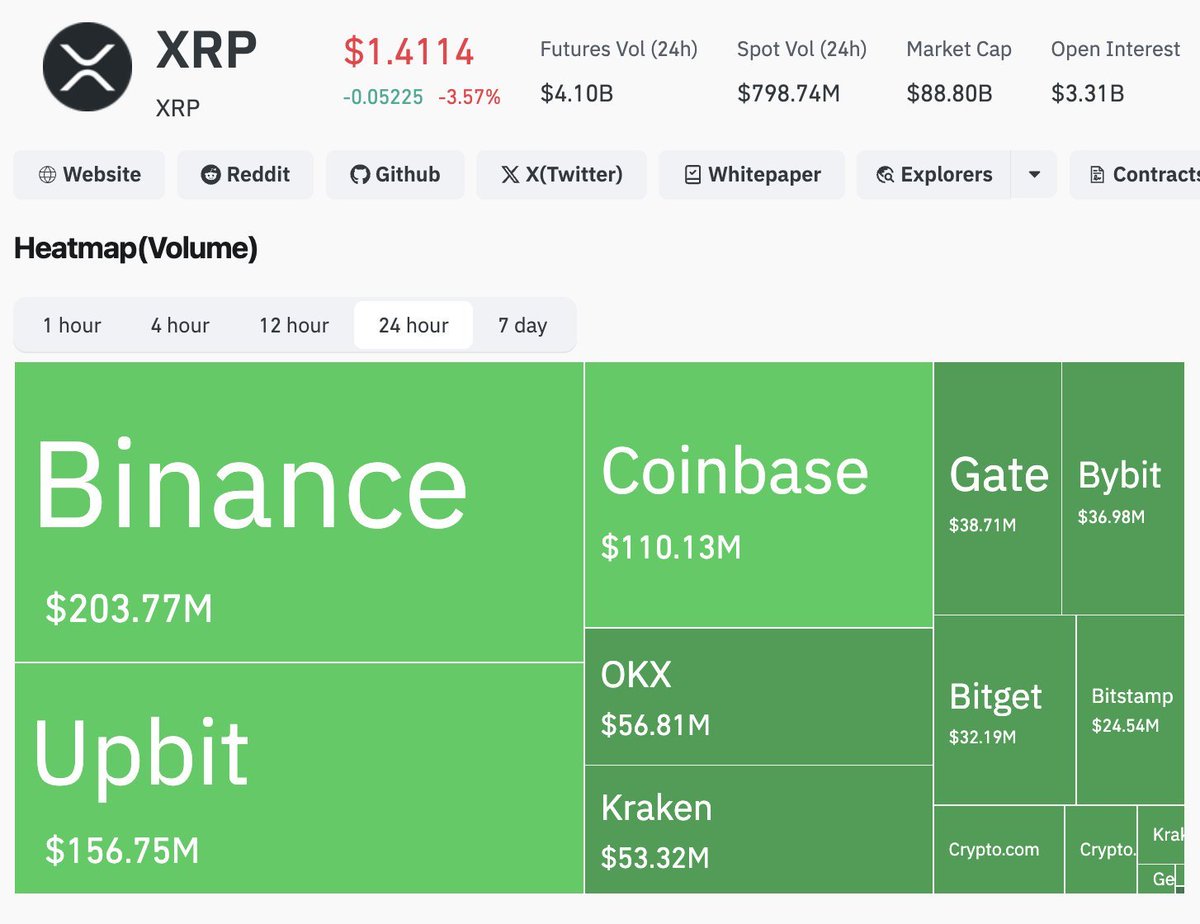
BREAKING🚨🚨🚨 $XRP did nearly $800M in spot volume over the last 24 hours.
Binance led with $203.77M, followed by Upbit at $156.75M and Coinbase at $110.13M.
And this is happening while price is down.
What are traders positioning for? 👀
🚨 Receipts are starting to stack up. 🚨
Subscribers already caught big moves on $NMR, $ZEC, $NEAR, $ONDO, $QNT, $MET and more.
Huge shoutout to @Cryptonic_1200 for sticking with the research.
I’m not slowing down either.
More utility altcoin deep dives incoming.
LOCKED IN!
JUST IN 🚨 WSJ says Ripple is becoming a serious competitor to Wall Street banks.
This is way bigger than another crypto headline.
Ripple is moving deeper into the financial system.
Are people still underestimating Ripple and $XRP?
What if this is the next one to move like $QNT and $ZEC did? 🚨🤯
The chart is sitting in a multi-year deviation at the exact moment the project is putting $52M into rebuilding its next phase.
I spent hours deep-diving the fundamentals, tokenomics, institutional connections