Don't compare your journey with someone who started with privilege.
Some had educated families, better schools, and opportunities. Others started with government schools, regional languages, and limited resources.
Measure your growth by how far you've come.
#RandomThoughts
It only takes one bold move to completely change the trajectory of your life. Move somewhere new. Start before you feel ready. Do the thing that scares you. The future you’re waiting for costs the present you’re clinging onto.
A PhD scholar leaving in the 5/6th year is often labeled "incapable." But has any1 considered that the pblm might smtimes be poor guidance, mentoring, or system itself?
Walking away after years of effort isn't easy. We just tend to question those with less power.
#PhD#Academia
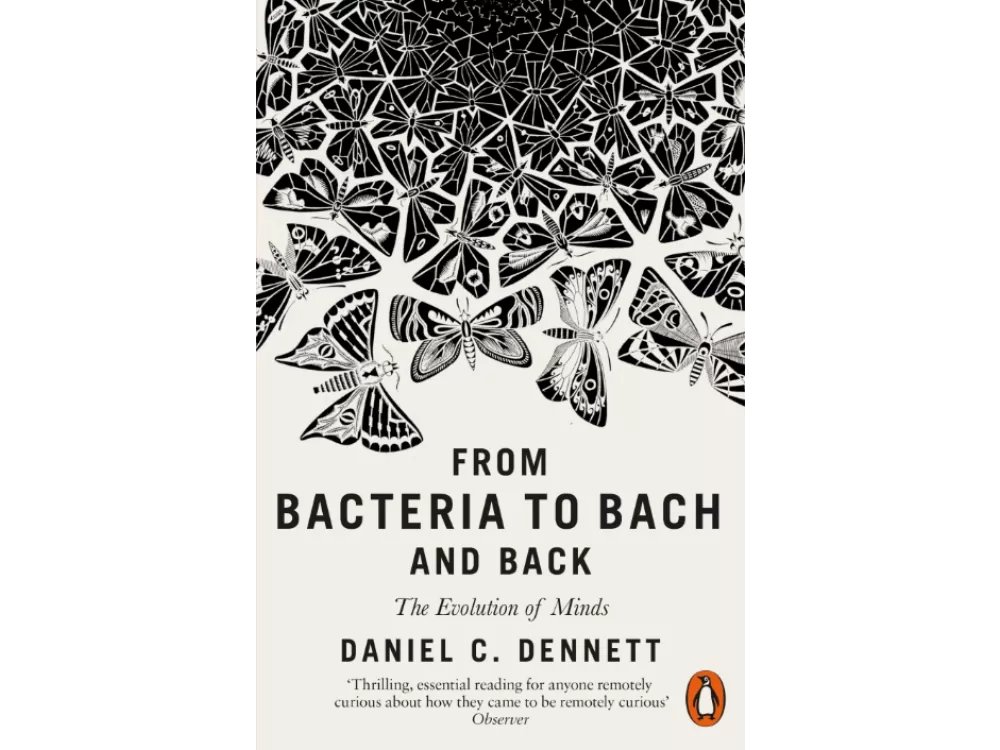
Daniel Dennett, who recently passed away, is an inspiration for people like me who love grand ideas that connect many different fields at a deep level (and be rigorous about that; well as rigorous as grand theories can be). His thinking is difficult to categorize: part philosopher, part scientist, he had many good ideas on topics ranging from evolution to consciousness to God.
The #book From Bacteria To Bach And Back had been lying on my shelf for many years and I recently picked it up because I’ve been thinking a lot about evolutionary constraints on brain and consciousness.
The book is hard to summarize because it spans so many topics, but perhaps the central idea is this: competence without comprehension is not only possible, but is the norm; but when comprehension slowly develops, it leads to an explosion of artifacts and culture that we see around us. Dennett argues that there’s a difference between performing a behavior and having a (manipulable) representation in the mind of that behavior such that you can “think” and “reflect” on that behavior to fix a particular context or to make it better.
For example, a bird making an intricate nest displays a startling case of competence but is debatable whether she understands what it’s doing. The bird nest works well because it is an adaptation to the environment the bird finds itself in, so there’s a rationale behind design of the bird nest but nobody designed it. This is what Dennet calls as a design without a designer where rationale for the designed objects are free-floating. So reasons exists but not in someone’s minds.
Humans, on the other hand, seem to understand what they’re doing as they can flexibly change their behavior depending on context. Our entire society and technology is a proof of us transcending beyond our evolved instincts.
How did that happen?
Dennett argues that this transition was gradual and links it to languages (and memes, in general). Our ancestors, like birds, would have instincts for performing various behaviours without understanding them. Imagine if one such biased behavior is copying the elders or copying the most successful. This kind of copying behavior could initially bootstrap rudimentary form of language as a group settles on some sort of shared signals. It also bootstraps knowledge-sharing (aka culture) as copying allows spread of successful discoveries much faster than what genetic reproduction cycles would allow.
Once rudimentary culture and language is in place, the benefits of having these capacities would allow for co-evolutionary process where the brain and biology of humans could change in order to absorb language and culture faster. However, this is still competence without comprehension. One can imagine sophisticated behavior in a primitive group of homnids but nobody knowing what they’re doing. Even proto-language (like most animal calls) could have been “mindless” in the sense of it eliciting the right behavioral responses, but individuals not comprehending what they’re doing.
So how did competence then led to comprehension? The road to comprehension wasn’t a step change, though. There’s a continuum of instinct to flexible behavior (which is a hallmark of comprehension). You could have behaviors that work well but you only sort-of understand why (for example, the impulse to do art or driving a car well).
Dennett suggests that gradually comprehension could have become better and better due to the need to justify our actions to others (or deceive others) in a social settings. Once a shared proto-language has taken hold in a group, everyone has an incentive to take advantage over others by giving false information. This creates a pressure to justify and convince through giving reasons and that required having a representation of reasons in the mind. Such representations of “why am I doing this” were glimmers of comprehension which became stronger thanks to the arms-race between deceivers and questioners.
This dynamic also explains where a sense of self comes from. In order to decieve others, you need to model others and their behavior in the situation at hand. And that model includes how you yourself will behave in response to their responses. As you can see here, self emerges within the theory of mind because social dynamics require identification of distinct selves including oneself. (This does make me wonder if solitary animals have an explicit sense of self that they feel as strongly as we feel.)
The last part of the book is about consciousness. Dennett is an illusionist, which means he believes that there’s no hard problem of consciousness to be solved. He says that our experienced reality is like a user-interface constructed by evolution on top of the raw reality. The user interface exists because it is beneficial to the organism’s survival but we must not mistake it for “truth”, which only a scientific investigation can reveal (and not introspection).
Over time, I’ve grown sympathetic to the illusionist position but haven’t yet come around to embracing it fully. My current feeling is that the hard problem will not be solved but will gradually dissolve as neuroscience progresses (just like the problem of “what is life” got dissolved as we made advances in biology).
There’s definitely an air of mystery around consciousness, but is it because evolution hides complexity of brain processes that compose it from us (which science will eventually reveal) or is it because consciousness is in some way fundamental in the universe?
Dennet argues it is the former and he calls this as the Cartesian Gravity. Our inner experience is so vivid that we mistake it for truth but we find it mysterious because evolution had no incentive to represent how it’s built. The more we probe internally, the more we find it as a given, which seems unexplainable and baffling. This also prevents us from being scientifically objective about consciousness as we keep gravitating to first-person experience (which could have holes that we’d never see unless we study it from a third person point of view). This is why Dennet advances his approach of studying consciousness, heterophenomenology, which treats first-person reports of consciousness as a third-person scientific object of analysis.
Nice one, Sir. I went through all your nonlinear dynamics lectures during the early years of my PhD and also read your book. A big fan of your teaching🙇♀️. Thank you for making such beautiful and complex ideas so accessible sir @stevenstrogatz
If you like thinking about what math can do for biology and vice versa, you might like this public talk I gave a year ago. It contains a lot of stories from my own life. "From Math to Bio and Back: Reflections on a Two Way Street" https://t.co/TzKE3jnK29
"Come tomorrow."
Tomorrow never comes.
"Come on Monday."
Monday arrives.
"Come on Friday."
Friday arrives.
The meeting never does.
#PhD#Academia#ResearchLife
Walking is an underrated form of therapy. You get sun on your skin. You activate your frontal lobe responsible for processing emotions. You release endorphins and relieve stress. Take a 20 minute walk outside and I guarantee you'll see the world different.
📢 Applications Open for CSIR-NIScPR Internship Programme
Gain hands-on experience in science communication, science policy research and knowledge dissemination at the interface of science, society and governance.
Open to UG, PG and PhD students from diverse academic backgrounds.
Potential areas of Internship:
Science Policy Research, Science Communication, Research Documentation & Knowledge Management, Library & Information Science Management, IT, data science, data analytics and AI-enabled knowledge systems
Apply now : https://t.co/2kX2CCMmrh,
@DrJitendraSingh@CSIR_IND@GVRayasam@DBTIndia@IndiaDST@moesgoi@ugc_india@ncert@AICTE_INDIA@Delhiuniversit
#CSIRNIScPR #InternshipOpportunity #ScienceCommunication #PolicyResearch #ScienceWriting
Just got to know a popular social media personality Sayoni Chakraborty also took her life yesterday. The mental health crisis in this country is just taking off and things will get progressively worse if we don’t act upon it.
Translating a very useful post by Dr Indranil Saha in English so that it reaches out to more and more people. Please read and share.
"Talk to me," "You could have told me," "Why did you do this?"—it's all pure hypocrisy.
Every time someone takes their own life because of depression, we see the same posts on social media: "Why didn't you call me?" or "You could have talked to us." But what actually happens in real life?
A person who is truly suffering from depression is simply not in the state of mind to talk. They don’t even have the energy to leave their room or sit at the dining table with their family. They might just hug a pillow and stare blankly at the ceiling fan, or stand on a balcony looking down at how far the drop is. And during those very moments, you can barely find anyone around to help them.
Instead, people say things like, "He's acting so weird lately," "Don't invite him, he'll ruin the mood," or "He's gone crazy." They just brush it off with, "Chill bro, we all have problems!"
Then there is the sheer ignorance about depression. People say, "What's a doctor going to do? If you start taking those pills, you'll be stuck taking them for life," or "I feel fine today, why should I take medicine?" We treat depression like a dirty secret. We have no problem taking pills for blood pressure or sugar, but medicine for our minds? Absolutely not.
When arranging marriages, families hide it if the guy or girl takes psychiatric medicine. They are terrified the family will be labeled as having "bad blood" or being "crazy," which would ruin the chances of the other brothers and sisters getting married.
If teenagers tell their parents they feel sad or feel like crying, they are immediately told, "You're overreacting." Parents will say, "We went through hard times too, but we handled it. Just be strong." They don't even try to understand that times have changed, and the world is different now.
Corporate offices will host seminars and lectures on mental health, but then force everyone to keep working in a completely toxic environment. To them, showing any mental weakness just means you are "unfit for work."
So, instead of putting on a fake show of grief after every tragic death, let's learn to accept reality. Let's look at the people around us with a little empathy and stop bullying them. Let's break the taboos around mental health and actually see a doctor when it's time.
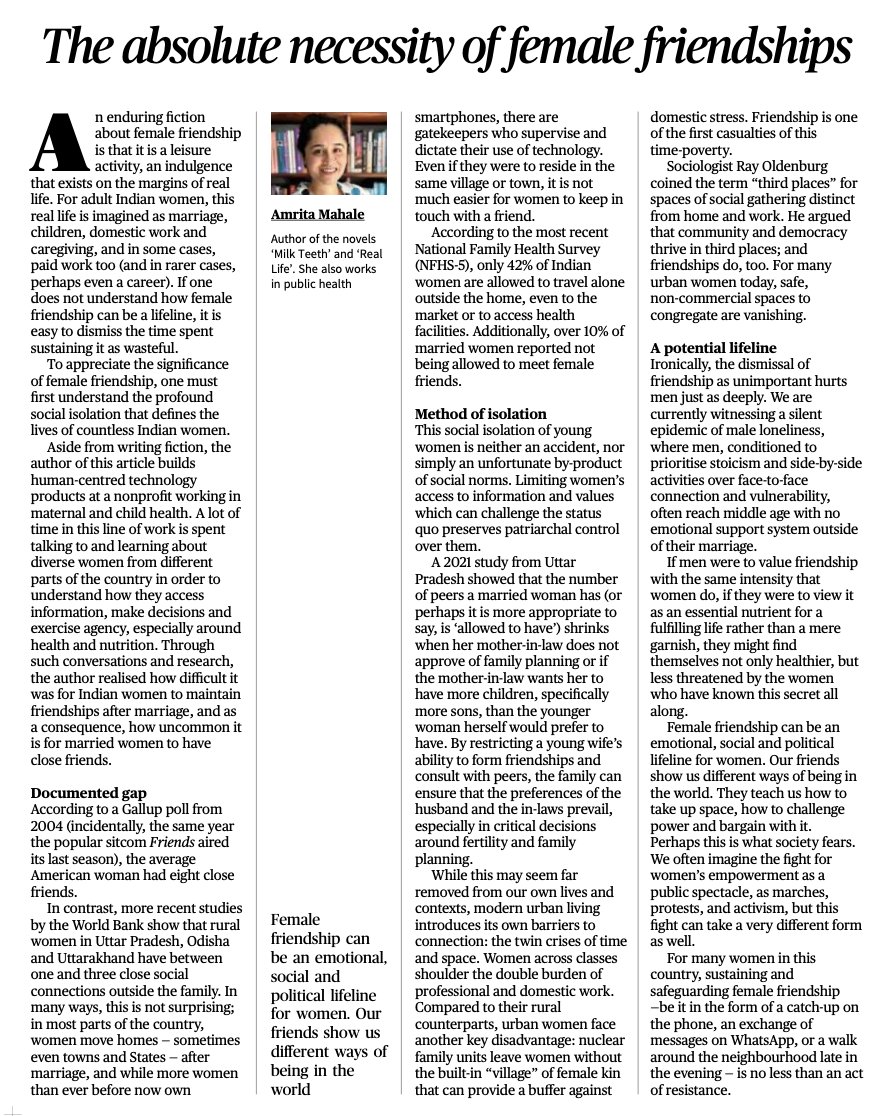
Female friendship can be an emotional, social and political lifeline for women. Our friends show us different ways of being in the world. They teach us how to take up space, how to challenge power and bargain with it.
My op-ed in the Hindu:
https://t.co/Ldw2fx9LdR
Books and music 🎶📚 are the biggest companions in my life. After spending long hours in the lab 🧪, listening to a song always rejuvenates me ✨, and reading books/novels while sipping tea ☕ feels like life itself. ❤️
#PhDLife#BooksAndMusic
No one really tells you this when you get older, but everyone is just figuring it out as they go. The people you look up to, your teachers, your parents, your heroes, they're all just winging it. Remember, this is their first time living life too. The next time you feel scared or uncertain about doing something new, whether it's starting a business or running a marathon or writing a book or even walking up to a stranger in that coffee shop, realize this: starting imperfectly will beat perfect inaction every single time. As the saying goes, you can't steer a parked car. Get after it!