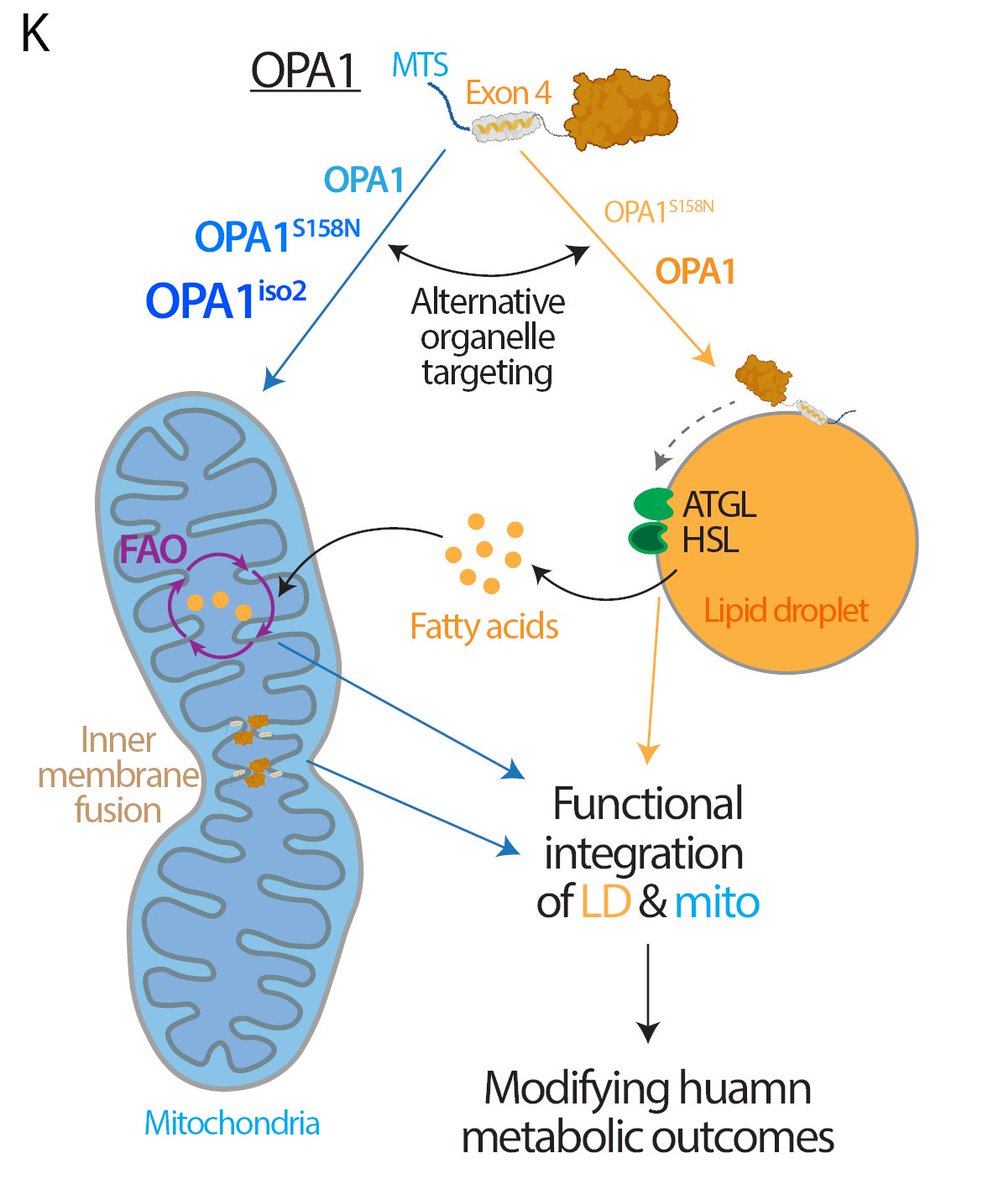
4) The OPA1 S158N variant attenuates FA release and associates with metabolic traits in pediatric cancer survivors.
These findings uncover an unexpected mitochondria–lipid droplet regulatory axis linking OPA1 to human metabolism.
New preprint from our team @chiluncellbio : OPA1 doesn’t just regulate mitochondrial fusion — a subpopulation localizes to lipid droplets and actively controls fatty acid release.
https://t.co/1L8AX6moqw.
We show:
1) Exon 4 encodes an amphipathic helix that targets OPA1 to LDs
2) LD-localized OPA1 recruits lipases and promotes FA release
3) LD targeting competes with mitochondrial localization and alters mitochondrial connectivity
We are thrilled to introduce FABCON, a “Fluorogen-Activated Bimolecular complementation at CONtact sites” tool kit for interrogating lipid droplet-organelle interaction and beyond in living cells.
https://t.co/8DaroDqX3K
A postdoctoral position in microbial pathogenesis is available in the Machner Lab at NIH.
Help us determine how Legionella pneumophila modulates host cells during infection.
For more details go to
https://t.co/N3EQiHtqZc
Interested in how a Legionella phospholipase effector and phospholipids regulate pathogen-containing-vacuole expansion within host cells? Check out our @MatthiasMachner paper! Proceedings of the National Academy of Sciences https://t.co/EFwJbcYktu
Job Alert!
We are hiring postdocs & scientists to interrogate the subcellular spatial organization of metabolism! These positions are supported by DP2 award @NIH_CommonFund and @StJudeResearch offering amazing training opportunities, generous salary/benefits, and GREAT science!
The Chang lab @stjuderesearch is looking for highly motivated postdocs and scientists to join us!
We apply innovative tools and approaches to interrogate the dynamic spatial organization of inter-organelle logistics. Details here, https://t.co/8ubraojP2Q