@sabir_huss50540 Often, a good test of conviction is if your current solution fails, are you still excited to spend time with your customers going deeper on the problem.
Founders spend too much time optimizing for the perfect startup idea.
Yet most startups suffer from shallow conviction, not bad ideas.
The best founders I know pick an idea they’re genuinely curious about, then burn the other boats.
Here’s a simple rubric for how to do it well.
Many founders get stuck trying to find the perfect startup idea before they commit. But the perfect idea doesn't exist in the abstract. The only way to find what works is to pick one, go deep, and get feedback from real customers.
In this episode of Startup School, YC's @xuster breaks down how to choose what to build, "burn the other boats," and go deep enough to practically run your customer's business— and why that depth is what surfaces the better idea underneath.
00:59 — The "Perfect Idea" trap
02:42 — Why working on multiple ideas fails
03:21 — How to actually go deep
04:51 — Could you run your customer's business?
06:18 — Build at the edge of what AI can do
08:37 — Aim at the most ambitious version
09:33 — What happens when the idea fails
10:27 — Walk fast in one direction
Your startup's growth rate is also its learning rate.
Setting an ambitious growth goal and trying to hit it is the fastest way to find out what's broken and how to fix it.
Not just the obvious stuff. Wrong customer, wrong problem, product nobody wants. It also stresses the founding team. You find out fast whether you can handle hard problems under pressure.
Bottlenecks only show up when you push.
If you're not having uncomfortable discoveries early, you're not pushing hard enough.
@charliermarsh Sometimes they're a good reason to work on something. When people say a market is "crowded," what that often means is that there's a real problem and none of the solutions are good enough yet.
Founders often ask me what to listen for in customer calls to know if they have a hair-on-fire problem.
This is the wrong question.
Can you run their business? If you were CEO, would this be a top 2 priority? Because most businesses never get to #3.
Rather than pitching your idea, learn the business so well you could run it yourself. You'll know exactly how big the problem is and what they'd pay.
And if this is going to 100x their business and they still won't buy? You just discovered the AI version of their company.
A mic drop moment @ycombinator tonight
@sama just offered $2M in OpenAI tokens to EVERY YC startup in the current batch in exchange for equity
Just like Yuri Milner offering to invest in every startup back when Sam was a YC partner
I can't wait to see what's unlocked when you let the most driven, creative and formidable founders tokenmaxx
AI-Native Discovery Engines
@xuster
For centuries, scientific discovery has run on the same loop: hypothesize, experiment, interpret, repeat. It works, but it's slow.
Frontier models have now reached PhD-level performance on scientific reasoning, and the frontier is shifting from copilots to systems that can run closed discovery loops on their own.
We’re bringing Jensen Huang to Startup School for a fireside chat with @garrytan!
From co-founding @nvidia in 1993 to building the backbone of the AI era, Jensen helped turn GPUs into the engine of modern computing.
Apply to attend: https://t.co/c1ISr8O64k
This summer we're launching YC Paper Club to bring researchers & builders together.
Every few weeks we'll host a small group dinner in Mountain View to share and discuss new research papers.
Interested in both research & building the future? Sign up at: https://t.co/uMgHeJyFT0
MIT student asked a question earlier today that a lot of young founders are quietly wondering about:
"Won’t the frontier labs just do everything?"
Yes it's true that OAI/Ant are shipping at incredible pace, but it's quite easy to avoid their blast radius and build amazing startups:
OpenAI is not going to build a cattle-herding drone, buy an old F-150 and drive from ranch to ranch like the founder of one of the fastest-growing YC W26 startups, Graze Mate.
Anthropic is not going to integrate with dental insurance verification systems (Lance).
Google is not going to navigate NATO procurement (Milliray).
The value is in the last mile, not the model. Sales cycles require humans who understand the customer. And most importantly, the market is expanding, not shrinking: AI isn't cannibalizing the existing 1% software spend — it's unlocking the other 5-6% that was going to humans. That's a much bigger market for startups yet-to-be-founded than the one the labs are playing in.
Now, what DOES seem risky?
A thin UI layer on top of ChatGPT with no domain expertise; a general-purpose chatbot or assistant; or a product that gets obsolete when model capabilities improve.
But — tools for specific industries; "full-stack" AI companies that actually are the service (AI law firm, AI accounting firm, AI uranium exploration company); or generally products where the customer doesn't want a tool but an outcome — are defensible ideas for startups.
Congrats to @astorinvest on their $5M seed!
They're building an AI investment advisor for everyday investors. It connects to your brokerage, analyzes your portfolio, and delivers personalized recommendations.
Less than two months after launch, thousands of users have already connected over $200M in assets to the platform.
https://t.co/7yaTfTcQW7
AI isn't just making teams more productive. It's changing how companies should be built.
In this episode of Startup School, YC Partner @sdianahu explains what it means to build an AI-native company, where AI isn't just a tool but the operating system your company runs on.
She breaks down how to make your company queryable so agents can improve across every function, why management hierarchies break down when an intelligence layer replaces human middleware, and why early-stage founders have a massive edge in building this way from day one.
00:58 - AI as your company’s operating system
01:57 - Open vs closed loop companies
03:00 - Making your company fully queryable
05:00 - The rise of the 1,000x engineer
07:12 - Why middle management disappears
09:12 - Startups will win this shift
Everyone thinks about money differently. The last generation of personal investment software was fine but not truly optimal for anyone. I know because I built one. AI unlocks a truly personalized advisor with deep understanding of financial situations and personal opinions. Excited that @brunokoba_ and @tulha_ are building this at @astorinvest. Congrats guys!
We (@astorinvest) raised a $5M seed led by Monashees, with participation from Goodwater, Gilgamesh Ventures, and other incredible investors.
In less than two months after launch, thousands of users have connected over $200M in assets to our platform. We're just getting started.
The team at @10x_Science is delivering a huge unlock for drug development by increasing the speed of protein characterization by orders of magnitude. David, Andrew and Vishnu are an insanely talented team working on a huge problem! And they’re hiring.
Congrats to @10x_Science on their $4.8M seed!
They're building AI for molecular-level protein characterization, a process that today requires specialized scientists spending weeks or months manually interpreting complex data. Their platform delivers the same insights in minutes.
https://t.co/wzDaZiETbc
@_groww is now a public company and is the largest investment platform in India. @lkeshre the founder and CEO is still the power user of the product he’s built and still talks to users today.
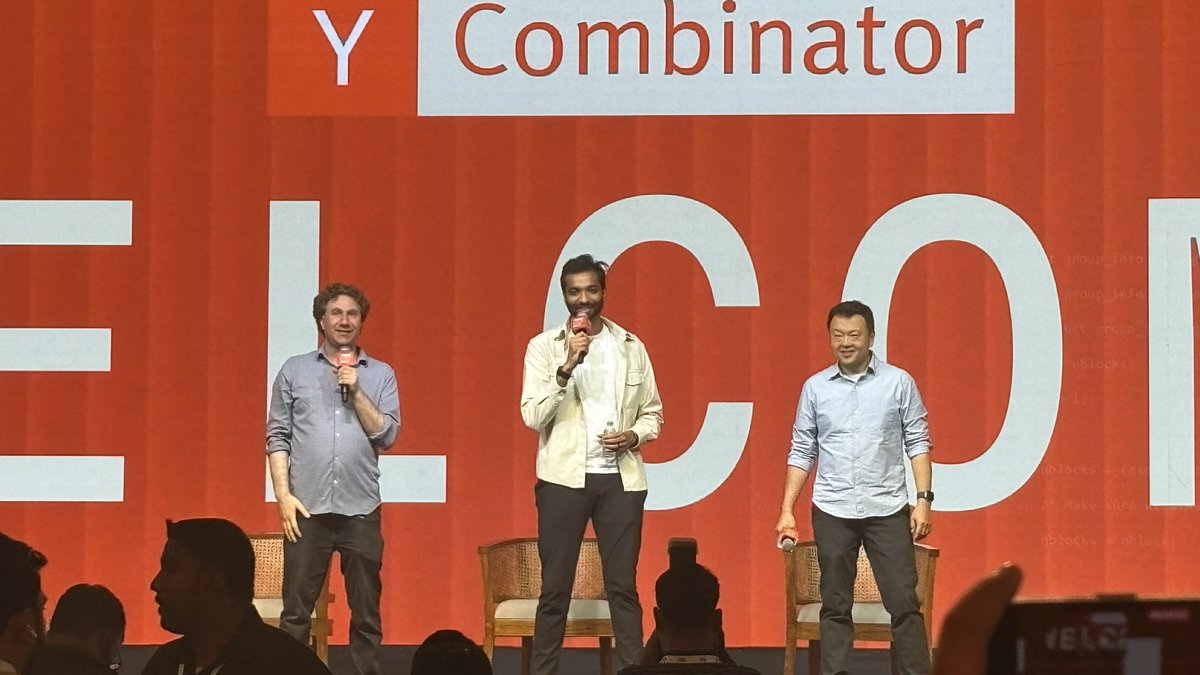
Had the privilege of sharing the stage at Startup School India where he spoke about building a generational consumer company.
We talked about product taste as being not just what looks good, but intentional design choices informed by an obsession with the customer. Lalit and how the team at Groww builds products exemplify this.
Photo credit: @gcs319