I technically don't have lyme any more!
according to IgeneX that just came back, lyme IgM bands improved
23++, 41+ (Jan) -> 23++ (now)
which is technically negative for borrelia burgdorferi in both IGX and CDC/NYS criteria (tho band 23 is much more specific to lyme than band 41)
the relapsing fever variant has also turned negative for both IgM and IgG
---
however, the co-infections!
babesia is still positive (but improved(?) from FISH positive to FISH negative but IgG positive)
bartonella is still indeterminate which likely means positive if I follow up with a Galaxy Diagnostics
---
overall, I'm pleasantly surprised because I haven't done any antibiotics (but I did intend to see if I can recover without antibiotics)
the main intervention with plausible biological contribution is maraviroc
otherwise I felt it's mostly just trigger identification and avoidance + symptom relief, and letting my body do its job(?)
---
in any case, I still have symptoms (possibly explained by continued presence of bartonella) and there's still some ways to go but this is consistent with my energy level improvements so far!
🚨 We just used AI to solve a 35-year-old open math problem!
In queuing theory, BAR is the "master equation" for finding networks reach a equilibrium. However, a core uniqueness conjecture about BAR remain open
Here is how human + AI cracked the case👇1/7 https://t.co/YPf3hghyT7
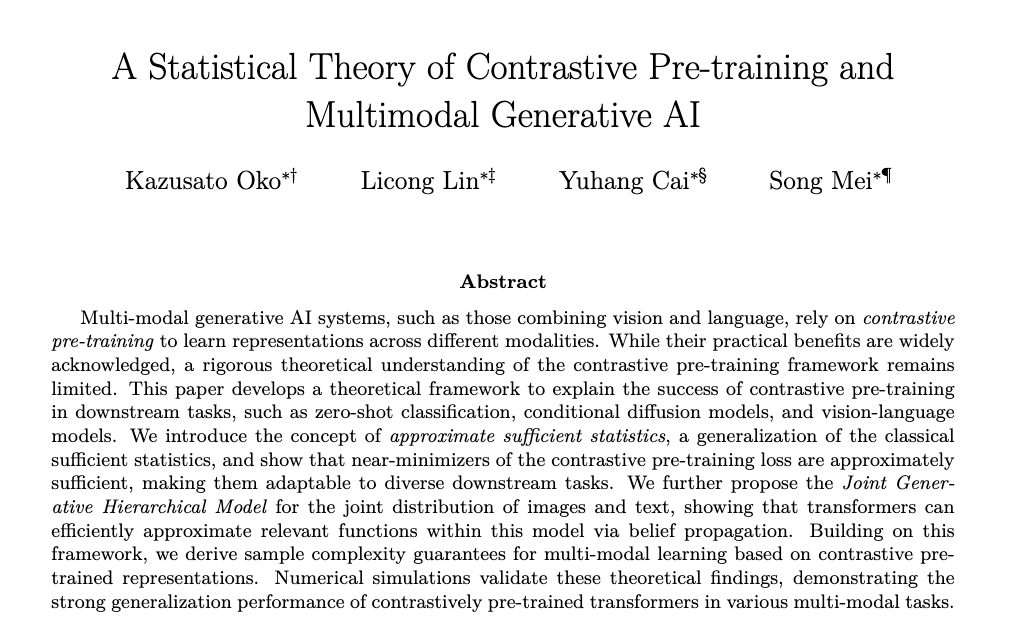
We present a new theoretical analysis of the CLIP model, focusing on controlling the estimation error of its representations in multimodal downstream tasks. The key is the notion of approximate sufficient statistics. In generative hierarchical models, we derive an end-to-end sample complexity bound. With Kazu, Licong, and @faro36241257 Yuhang.
ArXiv link: https://t.co/pwkEWAjaCs
Nous Research announces the pre-training of a 15B parameter language model over the internet, using Nous DisTrO and heterogeneous hardware contributed by our partners at @Oracle, @LambdaAPI, @NorthernDataGrp, @CrusoeCloud, and the Andromeda Cluster.
This run presents a loss curve and convergence rate that meets or exceeds centralized training.
Our paper and code on DeMo, the foundational research that led to Nous DisTrO, is now available (linked below).
Excited to share our latest research progress (joint work with @DrYangSong ): Consistency models can now scale stably to ImageNet 512x512 with up to 1.5B parameters using a simplified algorithm, and our 2-step samples closely approach the quality of diffusion models. See more details in our research paper: https://t.co/ExOZShv8fX
My personal prediction: real-time multimodal generation is on the horizon.
Importantly, with access to a two-sample oracle, our procedure bypasses the need to explicitly model and estimate the relationship between the independent and instrumental variables, showcasing the advantages compared to recent methods based on minimax optimization. [3/4]
My best article @ScienceMagazine. It took ~1 year for me to publish it since its 1st submission. I hope it will positively change the #culture. I hope you will work together with me to make a better world for the next #generations. Please retweet broadly.
https://t.co/EGEC6HC7hg
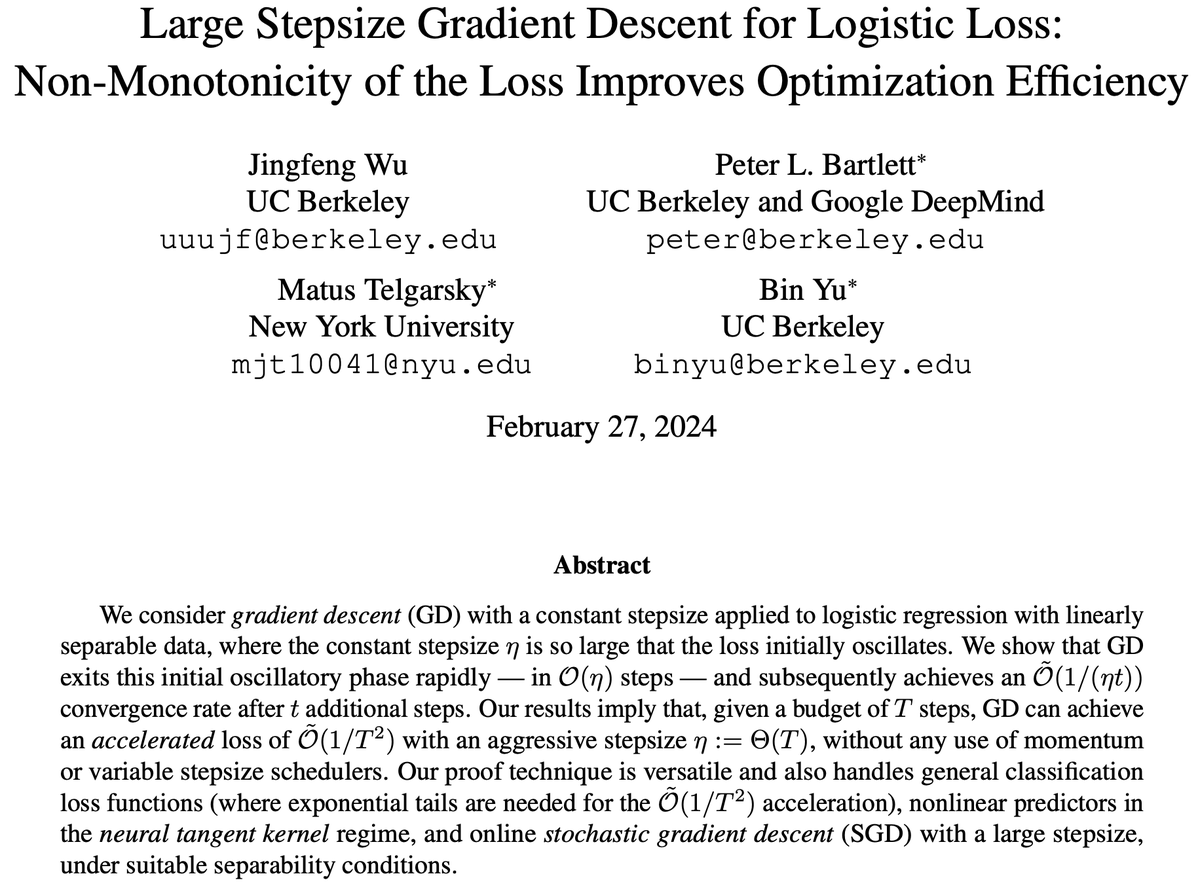
GD with LARGE stepsize induces an oscillatory loss that may sound scary, but the oscillation eventually accelerates optimization, provably
Core proof in <= 5 pages, which made me very proud of :)
New paper w/ Peter Bartlett, Matus Telgarsky, Bin Yu
https://t.co/cKM96LehmW
I actually do not agree. First, the infinite search space of high-order logics easily dwarfs the finite search space of the game of chess/Go. Second and more importantly, top mathematicians are artists: they aim to please themselves and there is no well-defined ultimate goal. LLM could help once they become substantially better in reasoning.
Our global analysis is precise for these models (i.e., no big-O notation or sufficiently wide/large layers), and moves away from local stability analysis done in some prior works. [5/6]