I could make over $100,000 with this info by creating a paid group, like most people would do.
But I'm giving it to you for free.
Here's a FREE SCRIPTS for tier-1 projects that lets you create hundreds of randomized wallets and get a TON of money from airdrops 👇
In crypto, we’ve seen billions lost to bridge exploits. Tokens shouldn’t be locked to one bridge.
That’s why we’re upgrading the Chain-Agnostic Token standard to be bridge-agnostic. Seamlessly integrated with @axelarnetwork, @chainlink CCIP, @layerzero_labs & @wormholecrypto. 🧵
Navigating "corporate speak" isn't easy.
Here's a helpful guide I put together:
"Let me check with my team" = No
"Possibly" = No
"On my roadmap" = Not happening
"This will be done in Q4" = This will be done in Q2 next year
"Disagree and commit" = I hate you
"Per my last email" = Try reading, for once in your life
"Challenging landscape" = We're going out of business, quickly
"Digital transformation" = We're going out of business, slowly
"Let's circle back" = We'll never speak of this again
"Take it offline" = We'll never speak of this again
"30,000 foot view" = I don't know what I'm saying
"Low hanging fruit" = Easy promotion
"Open up the kimono" = HR violation
"We use AI" = We don't use AI
"We use machine learning" = We don't use machine learning
"All hands on deck" = Let's actually try for once, please
A new champion arises: Introducing HerculesDEX 🔥
The Next-Generation DEX to Drive the @MetisDAO Ecosystem 🚀
Join us as we explore the innovative features that will shape the future of DeFi on Metis🌿
🧵👇
#JustDarioDaily
⚠️WILL $HSBC CONTINUE “WALKING ON WATER”? 🙄🚨
We already noticed that HSBC has been “walking on water” for a while (https://t.co/WwkehVa4Of), so a deep dive into their financials was long overdue to understand whether this was a “miracle” or an “illusion”. 😬
Tomorrow, 30th October, at 4am GMT, HSBC will report its Q3-23 results, and I wonder if the following items will continue to remain at odds with reality or come back to earth 🧐
1 - EXPECTED CREDIT LOSSES (“ECL”)
Banks strongly prefer to lend to #China customers through #HongKong. The reason is that in Hong Kong, there is still a Common Law-based judiciary system very similar to the UK one, hence quite favourable for "inking" commercial transactions on and (in theory) more helpful to creditors in case something goes south. If you think HSBC alone is lending 291bn$ into “Hong Kong” when the city's total GDP is 363bn$ (and if you add all local banks lending into HK you get many multiples vs GDP), then I have sad news for you: unicorns don’t exist! 😆
For this reason, the “minimal” exposure to China risk they love so much to brag about, in particular the “only 14bn$ exposure to China CRE”, is total nonsense and simply part of their big game of smoke and mirrors.
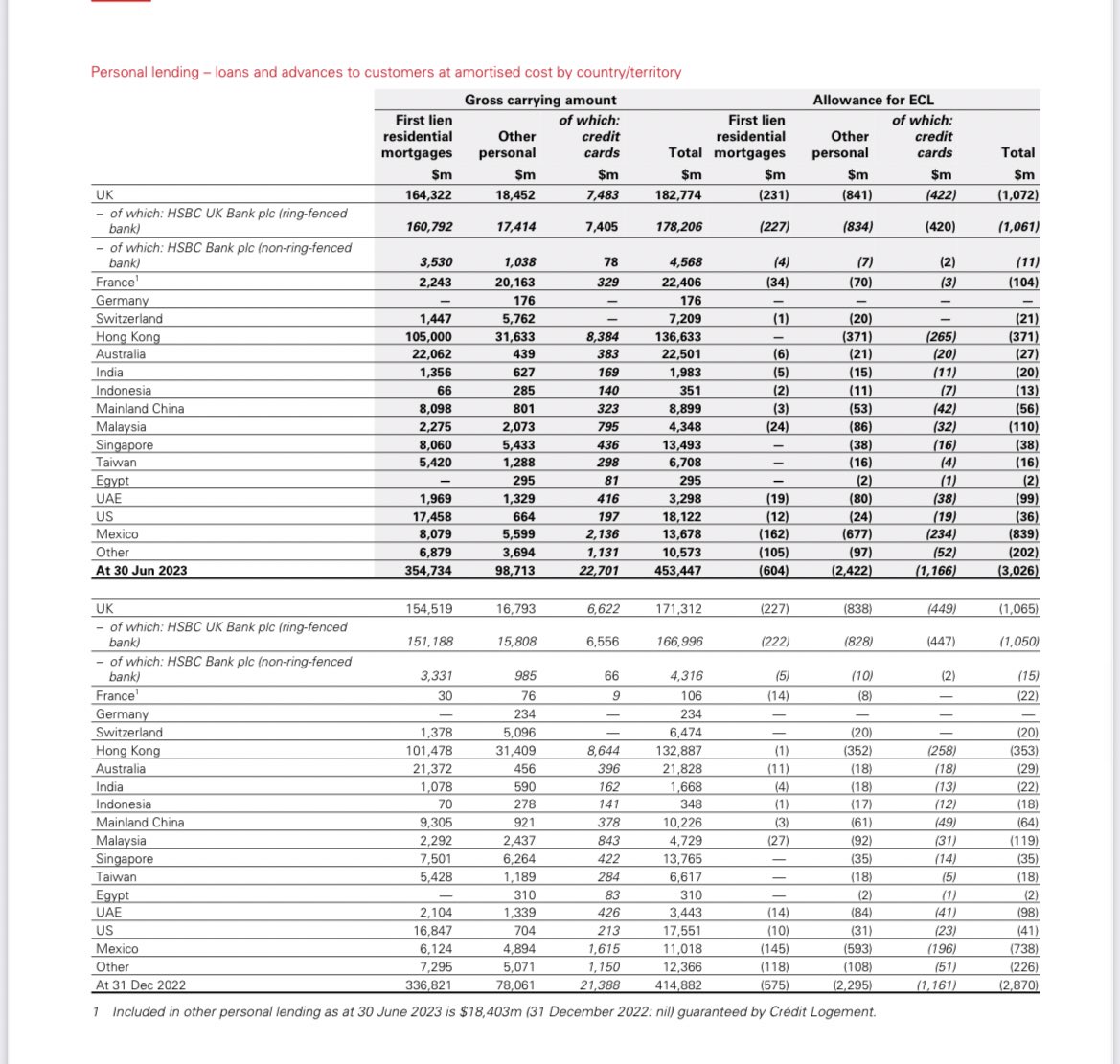
Guess how much the allowance for ECL increased in HSBC from Q4-22 to Q2-23 overall? 300 MILLION $USD! 🙈 Up until last quarter, HSBC only set aside ~12bn$ for ECL against ~1T$ in Loans, out of which a big chunk is concentrated across the #UK, #China and #HK.
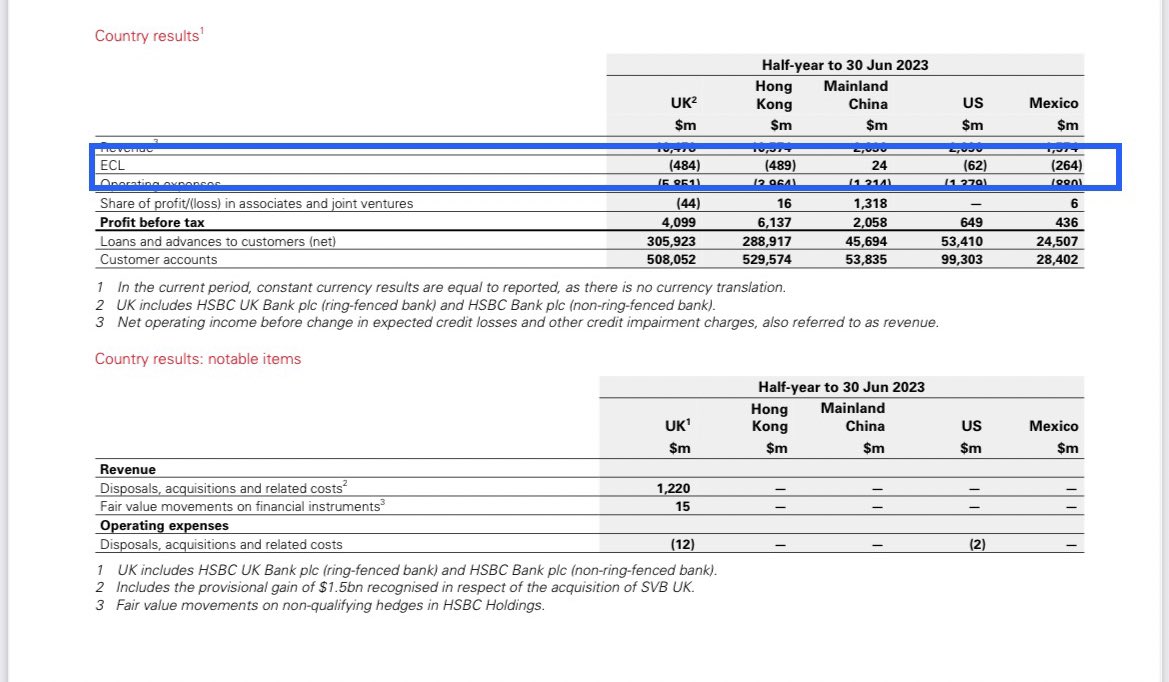
As if what I said so far wasn’t insane enough yet, guess how much allowance for ECL HSBC put aside against the loans directly in Mainland China (~46bn$ total) since the beginning of the year? ZERO! They actually “released” 24m$ 🤣.
Yep, HSBC’s ECL numbers do not make any sense, sorry…
2 - OFF-BALANCE SHEET RISK
As of Q2-23, HSBC had ~650bn$ of standing commitments to clients that can be drawn upon, needless to say how big this amount is compared to the size of the bank outstanding loans.
Now, let me tell you a personal story. Do you want to know what clients do when a liquidity crisis hits? They rush to draw up all their credit lines to stash emergency cash before the bank has time to shut them. I personally saw this happening in March 2020 at my desk when even AA rates companies, but very reliant on the (cheap) Commercial Credits market to fund their day-to-day operations, started to panic and grab any cash they could find.
Against these 650bn$ of off-balance sheet risk HSBC only put aside 350m$ for ECL despite the economic backdrop with $SIVB, $FRC and $CS that just imploded at that time, bankruptcy filings going through the roof, and central banks actively draining liquidity from the market. I mean, surely HSBC people are either very optimistic or blind… feel free to pick what you prefer!
3 - FINANCIAL INVESTMENTS
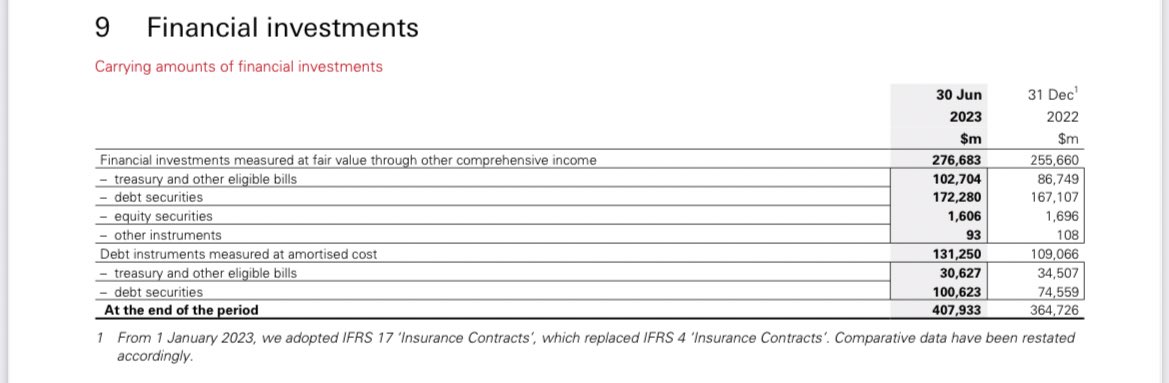
For H2-23, HSBC not only disclosed a cumulative unrealised loss of 3.5bn$ here (and they pretend we believe it 🙈), but they are so good that, while all the street including Jamie Dimon $JPM is bleeding, HSBC's financial investments increased in value during the period for ~43bn$! Furthermore, it looks like HSBC is the only bank in the world able to make money with US Treasuries so far this year with a total net gain of ~12bn$ between AFS and HTM books. Do you think the “miracles” end here? No sir! HSBC gained 31bn$ from debt securities in the first half of the year! 🤡🤯.
4 - THIN LIQUIDITY BUFFER
What’s concerning is that, overall, HSBC only holds ~130bn$ of high-quality treasuries, ~ 307bn$ cash and ~255bn$ of trading assets in its balance sheet against ~1,600bn$ in deposits, ~81bn$ of trading liabilities, ~139bn$ of Short Term funding (“Financial Liabilities at Fair Value”), 115bn$ of Insurance Contracts liabilities (CDS they sold for the most…) and 650bn$ of off-balance sheet standing credit lines. Putting all together, HSBC only has 27% of highly liquid assets to cover very short-term liabilities. 🥵
METIS WILL IMPLEMENT #ZK PROOFS😳But, what does it actually mean?
It means that Metis will become the first hybrid-rollup on #Ethereum, enabling:
🛡️Enhanced security
👁️Enhanced censorship-resistance
⚡️Near-instant finality
Never seen a bull market in which:
- Bank stocks keep falling
- Retail stocks keep falling
- Transport stocks keep falling
- Industrial stocks keep falling
- Healthcare stocks keep falling
- Real Est stocks keep falling
- Material stocks keep falling
New type of bull market 🤣
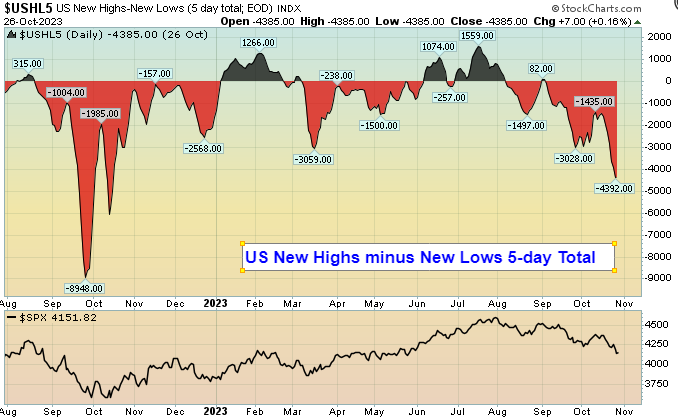
BREAKING: The S&P 500 has officially entered correction territory, now down 10% from its July high.
This means that the market is now down 10% from the exact date the Fed removed a recession from their forecast.
The S&P 500 has lost over $4 trillion in market cap since July.
Meanwhile, the 7 largest tech stocks have lost over $500 billion in value.
After supporting the entire market for so long, tech stocks seem to finally be under pressure.
Next week's Fed meeting is huge.
Let me summary my observations :
1/ China is on the edge of economic depression and Shanghai Composite keeps fighting for (M)MA200. My bet it'll be broken down till the end of this year
2/ China injects tons of money but in reality their intervention is less and less effective, and let's say openly almost zero based on amount of money, same as BoJ which is broke.
3/ Chinese PBOC liquidity mostly bids SHIBA + DOGE, so congrats effectivness of the policy (a bit of sarcasm)
4/ Japan seems to be done. This economy is TOTALLY destroyed and lots of Ph.Ds should be made how QQE really ends. Mostly as a brake which stops reforming the economy, but the longer you drive on a brake the more powerful stop you will get until the car stops and burns something for good. That's what Japan did.
5/ Tons of stocks broke key levels and MA, breadth is super weak and Mag7 was left as "the last one standing"
6/ Those stocks which broke first are now way below 2020 COVID lows levels, I'm observing each month more and more stocks going below that level too.
7/ "Direct stimulus checks" cost us bond market crash, which technically overextended economic dead cat bounce, when economy crashed in 2020 it was "retesting" some levels until Nov2020 when 1.5Ys of fake growth kicked in at the cost of flipping bond market into a secular bear market. The cost of buying the time in the economy is always exponential.
8/ Market won't get cheated another time on "direct stimulus checks" => stocks won't really get bid much, commodities will be ALL-IN and bonds will be crashed even more powerul, as inflation will rip 2-3x faster than during 2020 MMT experiment
9/ So in reality the economy is doing everything to deleverage, if you try to cheat it it'll blow up commodities higher and inflation expectations to kill real wages spreading social unrests.
10/ The level of zombification which left after QE + MMT is so huge that the economy can't really work effective using disinflation, that's why "you can't cure ineffectiveness (insolvency) with liqudity, because economy is going always to offset it using inflation couple times faster and more powerful.
11/ It's a dead end and long time ago I said : the economy will find a way to by-pass Central Bankers and spit them in their face. You can observe it now. In reality it turns out Central Bankers are on a short leash of The Economy which after 40Ys of secular disinflationary cycle decided to make a secular turn.
#JustDarioDaily
⚠️ SOMEONE SOMEWHERE HAS TO PAY A HIGH PRICE FOR BANK OF JAPAN INCOMPETENCE ⚠️
Not too long ago, $JPY was synonymous with the "safe haven" in the investment community. However, in all honesty, I never understood why because the numbers told such a different story. The #BOJ set the Japanese Economy on a Kamikaze trajectory long before I was born. Japan's banking system is a zombie that needs cheap and abundant liquidity to survive for 30 years, and the Internal Economy has been growing anemically till today. Soon, Germany will even overtake Japan as the third biggest economy worldwide.
Let me repeat what I said in July, THINGS ARE SO BAD THAT $JPY WILL KEEP DEPRECIATING IF JAPAN RAISES RATES. Why? Because they created a giant system that can only survive on cheap and abundant liquidity, a system that includes both internal and foreign financial companies. So if the #BOJ increases the cost of funding, they will need to print even more $JPY to fill the larger hole created in banks' balance sheets both inside and outside Japan.
What I am describing was meant to happen long ago, but due to several economic crises and #stockmarket crashes along the road, #FED and #ECB kept rates very low for a long time, releasing the pressure (to get its acts together) from the #BOJ. The combination of all these things created an abomination: everyone everywhere "forgot" that money carries a cost and isn't "free". Things became so stupid that in countries like Denmark, banks even started to give mortgages at negative rates in 2019!
Now that the BOJ enjoys the luxury of having its cake and eating it too no more, the time to take the tough decision to "cut an arm to save the body" is very close. Why this analogy? Because Japan caught an #inflation disease their immune system failed to contain and is now risking to spread throughout the whole body, threatening its death.
WILL "TWEAKING" THE YCC HELP? No, it won't, as explained above. Furthermore, do you know that 70% of the mortgages in Japan are Floating Rate? Paradoxically, tweaking the YCC alone is the worst thing the BOJ can do for Japanese people because it will weaken $JPY further and will even impoverish them with a higher cost for their debt.
SHALL THEY STOP PRINTING $JPY? This is already a much better option because it will take away the oxygen from all those zombie financial institutions that need a perpetual bailout to survive and ease the burden from the Japanese people who indirectly kept paying the bills for it. However, this will strengthen the $JPY significantly, and another side effect will be a huge toll on Japanese exports.
SHALL THE BOJ CONTINUE DEFENDING THE $JPY SELLING THROUGH ALL COUNTRY RESERVES? Of course not! And this is also a very dangerous thing to do, why? Because not only the market is more and more front running the BOJ, making these interventions "more expensive" in terms of losses on the principal value of the US Treasuries, but the more these reserves dwindle, the harder it is to justify $JPY as a "safe haven" currency. The less the perception of being a "safe haven," the more the selling on the $JPY, the higher the need to dump $USD reserves to defend the currency. It's a very dangerous vicious circle, isn't it?
WHAT THE HELL WHAT CAN JAPAN DO TO SAVE ITSELF? A "Marshall Plan" is needed for Japan. Foreign countries and financial institutions benefited greatly from all the $JPY printed through the decades by the BOJ and from the very cheap cost of funding that goosed foreign economies and #stocks much more than the Japanese one due to the $JPY carry trade. Japan needs a big restructuring and debt write-off, with the BOJ already holding more than 50% of the $JGB market and a Public Debt/GDP ratio alone at 225%, there is no point in keeping sailing on this course. If the status quo remains, I am worried there is a high chance Japan might need to knock at the IMF's door at some point in the future and join the list of "broken countries".
We invented Noir for developers to write powerful zero knowledge applications with intuitive, Rust-based syntax.
But browser support has been a major missing feature.
That changes today, with the release of NoirJS: a Javascript package for ZK applications in the browser.
↓
Sick of hearing about that fkn LayerZero airdrop?
I get it, but this is next level. We're talking real alpha here.
Here's a FREE SCRIPT for LayerZero that lets you create HUNDREDS of RANDOMIZED and UNIQUE wallets.
I'm dead serious 👇
Want some proof that rising Treasury yields is not a selloff, but something else?
Here are some charts to dispell that myth... And also show you how the Federal Reserve and Treasury are engaging in Yield curve control.
Yep, YCC in plain daylight 👇
OK, to start off, the U.S. Treasury holds auctions for various terms / durations frequently. There are many auctions for 4-weeks Treasuries, and usually about one per month for the 30-yr.
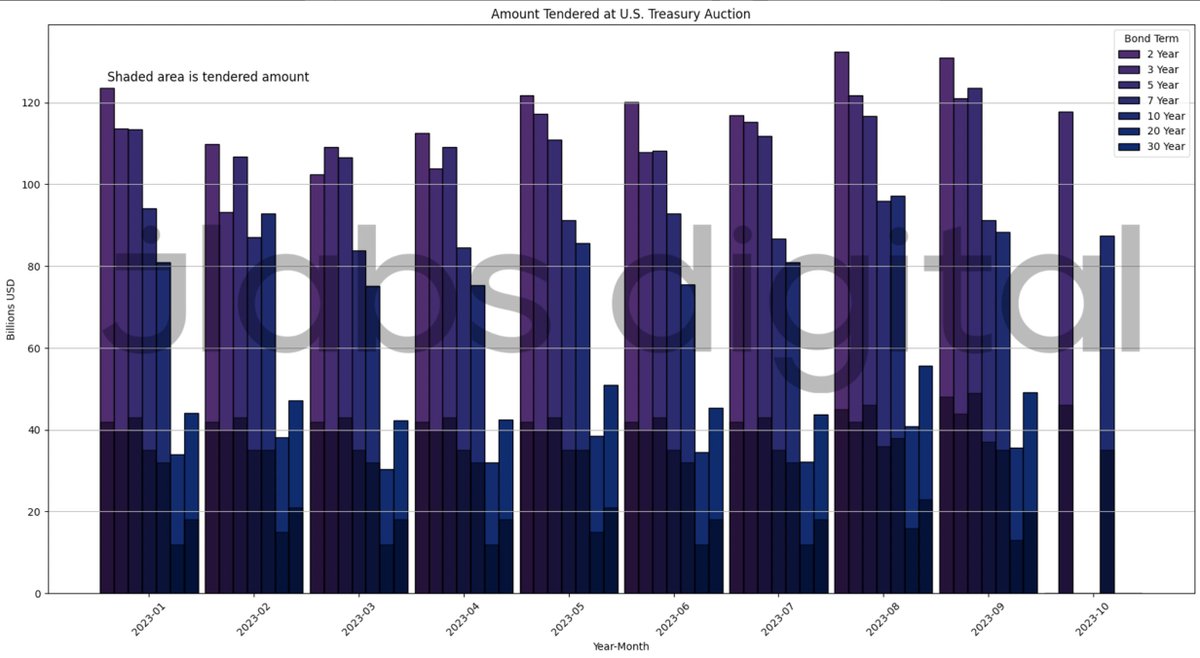
If we take all the bids placed at each auction, and sum it together for each term for each month, we get the chart below.
The main takeaway, more bids are happening at auction. First one is terms <52 weeks
This next one is for terms >52 weeks. It's also showing an increase in bids.
More bids typically mean higher prices / lower yields... Yet yields are going up. So why?
The shaded area at the bottom of those charts indicates the U.S. Treasury is tendering or rewarding MORE bids.
If we take the height of those bars and divide it by the shaded area, we get what's called a Cover-to-Bid ratio.
If the CTB is going sideways, it means the Treasury is rewarding bids at a rate consistent with this rising demand. This is a form of Yield Curve Control happening at auction
Here is the CTB for longer terms, it's moving sideways... (It's similar for short-term, but I only get 4 pictures for this 'X')
But there's more.
If we look at the amount of debt issued at short terms, we see major amounts compared to longer terms - in part why we broke the data into two charts.
Lots of Treasuries are happening at the shorter term/end. That's because the market is worried rates might keep rising.
But as JPow and Co signal to the market that terminal rates might be near, the Treasury can issue more debt at later terms. This helps normalize the curve.
It's in part why yields are rising... and they are rising not because of a selloff, but due to more issuance.
You'll also note the signaling of late by Fed officials to aid in this transition (ie - might not see more rate hikes in 2023).
This process takes time. It doesn't just happen over a few months. But because it takes time, the Fed is helping with yield curve control by changing its portfolio holdings.
Since demand is not at the long end yet, you'll see the Fed's holdings of Treasuries with maturities of 10 years of more have grown from 22% to 30% of its portfolio over the last couple years.
JPow is helping Yellen here.
And if anything, as much we hate to admit it, they are raising the curve successfully... And are now normalizing it through auctions.
Yes, yields are rising. They will keep going in a way that normalizes. I fully expect as demand begins to pick up in 10 and 30yr terms for JPow to consider a 25bps cut.
He'll say it's to jump start the economy, but it might have more to do with YCC. It's a way to get the market to "lock in" longer duration yields.
Why is it so important for yields to be higher... for longer?
That's the new financial system.
We saw Tether and USDC... Banks hold treasuries and issue deposit tokens against that collateral. It's a great solution for the US Treasury to create continual demand for their greatest asset -> debt.
Having continual buy pressure like this would be a welcomed gift by government officials. No more nagging budgets to consider.
And what better way to aid this transition than get rid of some little old banking regulation during the next selloff.
Huh? Yea, I'll need more time to explain. So I decided to jump on the @xChanging_Good podcast to explain. It's set to release next week.
In the interm, just know, YCC is happening. The Fed and Treasury are working together to accomplish the normalization process... All to create greater demand for debt...
And there's not a selloff. If anything, demand is rising and liquidity issues will surface in a different area of the market.
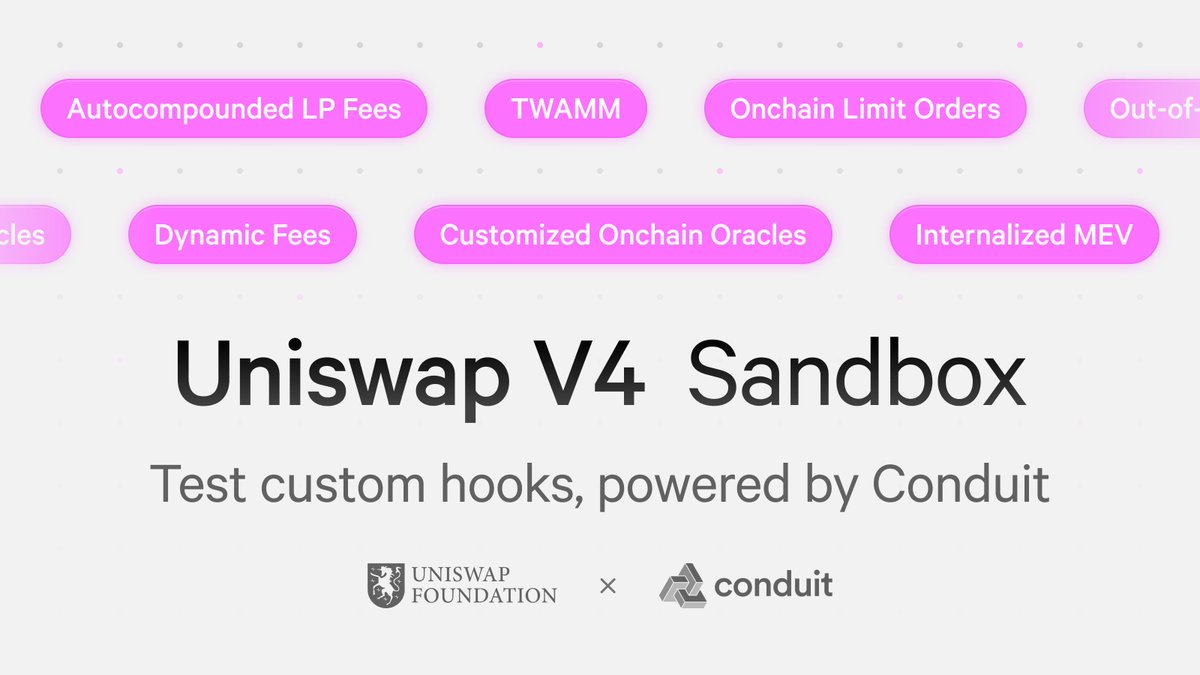
🦄 Announcing the Uniswap V4 Sandbox, an OP Stack rollup powered by @conduitxyz in collaboration with @UniswapFND
Build your own custom AMM on top of Uniswap's battle-tested contracts while still interoperating with existing liquidity instead of fragmenting it
#JustDarioDaily
⚠️ WHAT IF IS BANK OF AMERICA?⚠️
In the past week few things happened, apparently random, but then putting them all together I now wonder: “What if Baring is Bank of America?” Let me tell you why I suspect so (previous post in quote)
1 - $BAC “ACROBATICS”
In appearance, $BAC increased its deposits from Q2 to Q3 by 7bn$. Good, no? Nope. $BAC LOST 23.5bn$ in sight deposits that compensated with 31bn$ of “Interest Bearing Deposits” that likely are expensive CDs. Why? Because $BAC immediately placed the cash in Fed Funds that on a net basis increased by exactly 31bn$. As a matter of fact, $BAC cash balance DECREASED by 22bn$ in Q3, exactly the amount of sight deposits lost. Let’s do some math:
Dep. = 1,884bn$
ST Borr. = 40bn$
TOT1 = 1,924bn$
Cash = 351bn$
Trading Assets = 306bn$
TOT2 = 657bn$
TOT2/TOT1 = 34%
Shall we consider the AFS assets assuming $BAC can sell them at the FV they estimate?😌
AFS = 176bn$
TOT2* = 833bn$
TOT2* / TOT1 = 43.3% ⇒ This is IDENTICAL to Q2 but here is the funny thing, AFS INCREASED IN VALUE from 142bn$ to 175bn$ QoQ while rates continued to increase! 😂 All the other metrics are fairly stable vs Q2 with the exception of deposits so this leads me to wonder… did $BAC “adjust” AFS “fair value” to cover a 33bn hole?!
Now, where does the cash come from to plug this hole? From “off balance sheet” assets of course. I need to show you a few steps first, bear with me
2 - MICHAEL HARNETT FLIP TO “#BULLISH”
Wasn’t it very odd that with all that just happened in Israel, $BAC head of strategy, that has been consistently #bearish for years, suddenly flips to bullish?
3 - $BAC PB “SAW” BUYING EQUITY FLOW
I found this @zerohedge post very funny [https://t.co/Iewlmmb7Q6], but with the benefit of hindsight, I got to think whether this and “Harnett flip” are somewhat connected as a sign $BAC needs to push a bullish narrative right now. 🤔
4 - POWERFUL $VIX CRUSH IN THE LAST 2 DAYS
How many institutions are in the positions of seeing enough market flow to take a position against it? A handful. Among these, how many just published short term “bullish research” on #stocks after Israel events? Only one… $BAC
If you think the “Billions” episode where Bobby produces “research” to justify his market manipulative trades is fiction, then you never worked in a bank or hedge fund. I HAVE NO PROOF to say $BAC is trying to squeeze up the market, but coincidentally, a #bullish sentiment is helpful for them, and now I tell you why.
5 - I SUSPECT $BAC HAS BEEN SELLING CREDIT DERIVATIVES TO COVER HIS B/S HOLES
Why, despite the deteriorating Credit environment, with Bankruptcy filings going through the roof, does $BAC keep building up notional exposure to Credit Derivatives?! Here are the numbers:
Q3-23 N/A
Q2-23 478bn$
Q4-22 380bn$
Q4-21 365bn$
Q4-20 370bn$
As per $BAC's own risk disclosure, “The notional amount represents the maximum amount payable by the Corporation for most Credit Derivatives.”
Oh gosh, do you remember why in 2008 CDO and CLO credit spreads were not “widening” despite the subprime market crashing? Because banks kept bidding them!
Needless to say that if a “Credit Event” hits right now, either because of a black swan or simply because #stocks and #bond valuations start catching up with reality, $BAC will be in huge troubles considering they only have a 287bn Capital “cushion”. 🤦🏻♂️
Furthermore, even if the other day I said “banks are already using the #BTFP” (https://t.co/pCpzXuq5iP), I am actually not so sure Big Prime Brokers can really access that in practice in the same way everyone is afraid of taking money from the FED discount window. Why? Because that will manifest serious liquidity stress in the company! And what do clients do when they see danger? They run away with their money and assets! 👀
After writing this post, I am not surprised anymore that someone (maybe with more insights than me) is building a significant short position on $BAC 🤷🏻♂️ https://t.co/tR64YYAjKi








![DarioCpx's tweet photo. #JustDarioDaily
⚠️ WHAT IF IS BANK OF AMERICA?⚠️
In the past week few things happened, apparently random, but then putting them all together I now wonder: “What if Baring is Bank of America?” Let me tell you why I suspect so (previous post in quote)
1 - $BAC “ACROBATICS”
In appearance, $BAC increased its deposits from Q2 to Q3 by 7bn$. Good, no? Nope. $BAC LOST 23.5bn$ in sight deposits that compensated with 31bn$ of “Interest Bearing Deposits” that likely are expensive CDs. Why? Because $BAC immediately placed the cash in Fed Funds that on a net basis increased by exactly 31bn$. As a matter of fact, $BAC cash balance DECREASED by 22bn$ in Q3, exactly the amount of sight deposits lost. Let’s do some math:
Dep. = 1,884bn$
ST Borr. = 40bn$
TOT1 = 1,924bn$
Cash = 351bn$
Trading Assets = 306bn$
TOT2 = 657bn$
TOT2/TOT1 = 34%
Shall we consider the AFS assets assuming $BAC can sell them at the FV they estimate?😌
AFS = 176bn$
TOT2* = 833bn$
TOT2* / TOT1 = 43.3% ⇒ This is IDENTICAL to Q2 but here is the funny thing, AFS INCREASED IN VALUE from 142bn$ to 175bn$ QoQ while rates continued to increase! 😂 All the other metrics are fairly stable vs Q2 with the exception of deposits so this leads me to wonder… did $BAC “adjust” AFS “fair value” to cover a 33bn hole?!
Now, where does the cash come from to plug this hole? From “off balance sheet” assets of course. I need to show you a few steps first, bear with me
2 - MICHAEL HARNETT FLIP TO “#BULLISH”
Wasn’t it very odd that with all that just happened in Israel, $BAC head of strategy, that has been consistently #bearish for years, suddenly flips to bullish?
3 - $BAC PB “SAW” BUYING EQUITY FLOW
I found this @zerohedge post very funny [https://t.co/Iewlmmb7Q6], but with the benefit of hindsight, I got to think whether this and “Harnett flip” are somewhat connected as a sign $BAC needs to push a bullish narrative right now. 🤔
4 - POWERFUL $VIX CRUSH IN THE LAST 2 DAYS
How many institutions are in the positions of seeing enough market flow to take a position against it? A handful. Among these, how many just published short term “bullish research” on #stocks after Israel events? Only one… $BAC
If you think the “Billions” episode where Bobby produces “research” to justify his market manipulative trades is fiction, then you never worked in a bank or hedge fund. I HAVE NO PROOF to say $BAC is trying to squeeze up the market, but coincidentally, a #bullish sentiment is helpful for them, and now I tell you why.
5 - I SUSPECT $BAC HAS BEEN SELLING CREDIT DERIVATIVES TO COVER HIS B/S HOLES
Why, despite the deteriorating Credit environment, with Bankruptcy filings going through the roof, does $BAC keep building up notional exposure to Credit Derivatives?! Here are the numbers:
Q3-23 N/A
Q2-23 478bn$
Q4-22 380bn$
Q4-21 365bn$
Q4-20 370bn$
As per $BAC's own risk disclosure, “The notional amount represents the maximum amount payable by the Corporation for most Credit Derivatives.”
Oh gosh, do you remember why in 2008 CDO and CLO credit spreads were not “widening” despite the subprime market crashing? Because banks kept bidding them!
Needless to say that if a “Credit Event” hits right now, either because of a black swan or simply because #stocks and #bond valuations start catching up with reality, $BAC will be in huge troubles considering they only have a 287bn Capital “cushion”. 🤦🏻♂️
Furthermore, even if the other day I said “banks are already using the #BTFP” (https://t.co/pCpzXuq5iP), I am actually not so sure Big Prime Brokers can really access that in practice in the same way everyone is afraid of taking money from the FED discount window. Why? Because that will manifest serious liquidity stress in the company! And what do clients do when they see danger? They run away with their money and assets! 👀
After writing this post, I am not surprised anymore that someone (maybe with more insights than me) is building a significant short position on $BAC 🤷🏻♂️ https://t.co/tR64YYAjKi](https://pbs.twimg.com/media/F9QMnlEbYAAA5z_.jpg)
![DarioCpx's tweet photo. #JustDarioDaily
⚠️ WHAT IF IS BANK OF AMERICA?⚠️
In the past week few things happened, apparently random, but then putting them all together I now wonder: “What if Baring is Bank of America?” Let me tell you why I suspect so (previous post in quote)
1 - $BAC “ACROBATICS”
In appearance, $BAC increased its deposits from Q2 to Q3 by 7bn$. Good, no? Nope. $BAC LOST 23.5bn$ in sight deposits that compensated with 31bn$ of “Interest Bearing Deposits” that likely are expensive CDs. Why? Because $BAC immediately placed the cash in Fed Funds that on a net basis increased by exactly 31bn$. As a matter of fact, $BAC cash balance DECREASED by 22bn$ in Q3, exactly the amount of sight deposits lost. Let’s do some math:
Dep. = 1,884bn$
ST Borr. = 40bn$
TOT1 = 1,924bn$
Cash = 351bn$
Trading Assets = 306bn$
TOT2 = 657bn$
TOT2/TOT1 = 34%
Shall we consider the AFS assets assuming $BAC can sell them at the FV they estimate?😌
AFS = 176bn$
TOT2* = 833bn$
TOT2* / TOT1 = 43.3% ⇒ This is IDENTICAL to Q2 but here is the funny thing, AFS INCREASED IN VALUE from 142bn$ to 175bn$ QoQ while rates continued to increase! 😂 All the other metrics are fairly stable vs Q2 with the exception of deposits so this leads me to wonder… did $BAC “adjust” AFS “fair value” to cover a 33bn hole?!
Now, where does the cash come from to plug this hole? From “off balance sheet” assets of course. I need to show you a few steps first, bear with me
2 - MICHAEL HARNETT FLIP TO “#BULLISH”
Wasn’t it very odd that with all that just happened in Israel, $BAC head of strategy, that has been consistently #bearish for years, suddenly flips to bullish?
3 - $BAC PB “SAW” BUYING EQUITY FLOW
I found this @zerohedge post very funny [https://t.co/Iewlmmb7Q6], but with the benefit of hindsight, I got to think whether this and “Harnett flip” are somewhat connected as a sign $BAC needs to push a bullish narrative right now. 🤔
4 - POWERFUL $VIX CRUSH IN THE LAST 2 DAYS
How many institutions are in the positions of seeing enough market flow to take a position against it? A handful. Among these, how many just published short term “bullish research” on #stocks after Israel events? Only one… $BAC
If you think the “Billions” episode where Bobby produces “research” to justify his market manipulative trades is fiction, then you never worked in a bank or hedge fund. I HAVE NO PROOF to say $BAC is trying to squeeze up the market, but coincidentally, a #bullish sentiment is helpful for them, and now I tell you why.
5 - I SUSPECT $BAC HAS BEEN SELLING CREDIT DERIVATIVES TO COVER HIS B/S HOLES
Why, despite the deteriorating Credit environment, with Bankruptcy filings going through the roof, does $BAC keep building up notional exposure to Credit Derivatives?! Here are the numbers:
Q3-23 N/A
Q2-23 478bn$
Q4-22 380bn$
Q4-21 365bn$
Q4-20 370bn$
As per $BAC's own risk disclosure, “The notional amount represents the maximum amount payable by the Corporation for most Credit Derivatives.”
Oh gosh, do you remember why in 2008 CDO and CLO credit spreads were not “widening” despite the subprime market crashing? Because banks kept bidding them!
Needless to say that if a “Credit Event” hits right now, either because of a black swan or simply because #stocks and #bond valuations start catching up with reality, $BAC will be in huge troubles considering they only have a 287bn Capital “cushion”. 🤦🏻♂️
Furthermore, even if the other day I said “banks are already using the #BTFP” (https://t.co/pCpzXuq5iP), I am actually not so sure Big Prime Brokers can really access that in practice in the same way everyone is afraid of taking money from the FED discount window. Why? Because that will manifest serious liquidity stress in the company! And what do clients do when they see danger? They run away with their money and assets! 👀
After writing this post, I am not surprised anymore that someone (maybe with more insights than me) is building a significant short position on $BAC 🤷🏻♂️ https://t.co/tR64YYAjKi](https://pbs.twimg.com/media/F9QMnlDaAAAvTjD.jpg)












![DarioCpx's tweet photo. #JustDarioDaily
⚠️ WHAT IF IS BANK OF AMERICA?⚠️
In the past week few things happened, apparently random, but then putting them all together I now wonder: “What if Baring is Bank of America?” Let me tell you why I suspect so (previous post in quote)
1 - $BAC “ACROBATICS”
In appearance, $BAC increased its deposits from Q2 to Q3 by 7bn$. Good, no? Nope. $BAC LOST 23.5bn$ in sight deposits that compensated with 31bn$ of “Interest Bearing Deposits” that likely are expensive CDs. Why? Because $BAC immediately placed the cash in Fed Funds that on a net basis increased by exactly 31bn$. As a matter of fact, $BAC cash balance DECREASED by 22bn$ in Q3, exactly the amount of sight deposits lost. Let’s do some math:
Dep. = 1,884bn$
ST Borr. = 40bn$
TOT1 = 1,924bn$
Cash = 351bn$
Trading Assets = 306bn$
TOT2 = 657bn$
TOT2/TOT1 = 34%
Shall we consider the AFS assets assuming $BAC can sell them at the FV they estimate?😌
AFS = 176bn$
TOT2* = 833bn$
TOT2* / TOT1 = 43.3% ⇒ This is IDENTICAL to Q2 but here is the funny thing, AFS INCREASED IN VALUE from 142bn$ to 175bn$ QoQ while rates continued to increase! 😂 All the other metrics are fairly stable vs Q2 with the exception of deposits so this leads me to wonder… did $BAC “adjust” AFS “fair value” to cover a 33bn hole?!
Now, where does the cash come from to plug this hole? From “off balance sheet” assets of course. I need to show you a few steps first, bear with me
2 - MICHAEL HARNETT FLIP TO “#BULLISH”
Wasn’t it very odd that with all that just happened in Israel, $BAC head of strategy, that has been consistently #bearish for years, suddenly flips to bullish?
3 - $BAC PB “SAW” BUYING EQUITY FLOW
I found this @zerohedge post very funny [https://t.co/Iewlmmb7Q6], but with the benefit of hindsight, I got to think whether this and “Harnett flip” are somewhat connected as a sign $BAC needs to push a bullish narrative right now. 🤔
4 - POWERFUL $VIX CRUSH IN THE LAST 2 DAYS
How many institutions are in the positions of seeing enough market flow to take a position against it? A handful. Among these, how many just published short term “bullish research” on #stocks after Israel events? Only one… $BAC
If you think the “Billions” episode where Bobby produces “research” to justify his market manipulative trades is fiction, then you never worked in a bank or hedge fund. I HAVE NO PROOF to say $BAC is trying to squeeze up the market, but coincidentally, a #bullish sentiment is helpful for them, and now I tell you why.
5 - I SUSPECT $BAC HAS BEEN SELLING CREDIT DERIVATIVES TO COVER HIS B/S HOLES
Why, despite the deteriorating Credit environment, with Bankruptcy filings going through the roof, does $BAC keep building up notional exposure to Credit Derivatives?! Here are the numbers:
Q3-23 N/A
Q2-23 478bn$
Q4-22 380bn$
Q4-21 365bn$
Q4-20 370bn$
As per $BAC's own risk disclosure, “The notional amount represents the maximum amount payable by the Corporation for most Credit Derivatives.”
Oh gosh, do you remember why in 2008 CDO and CLO credit spreads were not “widening” despite the subprime market crashing? Because banks kept bidding them!
Needless to say that if a “Credit Event” hits right now, either because of a black swan or simply because #stocks and #bond valuations start catching up with reality, $BAC will be in huge troubles considering they only have a 287bn Capital “cushion”. 🤦🏻♂️
Furthermore, even if the other day I said “banks are already using the #BTFP” (https://t.co/pCpzXuq5iP), I am actually not so sure Big Prime Brokers can really access that in practice in the same way everyone is afraid of taking money from the FED discount window. Why? Because that will manifest serious liquidity stress in the company! And what do clients do when they see danger? They run away with their money and assets! 👀
After writing this post, I am not surprised anymore that someone (maybe with more insights than me) is building a significant short position on $BAC 🤷🏻♂️ https://t.co/tR64YYAjKi](https://pbs.twimg.com/media/F9QMnlHbcAAeDpp.jpg)


