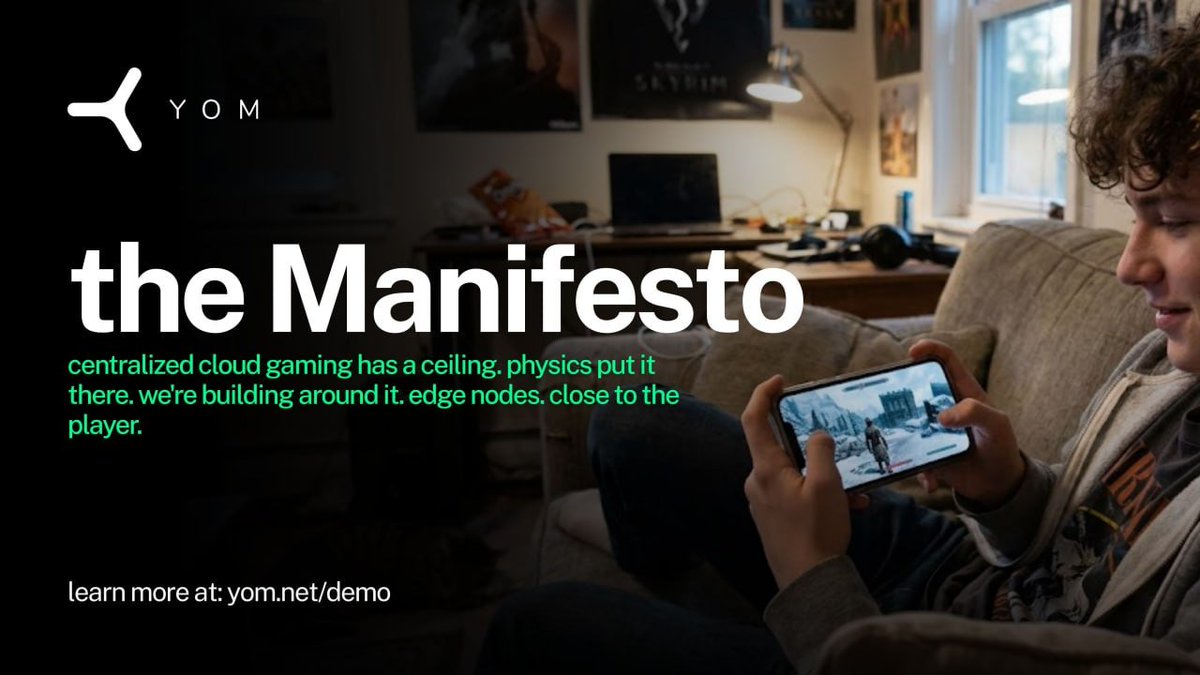
Somewhere, a billion-dollar company built a data center to stream games to your city.
It still adds 80ms of latency because it's 3,000 miles away.
Centralized cloud gaming has a ceiling. Physics put it there.
We're building around it. Edge nodes. Close to the player.
Click. Play. That's it.
https://t.co/EvAydwgc0G
Most Web3 games ask too much before the player plays.
Create a wallet. Fund it. Sign a transaction. Download a client. Install something else.
By the time the game loads, the player is gone.
YOM runs token mechanics under the hood. Click a link. Game streams. The chain stays the friction leaves.
The hidden problem with cloud gaming:
The bigger your audience, the heavier your bandwidth bill.
Centralized infrastructure punishes scale. Indie studios get hit first.
YOM's edge mesh flips the math. Compute moves closer to the player. Cost gets distributed instead of concentrated.
That's the structural alternative.
→ Learn more at https://t.co/EvAydwgc0G
A player presses play in Lisbon. A node responds in Warsaw. Neither knows the other exists.
The network measures the work. Settles it in $YOM. On-chain. In seconds.
Two strangers, one game session, zero trust needed.
https://t.co/3xC4VJqSsc
Most things in crypto happen loudly.
This one happens quietly.
Every time the YOM network is used, the settlement contract burns a part of $YOM. Automatically.
No announcement. No event. Just usage, doing its thing.
https://t.co/3xC4VJqSsc