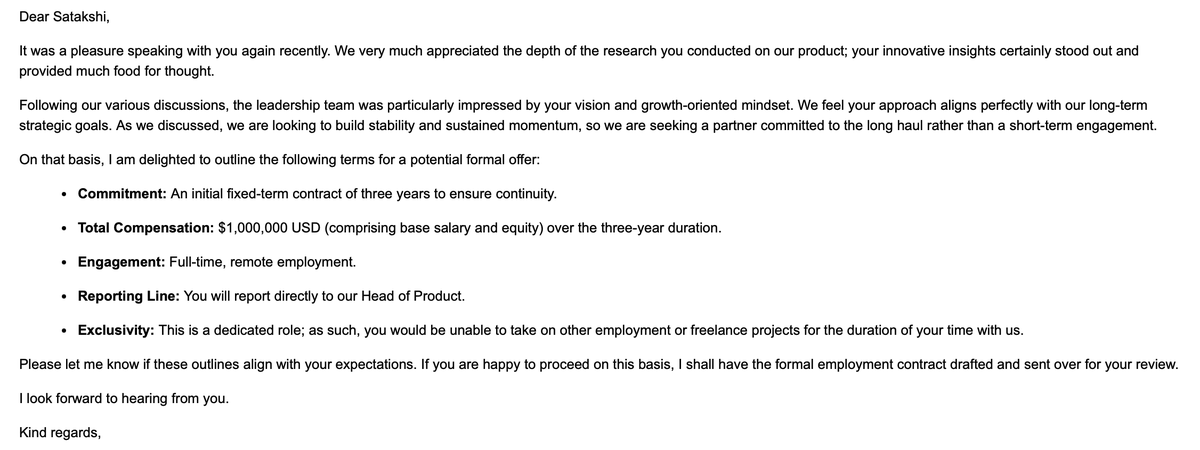
Our internal data shows Claude is accelerating AI development—a possible path to recursive self-improvement, or AI autonomously building a more capable successor.
It’s happening faster than we thought, and the implications deserve greater attention. https://t.co/OVVPJO7VQx
Transitioning Gemini CLI users to Antigravity CLI
We are unifying our efforts around a single harness and platform, Google Antigravity with four distinct surfaces:
• Antigravity 2.0
• Antigravity CLI
• Antigravity SDK
• Antigravity IDE
This will allow us to move faster and give you a streamlined experience wherever you do your best work.
Rebuilt in Go for speed, Antigravity CLI is available today and brings robust multi-agent orchestration and asynchronous workflows to your terminal.
Important things to know:
1. If you are using Gemini CLI through your Google one account (Google AI Pro or AI Ultra) or through Gemini Code Assist for individuals (free offering) we will be helping you migrate your workflows over the next 30 days.
2. No action required for Enterprise users. Enterprise plans and API keys will continue to be supported in Gemini CLI.
Read the full details in our blog post → https://t.co/IqvqDt9XLn
@PackBropagated Sadly it is human behaviour. Let's say u r 20 years into a job with limited growth oppurtunities(Happens as u rise in every company). If thr is a junior capable of doing u r work. Will u promote them & increase u r competition or delay their growth till u manage a promotion?
@SumitM_X https://t.co/VSxlo01RWP
Worth a read
In 2012 they were able to handle 1M+ connections per host. Erlang and the underlying BEAM architecture is so fascinating
The obsession with becoming a dollar millionaire is a vanity metric that only matters if your end goal is importing luxury goods or retiring in the US. For the vast majority of wealth creators in India, domestic Purchasing Power Parity (PPP) is what actually dictates your standard of living and financial stature. True wealth is built on how far your capital goes in the economy you actually live in, not an arbitrary foreign benchmark!
@SumitM_X I dont think Objects.isNull can cause a memory leak, you would probably nead to take a heap dump (will pause the prod service for a few seconds) and investigate
@SumitM_X In rebase all 50 of your commits are replayed one by one onto the head commit.
I have had good success with squashing to 1 commit and then rebasing that one commit onto main (ugly but easier to reason about)
At that point merge is fine too honestly (similar complexity)
Day 4/7 of Java Concurrency - wait(), notify(), notifyAll()
Every Java object has a monitor - a built-in lock + waiting room.
The API is simple - call wait() to release the lock and go to sleep. Another thread calls notify() to wake one sleeping thread up. notifyAll() wakes all of them.
You must hold the object’s lock to call these methods. Otherwise you get an IllegalMonitorStateException.
Never use if with wait() - The JVM is allowed to wake your thread for no reason at all - these are called spurious wakeups.
Always use a while loop to re-check the condition after every wakeup.
notify() wakes one random thread. If that thread doesn’t care about the condition that changed, you can lose the wake and potentially deadlock.
Almost always use notifyAll() - which wakes All waiting threads
In general we use higher level abstractions for synchronisation, but its good to know about the absolute fundamentals!
Day 3/7 of Java Concurrency -
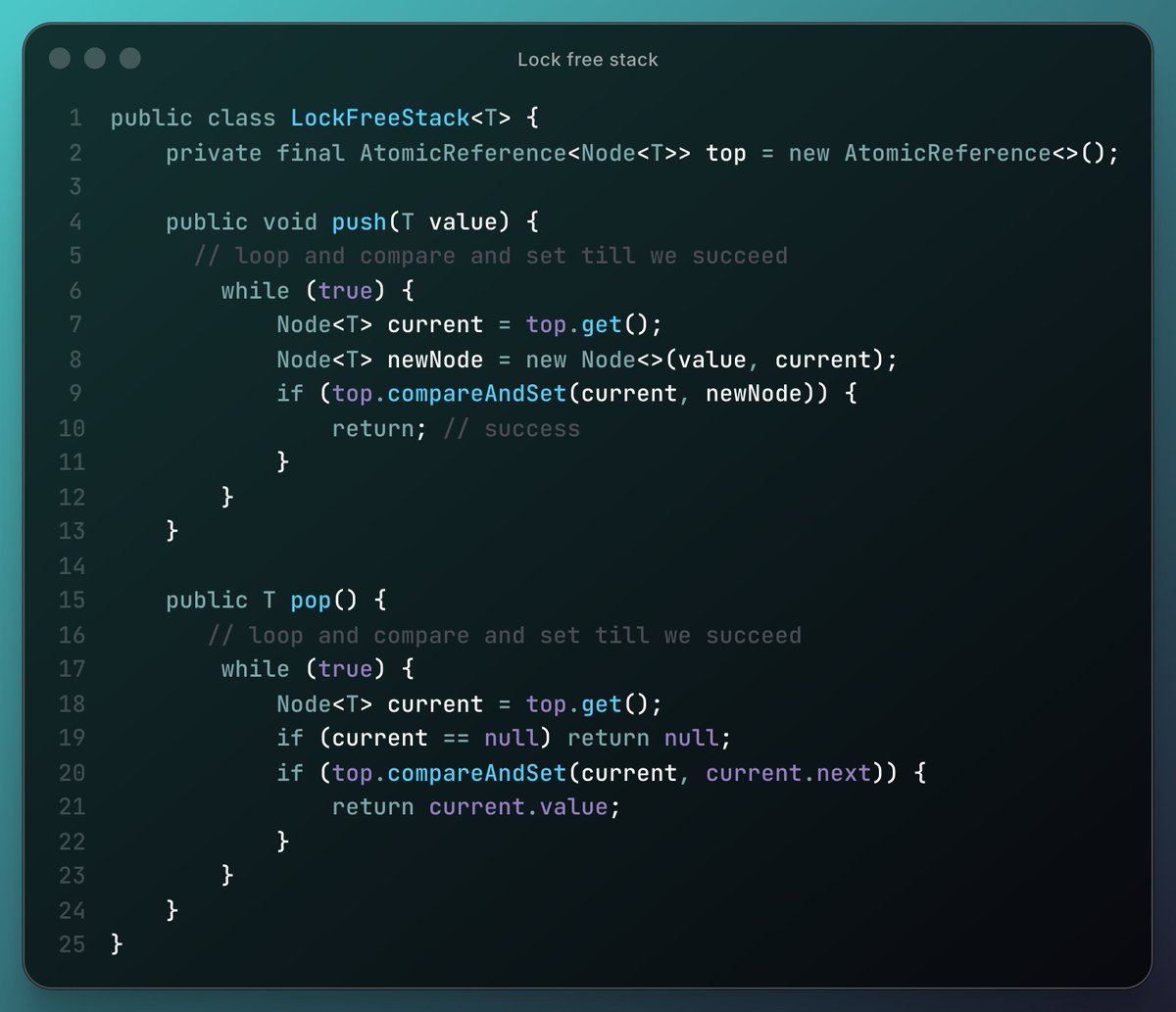
Compare and set - the secret sauce behind lock free data structures
Lock free data structures manage to avoid race conditions without using any locks at all - how is this even possible?
Enter compareAndSet, a method exposed by AtomicReference.
The API is very straightforward -
ref.compareAndSet(expected, newValue) -> if the current value is expected, then it sets it to newValue, otherwise if another thread updated it - we get a return false.
No waiting, no blocking.
The key pattern that makes this useful is running it in a loop, we keep comparing and setting in a loop till the thread eventually gets one return true, and we exit!
Look at this lock free implementation of a stack that can handle concurrent reads and writes!
@SumitM_X public String getUserName(User user) {
if (user == null) {
return "No User";
}
String name = user.getName();
if (name == null) {
return "No Name";
}
return name.toUpperCase();
}
Prefer using guard clauses, much more readable flat code