Tomorrow is Genetic Counselor Appreciation Day!
Yale Genetics’ genetic counselors help patients and families understand complex genetic information and make informed healthcare decisions. #GeneticCounselorAppreciationDay@GeneticCouns
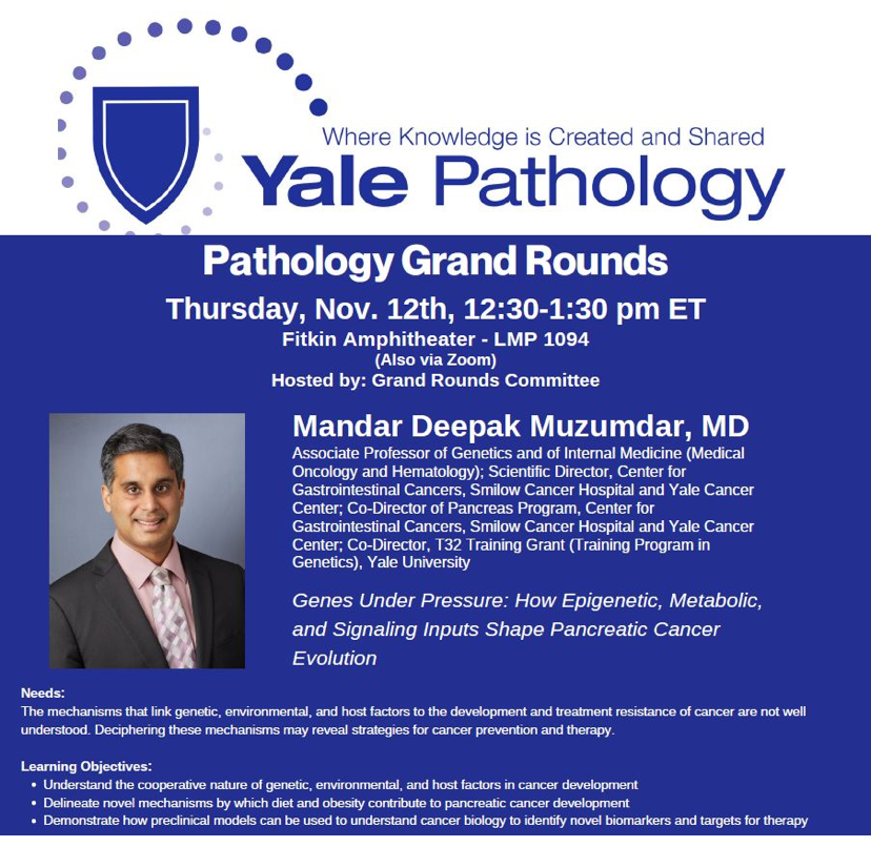
📣 TOMORROW 📣 (11/12) at Pathology Grand Rounds: how does pancreatic cancer evolve under pressure? Yale Genetics' @MuzumdarLab explores how epigenetic, metabolic, & signaling inputs shape cancer evolution in "Genes Under Pressure." 🧬 Find more details below 👇
What if routine primary care visits could flag your genetic risk before disease develops? Yale Genetics’ Yong-hui Jiang & Harlan Krumholz are coleading an NIH-funded initiative piloting genomic screening for actionable hereditary conditions in primary care
https://t.co/5s1kWZeWbD
TODAY! 11/10/26 Genetics Seminar Speaker Dr. Ibrahim Cisse, PhD, Max Planck Institute of Immunobiology and Epigenetics, presents: “Super-resolution imaging of transcription in living cells.”
Link below... https://t.co/RJorvbrHxO
Glad to share our latest publication in @naturemethods: Nondisruptive 3D profiling of combinations of epigenetic marks in single cells.
Epigenetic states and 3D chromatin folding are critical regulators of many genomic functions. While these mechanisms are known to be closely interlinked, studying their relationship remains challenging due to technical limitations. Sequencing-based single-cell or spatial histone modification profiling techniques often suffer from low sequencing read count per cell or per spatial spot, limiting gene-locus-specific analyses at the single-cell level. A recent imaging-based method termed epigenomic MERFISH (Cell 2022) enabled single-cell in situ histone modification profiling in a locus-specific manner with high genomic resolution (~2 kb). However, epigenomic MERFISH is limited to profiling only one epigenetic mark at a time, performs poorly when profiling repressive mark, and as we show in this work, disrupts the 3D genome thus prohibiting 3D genome co-profiling.
To address these limitations, we developed Epigenetic Proximity Hybridization Reaction (Epi-PHR), an imaging-based technology that represents the first epigenetic profiling method that:
🧬1) can simultaneously profile more than one histone modification and chromatin associated protein at numerous genomic loci with high genomic resolution,
🧬2) is non-disruptive and retains 3D chromatin architecture, and
🧬3) inherently provides single-cell, single-copy and in situ information.
We first demonstrated Epi-PHR's sensitivity at small genomic targets of 2 kb. We further showcased multiplexed Epi-PHR to profile combinations of epigenetic marks (including both active and repressive marks) at 200 genes in the same single cells in culture and tissue. Finally, we developed allelic Epi-PHR and combined it with fine-scale chromatin tracing to simultaneously profile epigenetic state and chromatin folding at the same genomic target with parent-of-origin specificity, generating the first single-cell phased examination of histone mark deposition and 3D genome architecture at an imprinted locus by any technique.
In the study of the imprinted locus, surprisingly we found among the maternal copies of this locus, the relationship between the histone mark and a chromatin domain boundary is opposite to what one would expect. This insight cannot be derived from existing bulk allele-specific CUT&RUN and Hi-C approaches. Our unexpected finding was uniquely enabled by allelic Epi-PHR combined with chromatin tracing.
We expect Epi-PHR will find broad application in diverse biomedical contexts. This work was co-led by Dr. Yanbo Chen, Dr. Jonathan Radda, and Dr. Myles Alderman III, and was done in collaboration with my @YaleGenetics colleague Professor Andrew Xiao. Thank you all my co-authors for your contributions to this work!
Link to paper: https://t.co/iXoPN8D8lr
Congratulations to Yale Genetics’ Dr. Nicole Lake @NicoleLake on two new NIH grants! Her work will develop new genomic tools for interpreting mitochondrial genome variation and investigate how mitochondrial DNA mutations drive neurological disease.
https://t.co/GXc89VjcBF
A study of 1 million diverse genomes identified mutations in FNIP1 linked to more muscle, less belly fat & lower blood sugar. Carriers had a 60% reduced risk of cardiometabolic disease, pointing to a possible drug target for diabetes + heart disease
https://t.co/CRs6osS2ar
Human pluripotent stem cells often develop differentiation biases in the lab, limiting disease modeling. A new study traces this to epigenetic drift and offers a chemical approach to restore their full differentiation potential.
https://t.co/gLFNDpsS3n
SAVE THE DATE! 11/10/26 Genetics Seminar Speaker Dr. Ibrahim Cisse, PhD, Max Planck Institute of Immunobiology and Epigenetics, presents: “Super-resolution imaging of transcription in living cells.”
Link below...
https://t.co/RJorvbsfnm
CRISPR is getting an upgrade. Instead of cutting DNA, a new wave of epigenetic editors modify the chemical markers attached to it, switching genes on/off without altering the genetic code itself. Safer, reversible, & showing promise in early trials
https://t.co/oow1joAsQx
🐙 Octopuses are strange down to their molecules. A mutation in their ribosomal RNA gene, found in no other organism on Earth, makes their protein-building machinery exceptionally accurate, resulting in fewer errors and less toxic protein buildup.
https://t.co/bMuTsCQe6Y
TODAY! 11/03/26 Genetics Seminar Speaker Dr. Oliver Hobert, PhD, Columbia University, presents: “Nervous system patterning and evolution in nematodes.”
Link below... https://t.co/n7QyFDm0BZ
A former goalkeeper and current PhD student reflects on how elite sport prepared them for lab life and where that preparation fell short. Read their essay on failure, uncertainty & staying steady when answers don't come easily 👇
https://t.co/4OSvVGD1UT
Moderna's newly FDA-approved mRNA flu vaccine delivers mRNA encoding the flu virus's hemagglutinin protein, triggering immunity. Its mRNA platform allows rapid reformulation to match evolving influenza strains, a key advantage over traditional vaccines 💉
https://t.co/lREB4rppN7
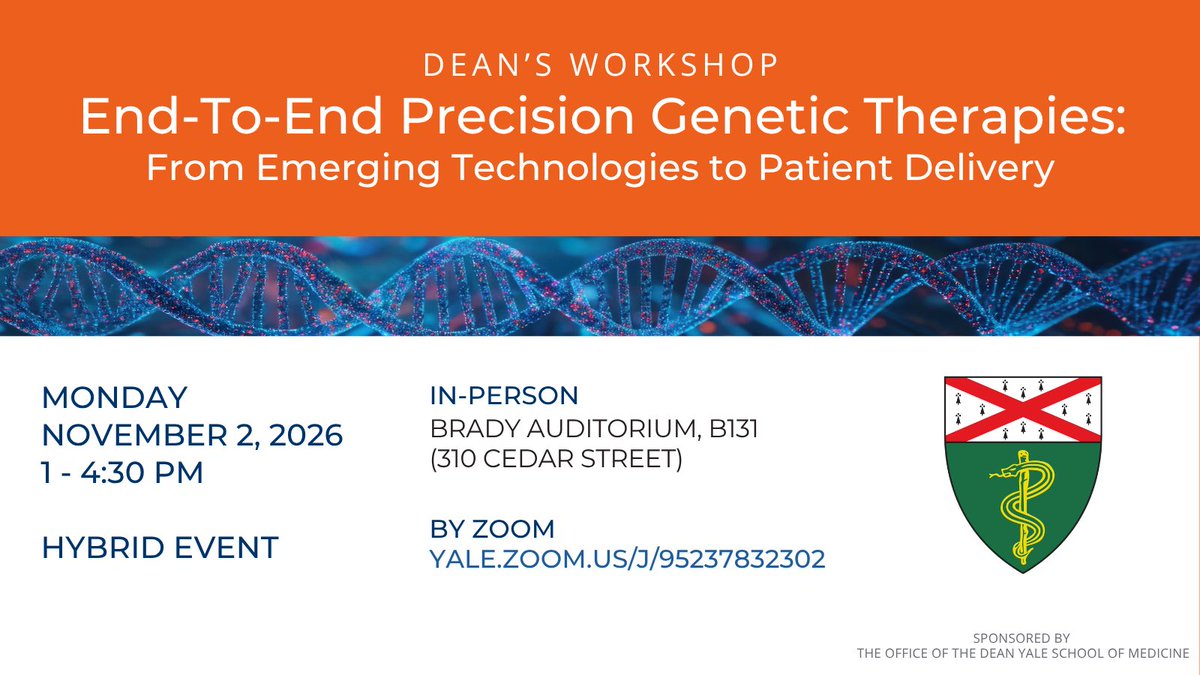
What does it actually take to bring a precision genetic therapy to patients? 🧬 Allyson Berent of @cureangelman joins the panel at the Dean's Workshop on Precision Genetic Therapies on Nov. 2nd to tackle that question.
👇See more info on the event here👇 https://t.co/HgICIvv8B9
SAVE THE DATE! 11/03/26 Genetics Seminar Speaker Dr. Oliver Hobert, PhD, Columbia University, presents: “Nervous system patterning and evolution in nematodes.”
Link below...
https://t.co/n7QyFDm0BZ
Why do some kidney transplant patients experience rejection despite treatment? A new Yale study links variants of the APOL1 gene to heightened immune activation and poorer graft survival, revealing a potential genetic mechanism behind transplant rejection
https://t.co/G65V3fOKT5
Fibromyalgia affects ~3% of the world yet its genetic basis is poorly understood. A new Yale-led study of 1.7 million subjects identified 45 genomic loci linked to the condition, pointing to shared architecture w/ chronic pain & autoimmune traits
https://t.co/1H8RAGT67X
TODAY! 10/27/26 Genetics Seminar Speaker Dr. Priya Moorjani, PhD, University of California, presents: "Mapping Our Past: Insights from Ancient and Modern Genomics."
Link below... https://t.co/sghfpqpssf