Breaking down Nigerian macroeconomics in premium local parlance & Gen Z speak. 📈Demystifying the "Yam & Knife" economy for consumers at home & the Diaspora. 🌍
NERSI's ₦50,000: what the minister said, what the programme page publishes, and the four answers still missing. Same questions for every camp. https://t.co/dtOAD9qlDX
@TomolaGroup 3.78m applied for the Dangote IPO; 0.97m hold money market funds. Why? Maybe they didn't know funds exist, couldn't meet the minimum, trusted the Dangote name more, or hoped for a quicker gain. And applying isn't buying: bids were 2.7x the offer. Which was it for you?
@thecableng From 25 Nov the CBN lets banks give each BDC $1m a week in dollar cash. Before, only 25% of the $150,000 limit could be cash. Yet banks already let naira cards pay abroad. Cards cover spending, not dollar notes. Is cash the gap BDCs fill? Wed: official ₦1,392, parallel ₦1,450.
@BusinessDayNg Pension assets: ₦31.8tn. FG securities: ₦17.8tn, about 56%. Infrastructure funds: about 1%. Private equity: under 1%. Any fund asks what safe return it gives up. T-bills near 16% (Sept) set the bar a small business must beat. Who benefits when that bar is high?
@cenbank Before the 2pm MPC briefing tomorrow, two numbers: policy rate 23%, inflation 14.06% (October). The gap, about 8.9 points, is how far the rate beats rising prices. A wide gap helps savers and squeezes borrowers. A cut narrows it. Are you a borrower or a saver?
@Afrinvest Two young earners on the ₦70,000 minimum wage earn ₦140,000 a month. The smallest Dangote IPO buy, ₦5,250, is 3.75% of that, before rent, food, school fees and transport. Oversubscribed 2.7x shows who had spare cash. How many young families have any?
4. Franchise or restructuring: Shoprite sold in 2021. The 2026 story is a franchise owner facing closures, rent and forex pressure. For any exit ask: who took over, did prices change, did jobs? Sources: Ecofin, Nairametrics, Legit.
Lists say 14 companies "left Nigeria". Read the sources and "left" means four different things, with different effects on your shelf, your price and your job. A short thread. 🧵
Between 2023 and November 2026.
Here are some notable companies that left Nigeria:
GlaxoSmithKline (GSK) - 2023
Procter & Gamble (P&G) - 2023
Bolt Food - 2023
Jumia Food - 2023
Unilever (selected product lines) - 2023
Sanofi - 2024
Kimberly-Clark - 2024
Equinor - 2024
Pick n Pay - 2024
Diageo (Guinness Nigeria stake) - 2024
Holcim (Lafarge Africa stake) - 2024–2025
Shell (onshore assets) - 2025
Shoprite (Nigerian franchise) - 2026
Uber - 2026
For example, GSK had operated in Nigeria for over 50 years before ending its direct operations in 2023.
What makes a company that has operated in a country for 30, 50 or even 80 years decide that its existing business model is no longer sustainable in Nigeria?
These companies survived military governments, economic recessions, political transitions and several currency crises and yet remain until after 2023.
Think deeply about what this means.
3. Import switch: the shelf stays, the price follows the dollar. P&G stopped local making. Kimberly-Clark is closing its Lagos factory. GSK moved to distributors. Fewer local jobs; more exchange-rate exposure.
@PremiumTimesng Bakassi port, three numbers missing. Cost: headlines say $3.5bn, the governor cited a $2.27bn initial funding approval. Who repays the Afreximbank money: not published. Finish date: none given. Same test for any project, any government: what it earns, who pays, by when?
@PremiumTimesng Last December, 28 firms got permits to capture flared gas: about $2bn and 3GW of power. Now a $2.2bn pitch. Same test for any pipeline of promises: how much is invested, how much power reaches the grid, by when? Flared gas is money burned. A plan is not yet a meter.
Two revenue numbers, one year. World Bank: ₦6.2tn federal revenue, Jan–Jun. Finance Minister: ₦33tn government revenue, Jan–Oct. The full-year federal target is about ₦34.3tn. Same yardstick? Ask both: what is counted, who keeps it, how much reaches the federal purse?
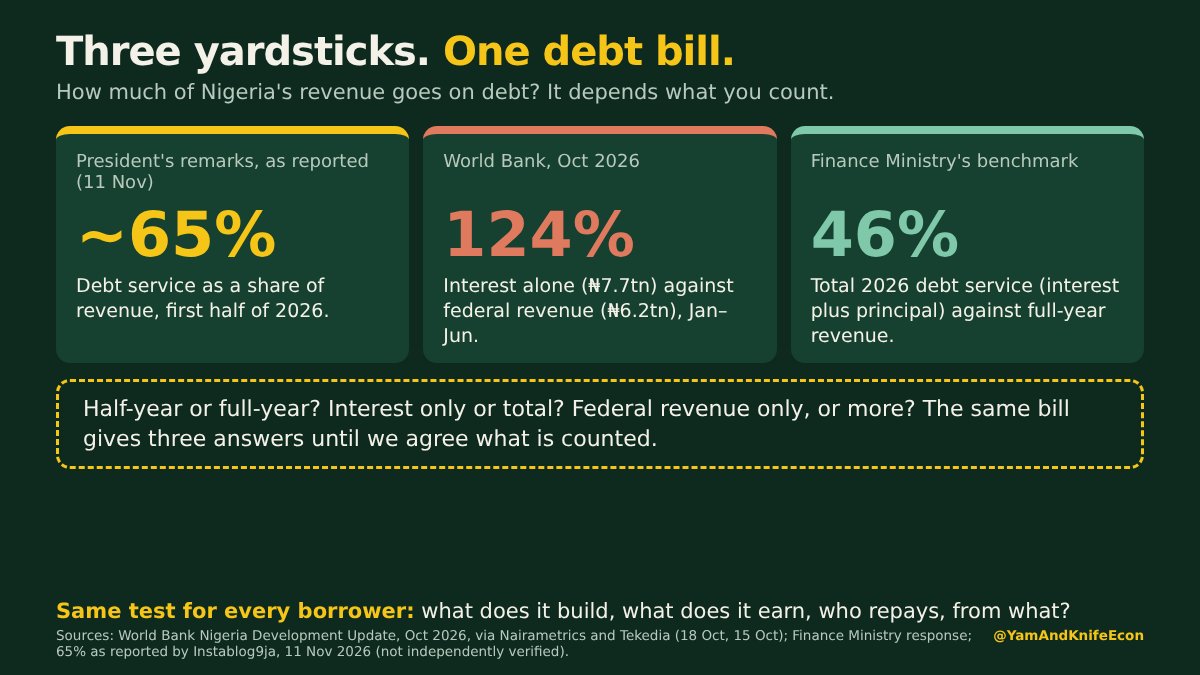
@instablog9ja The same bill in one picture. Half-year or full-year? Interest only or total? Until we agree what is counted, three answers can all be "right".
@instablog9ja Test for any loan, from any government: what does it build, what does it earn, who repays, from what? This post says debt service took about 65% of H1 revenue. World Bank: interest alone was 124%. Ministry: 46% for the full year. Three yardsticks, one bill. Which do we use?
@NaijaContext_ Why this matters for NERSI: the programme page says selection uses verified national ID records and wallets link to your NIN. If the World Bank's 121m against a 180m target is right (NIMC reports more), the ID gap is a payments gap too. Who is missing, and who fixes it?
@BusinessDayNg No registered phone, verified NIN or wallet? A poor household can be left out. A World Bank check found 56% of social protection beneficiaries were poor, but only 44% of benefits reached poor households. Same test for every scheme: who is listed, who is missing, who fixes it?
@PoojaMedia Fuller write-up of the questions people are asking on NERSI: what was said, what the programme page publishes, and the four answers still missing. https://t.co/d74pizWGZp
NERSI's ₦50,000: what the minister said, what the programme page publishes, and the four answers still missing. Same questions for every camp. https://t.co/dtOAD9qlDX
@PoojaMedia That Moniepoint code matches the one on the ministry's own NERSI page. Check three things on any message: right sender, only "reply YES" or your provider's code, and never a request for money, PIN, OTP or a link. Anything else, don't reply.
@TrendingEx Unofficial dates aren't a schedule. What's published: the minister said ₦50,000 monthly; the ministry's FAQ says ₦50,000, nothing deducted, no frequency. Unpublished: monthly or one-off, how many households, who funds it. Same three questions for every camp.