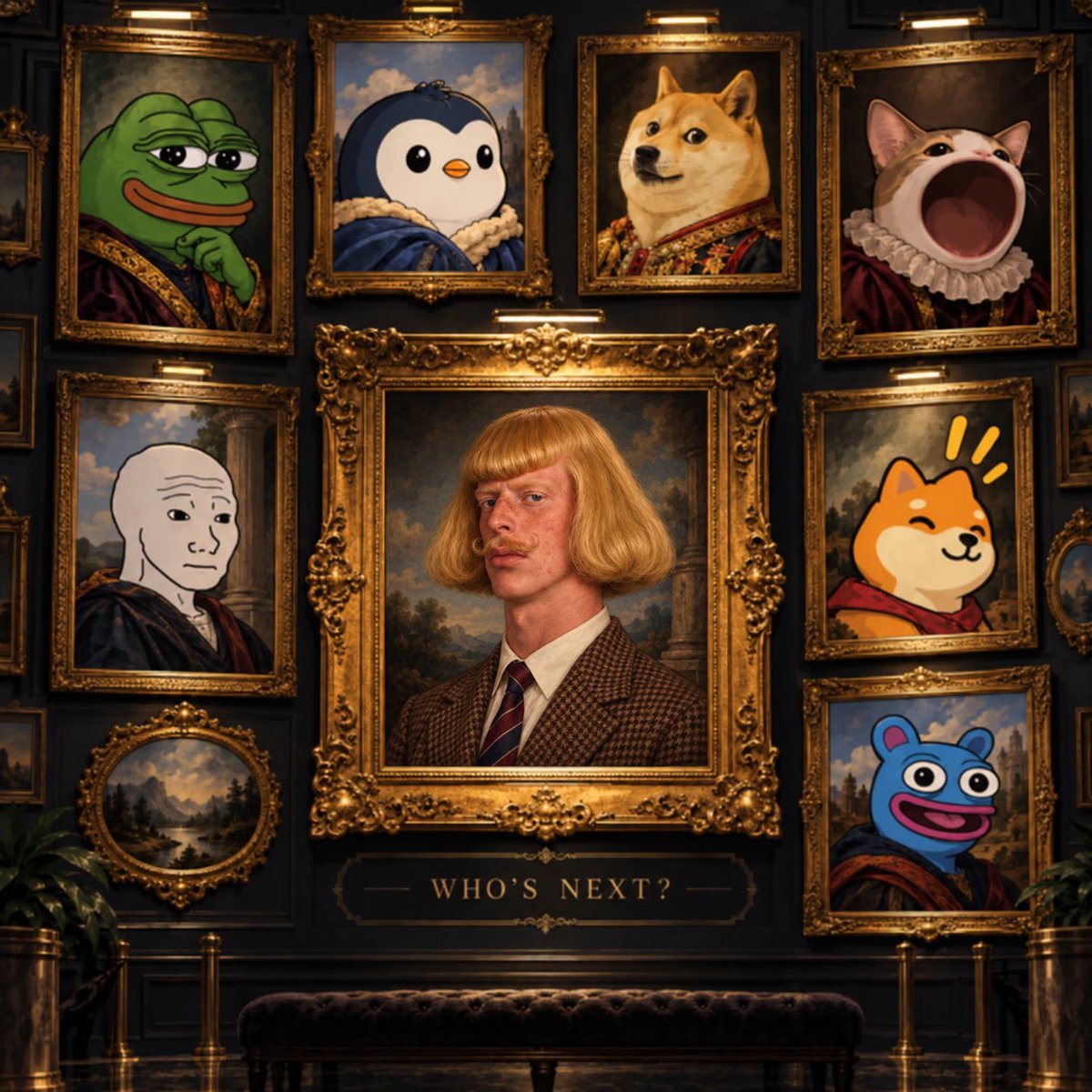
Our top holder just locked 5% of the entire solana:GTBxUiw6wJdmmkCGZgRHLyYxqu1vG4KtRpeox6yDpump supply into a non-cancelable Streamflow contract.
Not words. Not a screenshot. Not "trust me." Locked in code, for anyone on earth to verify.
What it means:
•Non-cancelable. It cannot be undone, not by them, not by anyone, ever.
•Fully locked until April 2027, then vesting gradually all the way into April 2028.
•Our biggest hand is committed for the long haul. No rug. No early exit. No games.
To everyone who doubted us, who called it, who said we were stalling, who said it would never happen: it's live, it's real, and it's permanent. You don't have to take my word for a single thing. Click the link and see it yourself.
PROOF, on-chain, right here: https://t.co/iwhMIIlUHf
$JEANPHIL launched 100% fair. No presale, no team allocation. And now our top holder is locking down and building toward 2028 and beyond.
We said we'd bring the proof the second it was done. Here it is. This is the next chapter.
$JEANPHIL
My Thoughts on $CLAUDIA, $JEANPHIL, and AI-Native Virtual IP
I believe AI-native virtual IP is emerging as a new industry, although it has not yet become a clearly defined, mature industry with established business models. More accurately, it is an emerging sector at the intersection of AI technology, entertainment IP, virtual idols, digital humans, short-form video, and fan economics.
The key distinction is whether AI is simply a tool used to create IP, or the underlying production model through which that IP is created and operated from the very beginning.
Traditional virtual IP is nothing new. Virtual idols, anime characters, game characters, and virtual influencers have existed for years. The real change is that AI is significantly lowering the cost of character creation, music production, video generation, and ongoing operations, while giving characters new opportunities to interact continuously with their audiences. Deloitte, a media and entertainment industry research firm, has also identified the integration of generative AI into everyday creative workflows and the rise of AI musicians and virtual influencers as trends worth watching.
So why do I believe this is becoming a new sector?
There are three developments worth paying attention to.
1. Character production is shifting from project-based creation to continuous operation.
In the past, building a virtual character typically required teams specializing in modeling, animation, screenwriting, voice acting, and operations. AI is lowering the costs across these areas, giving individual creators the opportunity to continuously produce music, videos, stories, and social media content around the same character.
In 2026, Japan's Dentsu launched CHARAMO, an AI-driven IP growth platform covering character development, social media content, character chat, podcasts, and merchandise. This shows that the industry is beginning to explore how AI can be used to operate characters continuously, rather than simply generate individual pieces of content.
2. Characters have the potential to evolve from content people watch into interactive digital personalities.
The difference between traditional virtual IP and AI-native virtual IP is becoming increasingly clear.
Traditional virtual IP: Characters are designed by teams and reach fans through animation, comics, games, performances, and other forms of content. Interaction and content updates generally depend on the production team.
AI-native virtual IP: Characters can continuously generate different forms of content and maintain relationships with users through conversations, personalized responses, and community interactions. They have the potential to evolve from protagonists in individual pieces of content into digital personalities that can be operated over the long term.
There are already concrete commercial experiments in this direction. For example, in 2026, WEBTOON partnered with Genies, with plans to turn comic characters into interactive digital avatars, exploring new fan experiences and monetization opportunities for creators.
3. The barriers to producing and operating IP may both decline.
In the past, whether a character could become a commercially valuable IP depended heavily on the production resources behind it. AI gives more creators the opportunity to develop characters, but it also means that the supply of content will grow rapidly.
Ultimately, the competitive advantage may shift from who can produce content to who can create characters that people remember and continuously build their influence over time.
AI lowers the barrier to producing characters, not the barrier to building a successful IP.
Applying this idea to projects such as CLAUDIA and JEANPHIL, we can view them as early experiments in this emerging sector. Creators use AI to produce content continuously, build attention around a consistent character, and then attempt to develop that character into an independent entertainment IP.
However, two layers need to be distinguished:
At the IP level: Can the character develop a stable audience, a coherent body of content, and cultural influence?
At the token level: Can that influence generate sustained demand for the token and a clear mechanism for value capture?
Success at the first level does not guarantee success at the second. A character can become a popular virtual IP while its associated memecoin still lacks a sustainable economic mechanism.
My conclusion is that AI-native virtual IP is an emerging industry worth paying attention to. But the long-term opportunity is not about how many videos AI can generate. It is about whether AI enables more people to create virtual characters that attract sustained attention, independently expand their own content worlds, and eventually become commercially valuable IPs—and whether the associated tokens can capture some of that value.
AI has officially broken the timeline.
First JeanPhil took over reality.
Now he’s rewriting internet history.
Skibidi? Non.
JeanPhil-di.
There is no escape.
Oui madame. 🥖
@JeanPhilMadame#JeanPhil#Skibidi#AI