I promised the second part of why I believe Ukraine will be able to get its territories back.
Many critics said Ukraine does not have enough troops to win everything back by force.
This misses the central point.
The key to Ukrainian victory is not necessarily marching infantry through every occupied village.
The key is the economic collapse of Russia’s war machine.
I believe Russia will sustain such huge economic losses that it will eventually face an Afghanistan-like withdrawal from occupied territories. Not because Moscow suddenly becomes moral. Not because Putin wakes up and respects international law. But because the occupation becomes economically, militarily and politically unsustainable.
Ukraine does not need to “win everything back” in the primitive sense of physically storming every meter of land.
Ukraine needs to make Russian occupation impossible to maintain.
And this is exactly where the economic numbers become decisive.
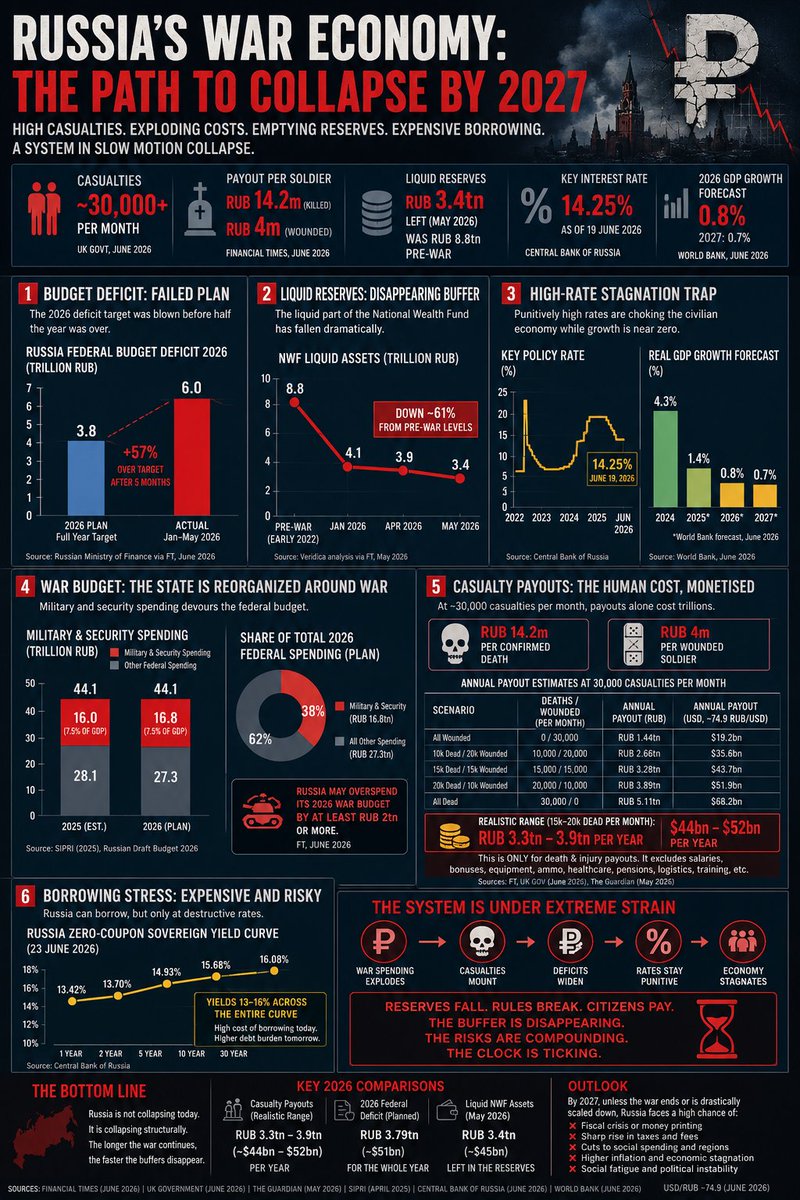
Russia is losing around 30,000 men per month or more. According to the current payout structure discussed in the FT, the federal payout is roughly RUB 14.2 million per confirmed death and around RUB 4 million per wounded soldier.
Now do the math.
At 30,000 casualties per month, Russia is processing around 360,000 casualties per year.
If a serious share of those are fatalities — and current estimates suggest a very high fatality rate — the direct death and injury payout bill alone can reach roughly RUB 3.3–3.9 trillion per year.
That is about $44–52 billion per year.
And this is only the payout for dead and wounded soldiers.
It does not include salaries.
It does not include signing bonuses.
It does not include pensions.
It does not include hospitals.
It does not include prosthetics.
It does not include ammunition.
It does not include drones.
It does not include tanks, artillery, logistics, missiles, fuel, transport, mobilisation, internal security, repression, propaganda, or reconstruction of destroyed units.
This is just the cost of monetising the human meat grinder.
Now compare this to the Russian federal budget.
Russia’s total planned federal expenditure for 2026 is around RUB 44 trillion.
So casualty payouts alone may consume roughly 7–9% of the entire federal budget.
Again: not the war. Not the army. Not defence. Just compensation for dead and wounded.
Then add the broader war budget.
Russian military and security spending is around RUB 16 trillion a year, roughly 35–40% of total federal spending.
This means the Russian state is no longer running a normal economy with a military component.
It is running a military machine with a civilian economy attached to it.
And the fiscal position is already deteriorating.
The planned 2026 deficit was around RUB 3.8 trillion.
By May, the deficit had already reached around RUB 6 trillion.
So the full-year deficit target was effectively destroyed before half the year was over.
At the same time, Russia’s liquid reserve cushion is shrinking. The liquid part of the National Wealth Fund was roughly RUB 8.8 trillion before the full-scale war. It is now around RUB 3.4 trillion.
This is the strategic buffer that allowed Russia to pretend it was stable.
That buffer is disappearing.
Then look at borrowing.
Russia can still borrow, yes. Nobody serious says otherwise.
But the point is not whether Russia can borrow.
The point is the price.
Russian sovereign yields are around 13–16% across the curve. That means the state is borrowing at destructive rates to finance war, casualties, compensation, drones, shells, pensions and occupation.
This creates the trap.
War spending increases the deficit.
The deficit requires borrowing.
Borrowing is expensive.
Expensive borrowing raises debt-service costs.
High rates crush the civilian economy.
Weak civilian growth reduces future tax capacity.
The state becomes even more dependent on war spending to keep GDP alive.
This is not strength.
This is fiscal cannibalism.
People look at Russian GDP and say: “See, Russia has not collapsed.”
This is childish analysis.
GDP can be positive while the underlying economic structure is being destroyed.
If you pay people to build tanks, dig trenches, produce shells, repair destroyed equipment and compensate dead soldiers, GDP may still show activity.
But that activity does not create future prosperity.
It consumes future capacity.
Russia is converting oil revenue, reserves, labour force, industrial capacity and state credibility into temporary battlefield pressure.
That can work for a while.
It cannot work forever.
Every month Russia continues this war, it loses tens of thousands of men, burns billions in payouts, destroys equipment, increases hidden liabilities, drains reserves, raises borrowing pressure, and forces the civilian economy to carry the war economy on its back.
This is why I believe Russia will not sustain this indefinitely.
The collapse will probably not look like a Hollywood scene.
It will look like Afghanistan.
First the empire says withdrawal is impossible.
Then it says it is only “repositioning.”
Then it says the operation achieved its objectives.
Then it leaves.
Ukraine’s task is therefore not to defeat Russia in some childish movie sense.
Ukraine’s task is to keep increasing the cost of occupation until Moscow’s equation breaks.
And this equation is already breaking.
Russia can occupy land only if it can afford the men, money, equipment, logistics, political repression and social silence required to hold it.
By 2027, I believe this model becomes structurally unsustainable.
That is why I believe Ukraine can get its territories back.
Not because Russia suddenly becomes weak in one day.
But because the war economy is slowly eating the Russian state from inside.