Today we welcome #UofT's 17th president, Melanie Woodin. An internationally recognized neuroscientist and double graduate of U of T, Woodin starts a new chapter on her first day in office. ➡️ https://t.co/m7LbcVmGyt
Please read our statement on the remarks made by Dr. Rosalind Picard at her NeurIPS 2024 invited talk and our commitment to respect, inclusivity, and upholding our values:
https://t.co/AsAtriVq5V
NeurIPS acknowledges that the cultural generalization made by the keynote speaker today reinforces implicit biases by making generalisations about Chinese scholars. This is not what NeurIPS stands for. NeurIPS is dedicated to being a safe space for all of us. We want to address the comment made during the invited talk this afternoon, as it is something that NeurIPS does not condone and it doesn't align with our code of conduct. We are addressing this issue with the speaker directly.
NeurIPS is dedicated to being a diverse and inclusive place where everyone is treated equally.
BREAKING NEWS
The Royal Swedish Academy of Sciences has decided to award the 2024 #NobelPrize in Chemistry with one half to David Baker “for computational protein design” and the other half jointly to Demis Hassabis and John M. Jumper “for protein structure prediction.”
Geoffrey E. Hinton, awarded the 2024 #NobelPrize in Physics, was born in 1947 in London, UK.
He earned his PhD in 1978 from the @EdinburghUni, UK. Hinton is currently a professor at the @UofT, Canada.
https://t.co/tmocGUNQvg
BREAKING NEWS
The Royal Swedish Academy of Sciences has decided to award the 2024 #NobelPrize in Physics to John J. Hopfield and Geoffrey E. Hinton “for foundational discoveries and inventions that enable machine learning with artificial neural networks.”
#UofT Professor Emeritus Geoffrey Hinton has won the 2024 Nobel Prize for Physics.
Hinton shares the prize with John J. Hopfield “for foundational discoveries and inventions that enable machine learning with artificial neural networks.” #NobelPrize https://t.co/NkWyAwi3eZ
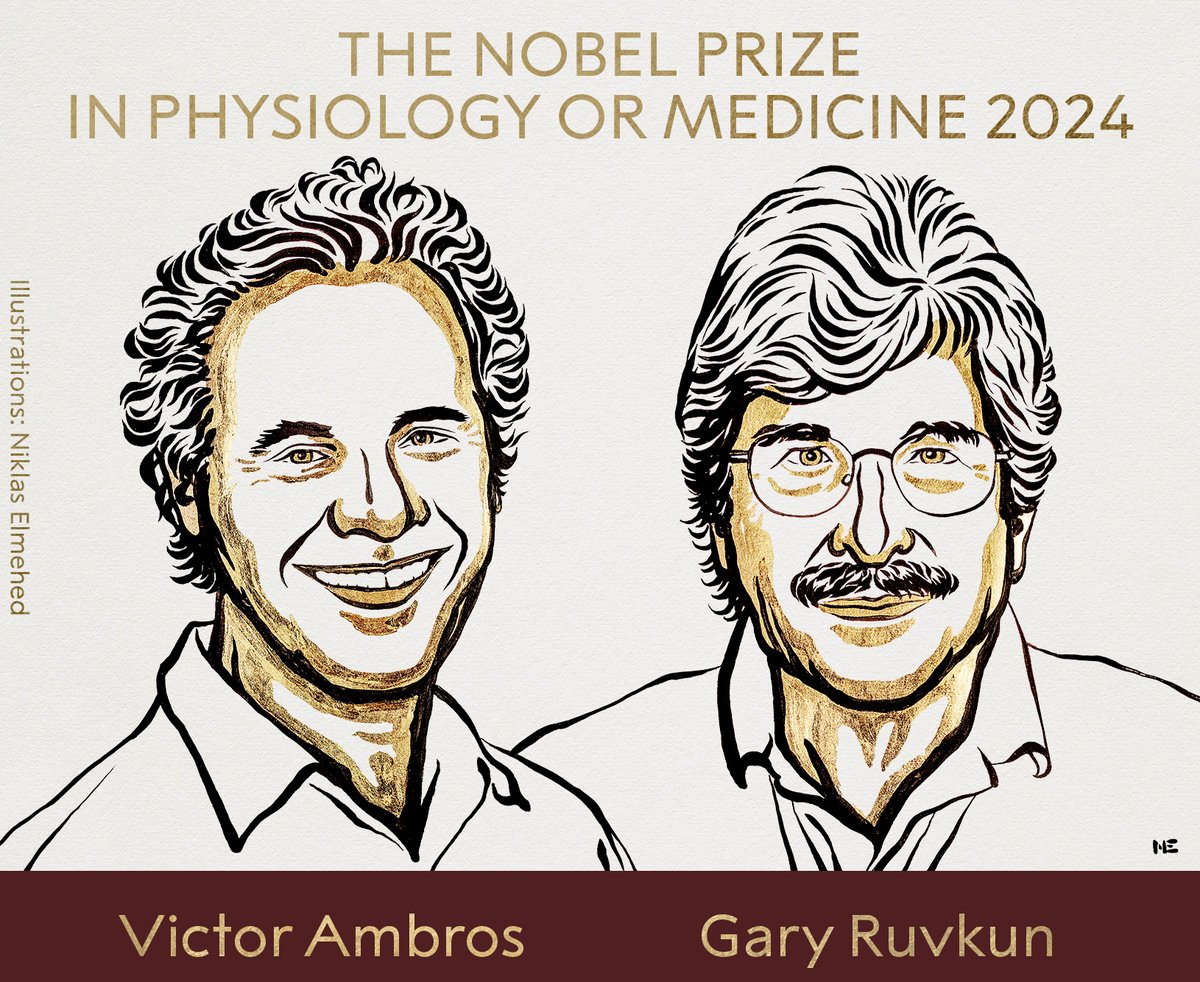
Congratulations to MIT alumnus Victor Ambros '75, PhD '79 and former postdoc @gary_ruvkun for winning a Nobel Prize in Medicine or Physiology! 🏅 @MIT_alumni
@Jiankui_He This is a seriously disturbing announcement that reflects your twisted view of scientific merit. I hope you no longer have access to any laboratory materials that will enable you to ruin the reputation of Chinese scientists again.
🚀 The Segment Anything Model (SAM) has been upgraded to SAM2, featuring an efficient image encoder for segmenting images and videos. But does SAM2 outperform SAM1 in medical image and video segmentation?
We're thrilled to present our paper "Segment Anything in Medical Images and Videos: Benchmark and Deployment"! We comprehensively benchmark SAM2 across 11 medical image modalities and videos.
📄 Paper: https://t.co/NSymKcOJ8q
💻 Code: https://t.co/9B7CG8J655
**Highlights:**
1. SAM2 doesn’t always outperform SAM1 in 2D medical images, but excels in video segmentation, making it more accurate and efficient for 3D images, such as CT and MR scans.
2. MedSAM still outperforms SAM2 on most 2D modalities, but SAM2 surpasses MedSAM for 3D image segmentation in a slice-by-slice approach.
3. Segmentation performance varies with model size; sometimes the smallest model outperforms larger ones.
4. Fine-tuning SAM2 significantly boosts its performance for medical image segmentation.
While SAM2 may struggle with challenging objects that have unclear boundaries or low contrast, it excels in generating good initial segmentation masks for common medical images and videos. However, the official interface doesn’t support medical data formats and has limitations on video length. To address this, we've developed a 3D Slicer Plugin and Gradio API for efficient 3D medical image and video segmentation. We invite you to try them out and provide feedback!
🔧 Deployment:
- 3D Slicer Plugin: https://t.co/j83JChav2r
- Gradio API: https://t.co/4zJUuPFR12
(Note: Due to GPU limitations, the online API is available for only 12 hours and may be slow. We highly recommend deploying the Gradio API with your own computing resources: https://t.co/q5UydWs6Xd
A big shoutout to Jun Ma (@JunMa_11) who recently joined our UHN AI hub (@UHNAIHUB) as Machine Learning Lead, and kudos to all co-authors: Sumin Kim, Feifei Li, Mohammed Baharoon (@BaharoonMS), Reza Asakereh, and Hongwei Lyu! This is true teamwork!
Looking forward to collaborating with the community to advance 3D medical image and video segmentation foundation models!
@UHN@UofTCompSci@UofT_LMP@UofT_TCAIREM@VectorInst
#MedTech #AIinHealthcare #DeepLearning #MedicalImaging #SAM2 #MedSAM #AIResearch