Vector Institute transforms cutting-edge artificial intelligence research into practical solutions. AI-generated content will be disclosed. FR: @InstitutVecteur
What does AI mean for the future of Canadian innovation and the public good? Hear from AI experts and innovators from organizations like @MaRSDD and @VectorInst at this free event.
📅 Sat, Nov 28 | 9:30 am-5 pm
📍 Toronto Reference Library
🎟️ https://t.co/OXKvbxIorV
Through a single, free application, you can share your academic background and research statement with Vector Faculty across the country who are actively recruiting for 2027.
Secure a connection with an interested supervisor before you navigate the formal university admissions process.
The priority deadline for full consideration by participating Faculty is this Friday, October 23 at 12:00 PM ET.
Learn more and apply today: https://t.co/FoGule6L4I
⏳ Priority applications are due this week for the 2026 Vector Graduate Student Program!
If you’re planning your master’s or PhD in AI, finding the right supervisor probably means you’re navigating dozens of directories and sending cold emails into the void. Our program offers a more direct route, putting your research fit first.
https://t.co/FoGule6L4I
Our social, economic, and political systems patch vulnerabilities at a human pace. Artificial intelligence operates at computer speed.
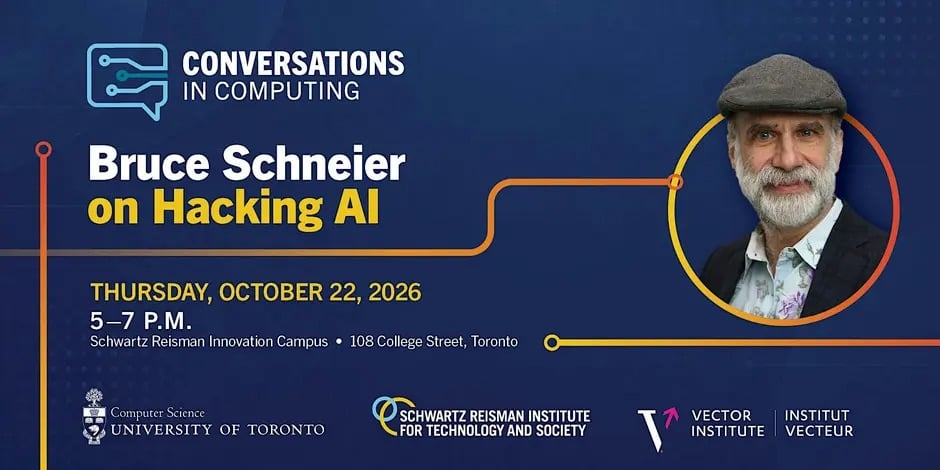
On October 22, security technologist Bruce Schneier will outline why this speed disparity matters. In Conversations in Computing: Hacking AI, he will explore how AI models are discovering and exploiting loopholes in human rule systems, from tax codes to financial markets.
Join Vector, @UofTCompSci, and @TorontoSRI for this in-person discussion:
📅 Thursday, Oct. 22 at 5:00 - 7:00 p.m
📍 Schwartz Reisman Innovation Campus, Toronto
ℹ️ Free admission, registration required.
Reserve your seat: https://t.co/cSBZkPpG86
We’re proud to welcome the @TownofCaledon as our first municipal partner. 🤝
Together, we’re bridging world-class AI research with civic reality, testing practical use cases, and building internal capacity to ensure any new technology deployed is safe, responsible, and focused on better outcomes for residents.
Learn more: https://t.co/1EQ1leHXA1
1/🧵New Research on LLM-Driven Discovery!
LLMs are increasingly used to discover new algorithms, theorems, and drugs by iteratively optimizing an objective inside a "harness."
Our finding: How you initialize a discovery harness matters a lot more than you might expect.
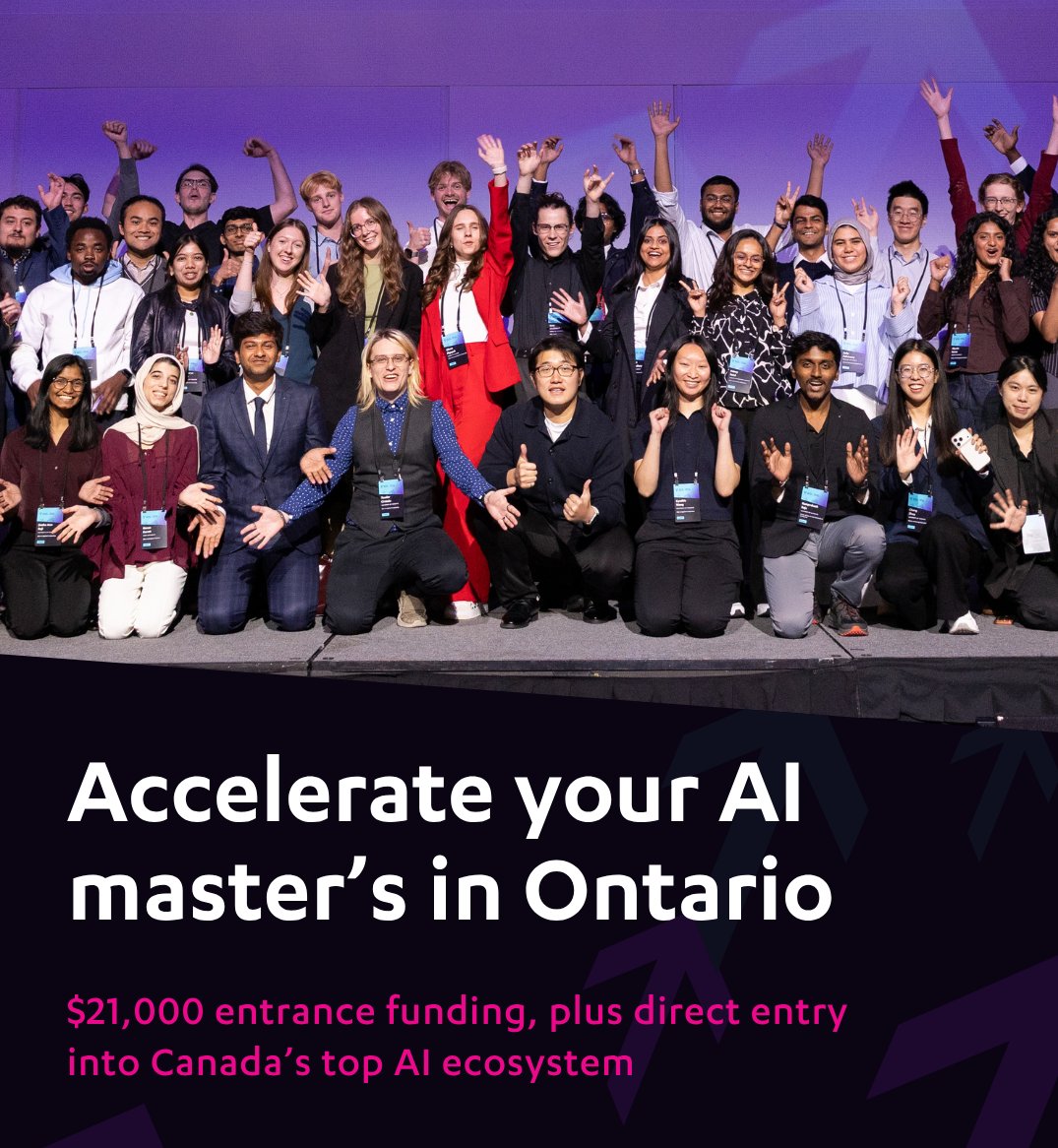
Are you applying for AI master’s programs in Ontario? Here’s how to put yourself in the running for an entrance scholarship with serious industry access.
For the 2027–28 academic year, the Vector Scholarship in AI (VSAI) increases to a $21,000 entrance award. Recipients also step straight into Canada’s most active AI ecosystem.
Here’s what VSAI recipients gain: 👇
Ready to plan your master’s pathway?
Explore Ontario’s 30 Vector-recognized programs and learn more about how the VSAI can open doors to your future today: https://t.co/hcGYs21NGL
Giving models structured context allows them to deliver high accuracy without heavy compute costs.
Vector's Ali Kore and Amrit Krishnan detail the complete extraction pipeline, evaluation methodology, and open-source code in our latest technical post: https://t.co/ur2kOipXqX
When AI systems search complex enterprise documents, standard retrieval methods often pull isolated snippets instead of connecting the facts; standard vector similarity search breaks down when retrieval-augmented generation pipelines require multi-hop reasoning.
Our AI Engineering team developed an alternative Entity-Based Knowledge Graph RAG architecture that increases retrieval accuracy by up to 54% on complex queries.
Continue reading to learn more, or go straight to the full analysis: https://t.co/Q6TCI8Hiyg
The results show clear advantages for structured knowledge. On complex multi-hop queries, retrieval accuracy increased from 40 per cent to 55 per cent using GPT-4o.
Smaller, cost-effective models like GPT-4o-mini jumped from 36 to 56% accuracy, all while adding only 0.05 seconds of latency. Providing structural context allows these smaller models to match the performance of larger models.