יוסי ורטר: ״תגובתו האינסטינקטיבית של גדי אייזנקוט כשנ��קל לראשונה בסרטון הליכוד שרימז לבנו ההרוג גל, הייתה הלם. הוא הריץ את יצירת הפאר לאחור, כמה פעמים. הוא באמת דומה לגל? שאל את יועציו. זו כנראה הכוונה, ענו לו. כמה העירו שהרקע הפסטורלי בצבעי פסטל רומז לגן עדן.
״בשעות שלאח�� מכן, כאשר תחושת הקבס שחש כל אדם הגון נסוגה מעט, הם הסיקו את המסקנות הבאות: הראשונה, אם 98 ימים לפני הבחירות נתניהו אינו מהסס לפגוע באב שכול מן המלחמה האחרונה, אזי הוא בלחץ. מדוע הוא בלחץ? כי מפלגת ישר כבר ראש בראש מול הליכוד, ובסקרים מסוימים אף מובילה במנדט. כי במדד ההתאמה לראשות הממשלה, שבעיני הסוקרים הוא קריטי, אייזנקוט פותח פער גדול. ואולי כי הרמטכ״ל לשעבר, שהוא האנטי-תזה של נתניהו בכל תחום אפשרי, הוא הפוליטיקאי השני הכי אהוב בקרב מצביעי הימין- אחריו״
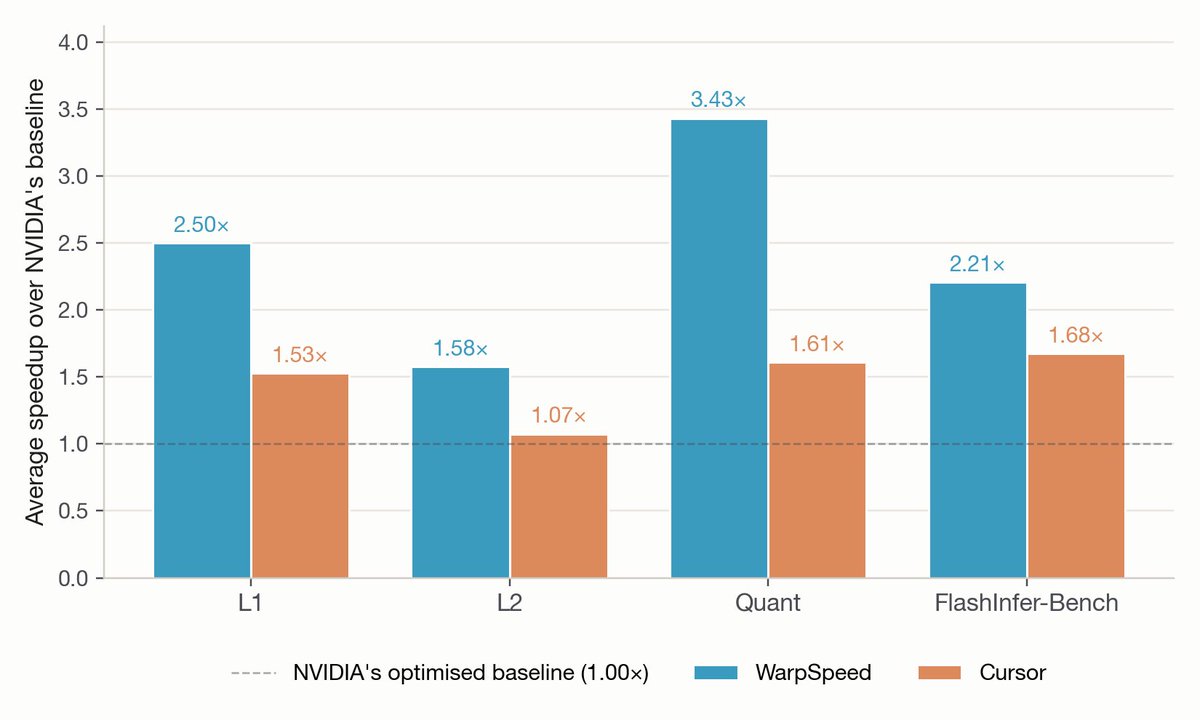
We ran WarpSpeed, our autonomous optimization agent, on @NVIDIA's new SOL-ExecBench for a single day.
It took first place by a wide margin, beating the optimized kernels on 90% of problems, with an average speedup of 2.24x.
ExecBench gathers 235 of the hardest CUDA kernels in production today, lifted from real workloads in DeepSeek, Qwen, Gemma and Kimi.
Blackwell kernels are notoriously hard to write. But we find that verification is just as hard.
We have a story to tell.
https://t.co/aQX9XXCz4z
אדוני המפכ״ל.
ככה לא אמור להראות בציבור שוטר במשטרת ישראל.
עם כיסוי פנים ( ממי הוא חושש ?)
ללא תג עם שמו עפ״י הפקודה ( מה הוא מסתיר ? ).
ועם מצלמת גוף ( רואה ואינו נראה) וקעקועים מפחידים על הידיים.
אזרחי ישראל הם הבעלים של המשטרה הזאת והלקוחות שלה.
השוטרים אמורים לשרת את הציבור ולא להטיל עליו אימה מראש
@IL_police
לקרוא ולא להאמין – ראש הממשלה הצליח להפחיד את עולם החוק הישראלי על מנת שלא יחקרו אותו באזהרה. מה קרה? למה לפחד? הגיע הזמן להעמיד את הבוגדים לדין! וחשוב לחקור את ראש הממשלה לדעת מה בדיוק קרה! חבל שהוא לא הבין שהיה צריך להקים ועדת בחירה בראשות שופט. מגיע לעם ישראל לדעת מה בדיוק קרה! זה יותר גרוע מווטרגייט.
(נטעאל בנדל: 7 ימים, ידיעות אחרונות/ עורכת 7 ימים: אפרת זמר ברונפמן/ עורך ראשי: ניקי לוי)
https://t.co/9wP4lsLCcE
פשוט לא יאומן!! פרסום ראשון: יומנו של שר המשפטים י��יב לוין נחשף: בחודשים יולי, אוגוסט וספטמבר נכח השר ב38 ארועים( חתונות, בריתות, בר מצוות) וזאת לעומת 4 פגישות בלבד עם משפחות החטופים!! היומן נחשף בעקבות בקשה של ��מותת הצלחה @elad_man.
לפי הפירוט הבא:
יולי: 13 ארועים
2 פגישות עם משפחות חטופים
אוגוסט: 6 ארועים
פגישה אחת עם משפחות חטופים
ספטמבר: 19 ארועים
פגישה אחת עם משפחות חטופים.
מישהו אמר סדר עדיפויות??
ראו הודעה שהועברה.
מפרסמת כי זה חשוב.
——
*יום א׳ | 27.10 | 8:30 | בית משפט השלום ברחובות*
📌
*סילמן רודפת אזרחים-תחילת שלב ההוכחות במשפט הפוליטי נגד ירדן מן.*
⚖️
*מתוכננים להגיע להעיד:*
המתלוננת הסדרתית השרה עידית סילמן, ובנוסף ארבעת העדים בתיק, אשר לטענת חלקם, ראו את האירוע *שלא* היה.
זהו היום הראשון מבין יומיים של דיונים, כפי שקבע בית המשפט הנכבד ברחובות.
*כולנו עומדים פה למשפט!!! בואו לקרוא לא לרדיפה פוליטית!*👊🏼
חשוב להפיץ, להפיץ, להפיץ כמה שיותר ולהגיע 💪
כתובת: בית משפט השלום, עמיאל רוז׳נסקי 9, רחובות (חניה בקניון עופר רחובות).
We’re collaborating with our competitors and it can actually help our business (and our users!).
Last week I met @MarcKlingen, the CEO and co-founder of @langfuse. We recently started collaborating around OpenTelemetry and OpenLLMetry with the goal of standardizing the way customers monitor their LLM-based applications. The idea is simple - to start monitoring, you need to install an SDK. This requires a lot of engineering effort across your entire stack. If you’re using a standard like OpenTelemetry, you only need to do it once. You’re then never vendor-locked to a single platform.
Mark and I are both strong believers in open source and open protocols. Both of our products are open-source based, and we win by building the best product for our users - not by locking them in our own ecosystem. By using OpenTelemetry, we will benefit from consolidating the endless effort of supporting the new advancements in the LLM world. Every day there’s a new model that needs to be supported; a new vector database; or a new breaking change to LangChain. You’ll be surprised, but a significant part of our day-to-day work is actually keeping up with changes. For me, OpenAI DevDay was more of an endless list of backlog tasks that I now need to implement rather than an exciting event (just kidding; it was also super exciting - I’ll write about it more next week).
The future is open; in my opinion, open tools will always win. I always prefer them over closed tools whenever I can. And so should you.
*In the photo: enjoying a cup of coffee at Sighglass SF
About a month ago, @galklm and I woke up one morning to discover a new customer of us had started to send us x100 traffic than all of our customers’ traffic combined. We were already handling billions of spans, but this was something else.
We got into “incident mode”. Opened our monitoring dashboards, checking for errors and alerts. Worrying that our customers cannot use our platform until we figure out what to do. But… everything was fine. Yes, there was a slight delay in writing records to our database, but we just added a couple more replicas to our writer service and everything calmed down.
We weren't just lucky. When we started @traceloopdev, we made an unconventional decision - build for scale from day 1.
It’s unconventional because when you’re starting a startup - you never think about scale. “Just get me one company to use my product and I’ll be happy”. So you usually build the scrappiest product you can just so you can get it out of the door - and then launch and iterate from there. Thinking about scale means you have to design, and you may move slower.
But, we think it doesn’t have to be that way. The cloud environment and infrastructure have developed so much in the past 20 years which makes it really easy to build scalable systems. With a couple of simple decisions you can build reliable systems and avoid huge refactors early on that WILL slow you down just as you’re starting to get your first users.
For us - we’re building a monitoring platform, so we don’t really have a choice - our users expect the platform to be extremely reliable. If your monitoring system is failing - how can you even trust it?
So we designed a scalable system. And it has proven to be one of the best decisions we’ve made.
We built a separate pipeline for handling data sent by our customers. The dashboard itself has much lower scale than the part of our application which processes logs and traces from application so it makes sense to separate it.
We’ve written everything in Go, which is one of the fastest languages out there that is also easy to use, we’ve added a Kafka cluster in between. It acts as a queue to backpressure incoming data and handle bursts. We deployed everything on Kubernetes so we can easily scale everything as needed.
It’s been a year now - and it never failed. Always build for scale.
I think this is one of the most visually appealing features we've developed at Traceloop. I'm excited to announce that we now natively support all vision models (OpenAI and Anthropic included).
You can now see traces of vision-based flows with no limit on the payload size (well, except for the limit imposed by the LLM itself).
No matter whether you're sending images as base64, or URLs - we've got you covered! and all with <0.001ms impact on app latency thanks to our native OpenTelemetry support.
Huge shout out for Gal Kleinman my co-founder and CTO for building this 🙌
Meta just released Llama 3.2 yesterday, and as usual they didn’t use an open-source license. Here’s why, and the connection to how open-source companies like us can make money.
There’s a pretty easy way to understand the definition of what is an open source project - it’s a project that publishes its own code, and allows anyone to do anything they want with it. No restrictions.
The good thing with that is that it fosters a developer community - people come and want to contribute for free and help you build your project - because they know that anyone (including themselves) can use it whenever they want.
The bad thing is that your competitors can also do that.
This is what happened for example to Elastic, where AWS took their open-source search engine and offered it as a paid service on their platform, taking away users from Elastic’s own paid service.
Back then, it caused Elastic to change their own license to its own proprietary license that basically said something like “you can do whatever you want with our code unless you’re Amazon”. That caused a huge backlash among the developers community, where people who contributed code felt “betrayed” - no one asked what to do with the code they have (partially) written.
This is why Meta chose a different path for Llama from day 1. It’s not a complete open-source project. You can use it, but there are some restrictions on the scale of the usage. Which again, basically blocks the cloud providers to be able to freely offer the model on their platform.
This touches a topic that is near and dear to my heart - how to monetize on open source? If your open-source is successful - great! Everyone knows about you, and everyone can just use you for free, right? Not necessarily.
Companies usually take one of 3 strategies to solve this:
- Not completely open source. Make the code available, but limit what people can do with it (like Elastic/ Meta)
- Complete open-source. And just monetize on support (like RedHat did with Linux).
- What we at @traceloopdev did. Clearly separate an open-source offering and a paid complimentary offering
The fact that you’re building an open-source project doesn’t mean you have to open-source your entire product. You can open-source portions of it, ones that can provide value to users, and they can use it completely for free. Another option is to build a premium/paid offering that has a compelling benefit that will shift some of your users to become paid customers of your platform.
Are you building an open-source project? Or using one? What’s your preferred strategy?
I've contributed to many open-source projects during my career and Hacktoberfest has always been the peak of it all. A whole month dedicated to advancing the great software that is building the Internet (and a chance to get lots of cool swag!).
So when @nevodavid asked me to join DevFest AI with OpenLLMetry and @traceloopdev it was a no-brainer.
We're super excited to sponsor this special AI edition of Hacktoberfest!
Join us to contribute and advance the technologies that built the AI world. We have lots of talks, webinars, cool projects, and (of course) swag coming up this month. Register through the link in the comments below.
We grew from two to six people in a couple of months - here's what I learned from finding the right people.
For a long time, it was just me and Gal. We both wrote code, ran sales calls, did customer support - whatever was needed. And it worked well.
The fact that we were in on all the details helped us to close loops with customers quickly, fix bugs, and develop missing features. But as our user base grew, it became harder to support everyone (yes, even with tools like Copilot and Cursor) and we started to lag behind. So we decided to hire our first engineers to help us double down.
Those engineers are usually called “founding engineers”, because they truly are part of the founding of the company. In my philosophy, they need to be a jack of all trades. They need to want to write frontend, and backend; Python and Go; train models, do devops; and even customer support; or product management. Because this is the life at an early stage startup.
You’re founding something that will be big, and you need to know about everything that’s happening so we can understand each other well, collaborate efficiently, and everyone can always take whatever is the most important task for the company and execute it.
So how do you hire them?
Ideally, is someone you already know. You worked with them in your last job, they’re good friends from the university. Or someone you trust referred them to you. But that’s not always the case, and sometimes we had to interview.
Our process was simple - we started with a 30 min non-formal chat where we got to know each other and figured out whether it’s a good fit. We then had a small take-home task and we wrapped it with a 1 hour technical interview where we also discussed the take-home task. I know many people hate take-home tasks but I actually think they’re super valuable for both the candidate and the company. All these helped us understand if the person sitting really has what it takes to be a founding engineer.
How do you find your first employees? Were you the first employee in some company? What was your experience like?
*In the photo: 50% of Traceloop
OpenAI just released O1, but is it really worth the hype? Here’s why I don’t think so and why it doesn’t get us closer to AGI.
GPT 3 was revolutionary. It was a combination of a large enough langage model, with some novel fine-tuning techniques produced something really different. A model you can talk to, and can answer questions pretty accurately.
We’ve seen many better models since - GPT-4, Sonnet, Gemini and others. But all were just incremental updates. They all used a GPT-3 or a similar model and built around it to make it more sophisticated.
And O1 is no different. OpenAI calls it a “reasoning” model. And it’s indeed impressive - with PhD level math and chemistry and better code completion capabilities. But to me, it looks like another architecture change, with sophisticated prompt engineering techniques built right in.
So what’s happening under the hood? Though OpenAI hasn’t released details, it seems like they’ve embedded the “chain of thought” technique which instructs the model to work step-by-step on a solution.
It’s like when your math teacher made you show your full solution, not just the final answer. This allows the model to handle complex problems step-by-step. This is probably why the model is slower than previous versions.
Is this AGI? No. Is this bringing us closer to AGI? Probably not. This is an incremental change that is valuable to us who built applications on top of OpenAI. AGI will probably come from a whole different direction, with a new architecture for building models other than the 7 year old Transformers model.
What do you think?


![Memoirs's tweet photo. Valid Best-Model Identification for LLM Evaluation via Low-Rank Factorization
Elad Tolochinsky, Yaniv Tenzer, Yaniv Romano
https://t.co/IDoGxdhtbM [𝚌𝚜.𝙻𝙶] https://t.co/j6QERDx3rN](https://pbs.twimg.com/media/HIOevQHXYAA_vmE.png)





