The Almanack of Hyperliquid
Written by @paramonoww
"I used to be a hater of Hyperliquid. The first time I started learning about it was at the beginning of 2024, and it didn't click. Just some perp DEX on Arbitrum (like there were dozens of them elsewhere) with heavy centralization issues, closed-source node code, etc."
"This essay is about exactly how Hyperliquid is different, not only from perp DEXes and CEXes, but also from almost every other protocol in this space, and why you should at least get familiar with it."
https://t.co/CZ3gNXSzhj
Happy hyperliquid:native ATH to those who celebrate.
TradFi is paying attention.
Trade[XYZ] is arguably the biggest success story of the past couple of years.
Pre-IPO price discovery is happening onchain.
RWA price discovery is happening onchain when TradFi sleeps
New revenue streams through stablecoins with Coinbase.
IPO summer is ahead, and the world is watching.
Jeff based.
ETFs and DATs are eating up the entire float.
Still cheap given the TAM.
The CFTC Chair praising perpetual derivatives and Hyperliquid.
HPC doing an amazing job advancing the discussion around the regulatory landscape.
I could go on for hours, but you get the idea.
This was always meant to be a generational trade for the believers and the people who actually did their homework.
hyperliquid:native is an unprecedented financial asset.
Job's not finished.
Hyperliquid.
Using FDV to value hyperliquid:native doesn't make much sense.
We've been pretty vocal about this for a long time, yet we still see people relying on FDV over and over again.
We're glad @HypeStrat has released a framework explaining how they calculate the Outstanding Token Supply (OTS) of HYPE, and we're happy to have contributed to the discussion.
Overall, we agree with the framework, but there are a couple of additional nuances worth highlighting.
First, based on Q1 figures, the Hyperliquid team has only claimed around 5% of the tokens they were entitled to through the vesting schedule. While we believe it makes sense to include the full contributor allocation in OTS, the reality is that a large portion of that supply is unlikely to hit the market anytime soon, which further reduces effective selling pressure.
Second, multiple HIP-3 deployers currently have 500,000 HYPE locked as part of the deployment requirements. Those tokens are included in OTS, but they are not freely tradable and therefore do not contribute to the actual float today.
This distinction is important. While OTS is the right framework for valuation purposes, the effective float is meaningfully lower.
More broadly, the key idea behind the framework is that future dilution should not be viewed in isolation. Community rewards and future emissions are intended to create value for the network. If deployed effectively, the value created should exceed the dilution introduced.
Put differently, the goal is for $1 of incentives to generate more than $1 of value and future buybacks.
Full article from @JeroenNieuwkoop below.
Hyperliquid.
Hyperliquid can’t just burn those tokens. Would a public company remove its ability to issue more shares in the future? Hyperliquid needs to retain the option to use those tokens if needed.
They can’t simply burn them now and then issue more tokens later.
As for the 38% allocated to future emissions / community rewards, this will most likely be distributed over a long period through staking rewards or another incentives campaign. The key point is: if this supply worth billions is ever used, it should be because it drives meaningful growth, adoption, and value creation — which would ultimately be shared with stakers, users, and HYPE holders. In that sense, it largely offsets itself. And if you want to factor those future emissions into valuation, then you should also factor in projected growth over the next 5 years. Otherwise, I don’t think it makes sense to use that 38% to compute market cap today.
For team supply, I agree it should be considered but to what extent? We now have historical data on team behavior: only 5% of the HYPE they were entitled to has been claimed. If you don’t want to account for that level of team exceptionalism / ethics, that’s your call, but we do have enough information to reasonably conclude that the full team allocation is unlikely to hit the market anytime soon.
Also, we already have billions worth of HYPE removed via the AF, millions of HYPE removed through HIP-3 deployers, DATs, unclaimed airdrop allocations, and eventually future HYPE buybacks from Hyperliquid.
If you want to look forward when accounting for emissions, then you should also look forward on the buyback / supply reduction side and remove what is realistically expected to come out of circulation.
But using FDV the way you’re doing here, without that context, is misleading to your readers.
We’re glad to be featured on the @hl_eco website. The platform aggregates everything related to Hyperliquid, and it’s an honor for HRC to have its own dedicated research section.
This is what Hyperliquid is all about: people collaborating and doing their best to bring as much value as possible to the ecosystem. The information gap around Hyperliquid has been a long-standing issue, and teams like HL Eco and HRC are working to help reduce it.
Link of the website below.
Onwards. Hyperliquid.
Imagine max longing the leader of a structurally growing sector, one that just gained +10pp QoQ market share,
where a single builder already does more volume than entire Solana DEX ecosystems,
with likely ~$200M ARR added from the Circle announcement (not priced in), 90% fee reduction on RWA markets, and 99% programmatic buybacks with no VCs,
while the team is already expanding into prediction markets and options, and competitors are still stuck fighting for perps.
Imagine.
2026 Trade[XYZ] Q1 Report
Last week, HRC published the Hyperliquid 2026 Q1 Report. This week, we're following up with @tradexyz because the mission to reduce information asymmetry doesn't stop at Hyperliquid itself.
HIP-3 formalized the open-infrastructure thesis at the market layer: external teams deploying perpetual markets on Hyperliquid's orderbook while earning 50% of the fees their markets generate.
Trade[XYZ] was the first to deploy under this framework and remains by far the largest, accounting for approximately 85–90% of all HIP-3 volume.
Billions in daily volume, genuine weekend price discovery, and two major macro stress events later, this is no longer just a successful product launch.
"It points to a structural shift in how global markets could operate"
At that scale, independent and rigorous reporting becomes a necessity.
Some excerpts below, full PDF at the link. We hope you find it valuable.
Hyperliquid. XYZ.
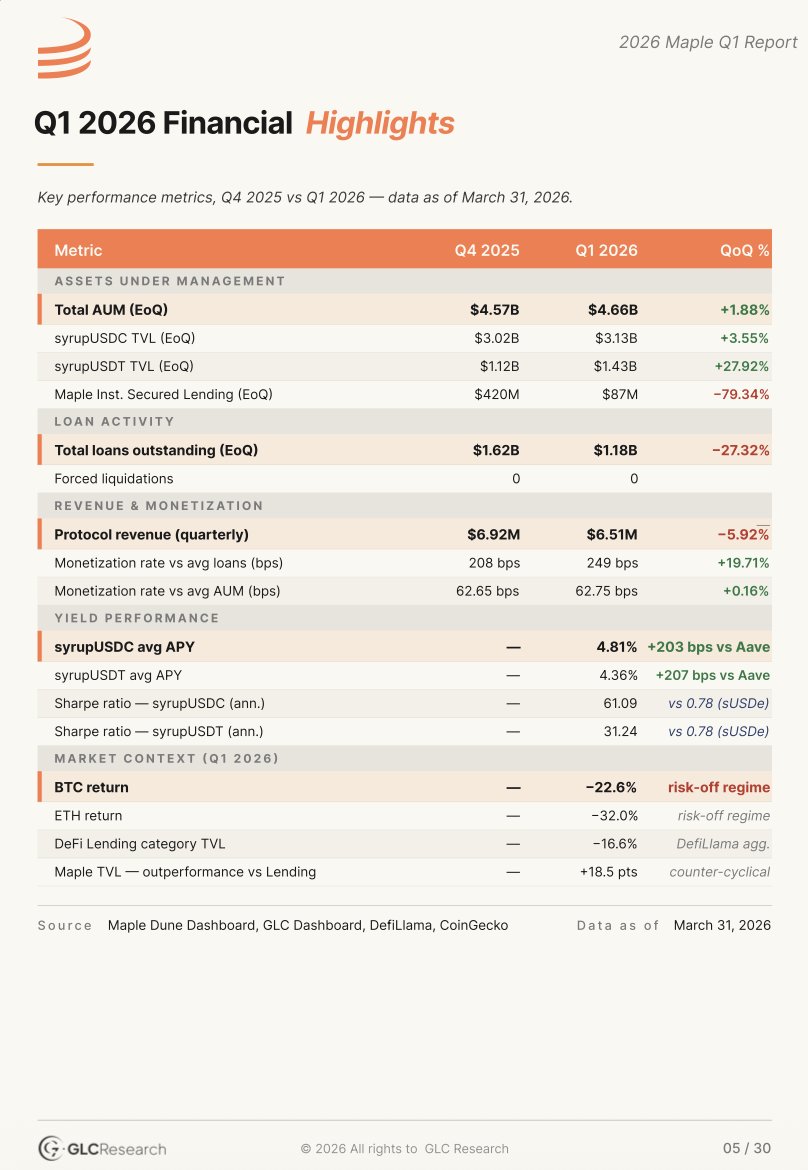
2026 Maple Q1 Report
Today we're releasing our Maple Finance Q1 2026 Report.
We've been covering Maple for over a year now, started when few were paying attention and this quarter gives us something meaningful to document.
Q1 threw everything at the protocol: a -20% crypto market drawdown, geopolitical shocks, and two distinct redemption waves.
Here's how Maple came out the other side:
→ AUM closed at $4.66B (+517% YoY)
→ Maple's revenue: $6.51M (+451% YoY)
→ Zero forced liquidations. 70+ margin calls resolved in a few hours at peak stress.
Enjoy the read. Some excerpts below, with the link to the full PDF and spreadsheet with historical data.
@maplefinance ethereum:0x643c4e15d7d62ad0abec4a9bd4b001aa3ef52d66
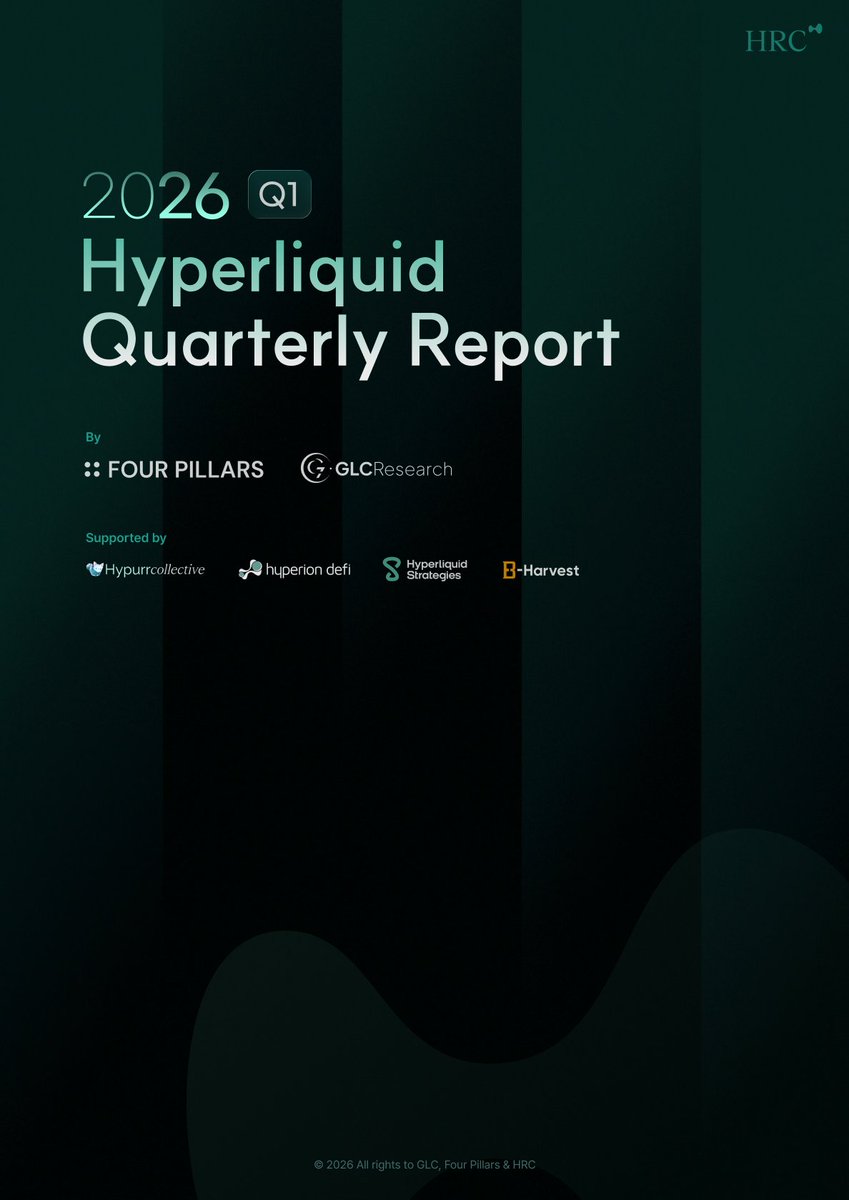
Thrilled to release our 2026 Hyperliquid Q1 Report.
There’s never a quiet quarter with Hyperliquid, and this one was no exception.
Despite one of the toughest quarters the industry has seen in years, Hyperliquid stood out, with equity perps surging, driven by @tradexyz
And this time, Hyperliquid won’t be the only focus. Trade[XYZ] was the standout growth story of the quarter, and we’re making sure it gets the dedicated coverage it deserves.
See you on Tuesday ;))
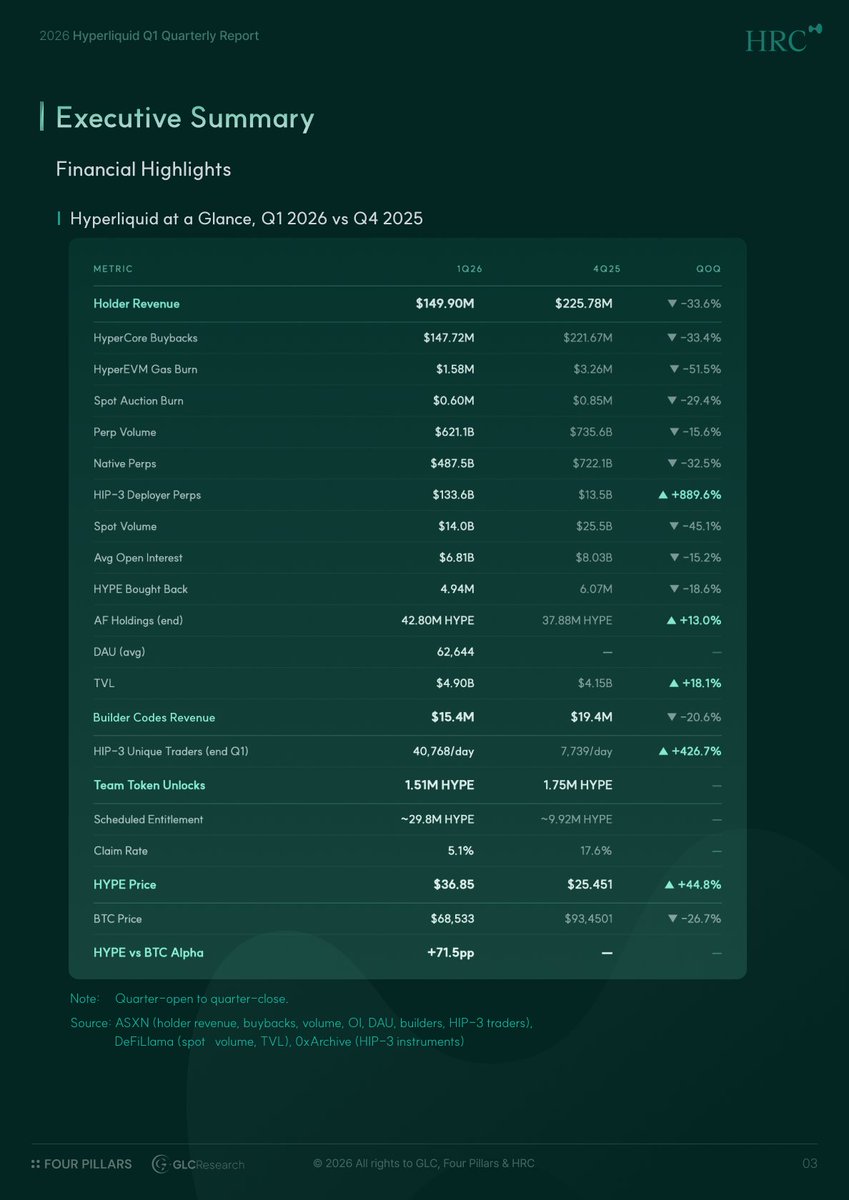
2026 Hyperliquid Q1 Report
Today, we're excited to release Hyperliquid's 2026 Q1 Report.
While Q1 stands as one of crypto’s most challenging quarters since 2018, Hyperliquid emerged stronger. As markets fell sharply, the protocol continued to gain traction, with HYPE returning +44.2% and entering the top 10.
More importantly, the quarter brought Hyperliquid closer to the “House of All Finance” vision, from institutional recognition through S&P Dow Jones to emerging as a price discovery venue for oil and other assets.
Enjoy the read. Some excerpts below, with the link to the full PDF.
Hyperliquid.
This is arguably one of the best integrations to expand distribution beyond crypto-native users.
Now that $SYRUP is available on @Revolut, the question remains:
"When syrupUSDC?" 👀
HPC Files Comment to the CFTC’s ANPRM on Prediction Markets
Letter from @HyperliquidPC
"Prediction markets are a natural application of the price discovery function at the heart of the CEA.
Their precision in defining narrow, event-based underliers provides market participants a tool to express views directly on specific events, rather than seeking exposure to those events indirectly through other financial instruments that the event may influence."
Thank you to HPC, @jchervinsky, @BradBourque, @salahghazzal, and everyone involved for the work you’re doing.
Link to the letter in the comments below.
▫️TradeXYZ reached parity with Lighter in March (11.29% vs 11.38%), capturing the same market share
▫️TradeXYZ generated 2x the perp volume of all Solana perps combined in March ($58.57B vs $29.45B)
▫️Only two protocols gained market share MoM: TradeXYZ (+5.24pp) and Hyperliquid (+3.06pp)
▫️Lighter: -67% QoQ, chart below.


![HyperliquidR's tweet photo. 2026 Trade[XYZ] Q1 Report
Last week, HRC published the Hyperliquid 2026 Q1 Report. This week, we're following up with @tradexyz because the mission to reduce information asymmetry doesn't stop at Hyperliquid itself.
HIP-3 formalized the open-infrastructure thesis at the market layer: external teams deploying perpetual markets on Hyperliquid's orderbook while earning 50% of the fees their markets generate.
Trade[XYZ] was the first to deploy under this framework and remains by far the largest, accounting for approximately 85–90% of all HIP-3 volume.
Billions in daily volume, genuine weekend price discovery, and two major macro stress events later, this is no longer just a successful product launch.
"It points to a structural shift in how global markets could operate"
At that scale, independent and rigorous reporting becomes a necessity.
Some excerpts below, full PDF at the link. We hope you find it valuable.
Hyperliquid. XYZ.](https://pbs.twimg.com/media/HIHM_e1XoAAbP5m.jpg)




![GLC_Research's tweet photo. Happy hyperliquid:native ATH to those who celebrate.
TradFi is paying attention.
Trade[XYZ] is arguably the biggest success story of the past couple of years.
Pre-IPO price discovery is happening onchain.
RWA price discovery is happening onchain when TradFi sleeps
New revenue streams through stablecoins with Coinbase.
IPO summer is ahead, and the world is watching.
Jeff based.
ETFs and DATs are eating up the entire float.
Still cheap given the TAM.
The CFTC Chair praising perpetual derivatives and Hyperliquid.
HPC doing an amazing job advancing the discussion around the regulatory landscape.
I could go on for hours, but you get the idea.
This was always meant to be a generational trade for the believers and the people who actually did their homework.
hyperliquid:native is an unprecedented financial asset.
Job's not finished.
Hyperliquid.](https://pbs.twimg.com/media/HK7hGzGXYAEgS7w.jpg)


![HyperliquidR's tweet photo. 2026 Trade[XYZ] Q1 Report
Last week, HRC published the Hyperliquid 2026 Q1 Report. This week, we're following up with @tradexyz because the mission to reduce information asymmetry doesn't stop at Hyperliquid itself.
HIP-3 formalized the open-infrastructure thesis at the market layer: external teams deploying perpetual markets on Hyperliquid's orderbook while earning 50% of the fees their markets generate.
Trade[XYZ] was the first to deploy under this framework and remains by far the largest, accounting for approximately 85–90% of all HIP-3 volume.
Billions in daily volume, genuine weekend price discovery, and two major macro stress events later, this is no longer just a successful product launch.
"It points to a structural shift in how global markets could operate"
At that scale, independent and rigorous reporting becomes a necessity.
Some excerpts below, full PDF at the link. We hope you find it valuable.
Hyperliquid. XYZ.](https://pbs.twimg.com/media/HIHT545XcAAgFNB.jpg)