Independent researcher in Egyptology & archaeoastronomy.Decoding ancient Egyptian religion via Stellar Pareidolia Hypothesis. (Account for scientific research).
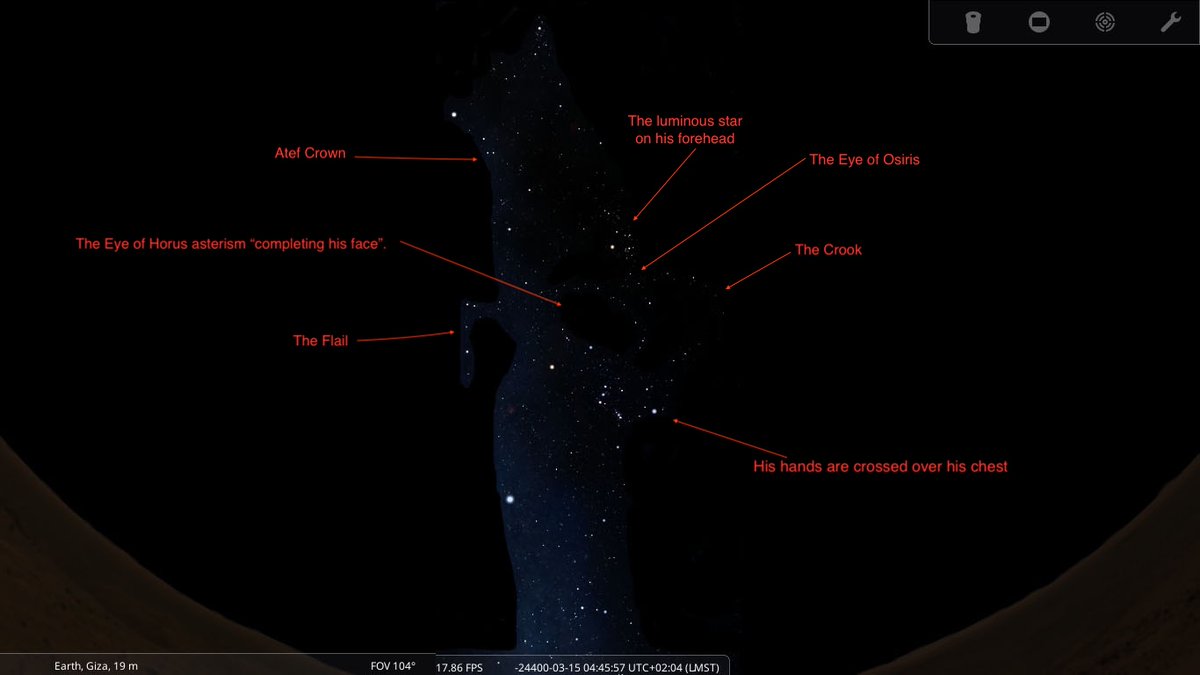
58. Here is what I believe to be the asterism that inspired Osiris, revealed here for the first time. Rising in the east (c. 24,000 BCE), it matches the Sphinx's gaze. Image 3 maps Osiris's attributes—the Eye of Horus, the Crook, and the Flail—based on ancient religious texts.
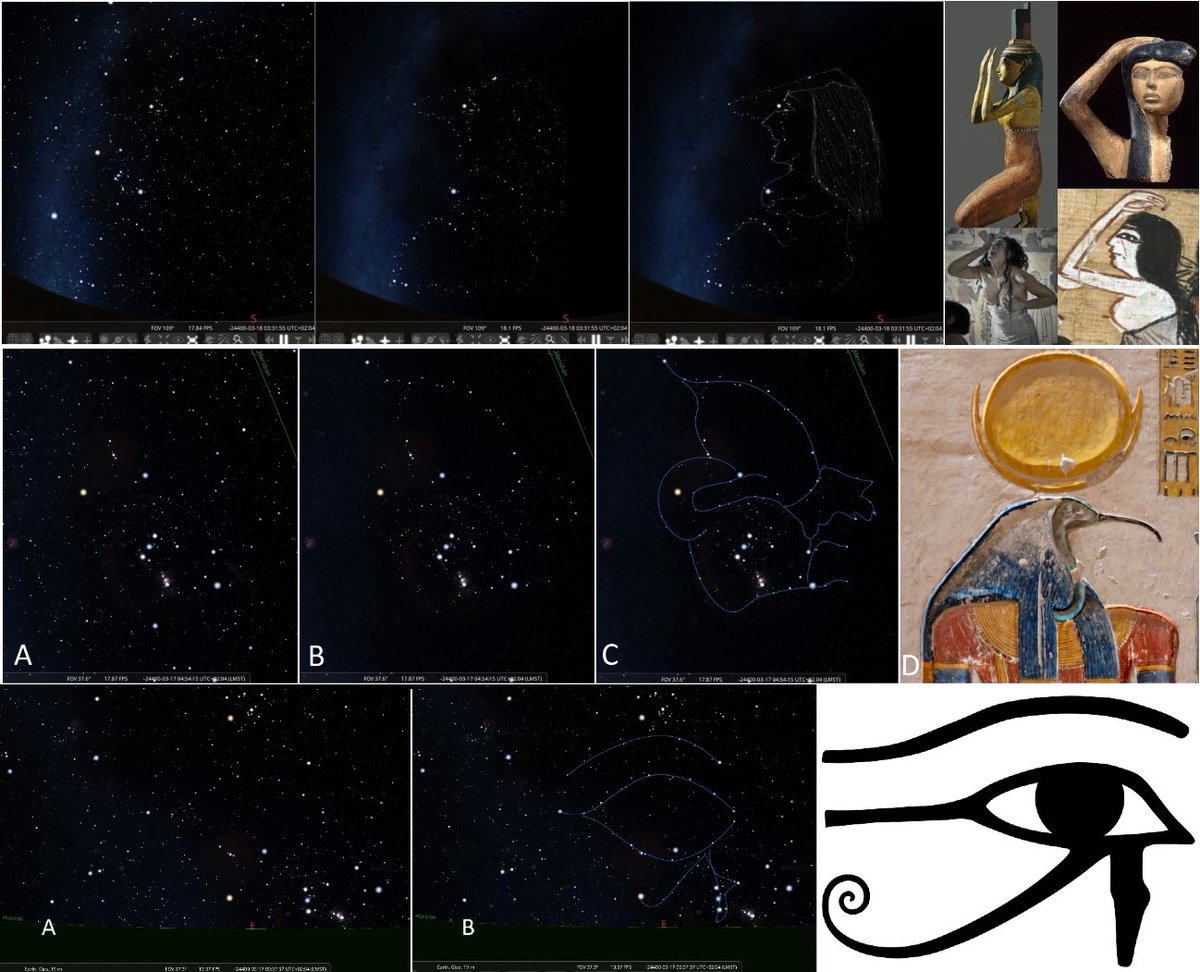
Let us take Isis, for example. Some scholars believe that Sirius represents her, but this does not explain the traits associated with her in the texts: weeping, mourning, placing one hand over her head while the other holds her chest, her appearance as an owl or a kite, and her relationship with Osiris, her union with Nephthys, and her connection with Horus and Ra.
All of these elements are actually present in the stars. But to uncover them, we need to use the right tool, at the right time, and in the right place. Only then can we find the key that explains the origins of all the elements of this complex religious system.
If a theory proposes a stellar origin for the adze based on its resemblance to the Dipper, then it should also be able to identify comparable stellar origins for the other - at least major- elements of the Egyptian religious system. Otherwise, explaining one correspondence does not resolve the much deeper ambiguity and complexity of the gods, their manifestations, myths, and symbols.
I believe the earliest Egyptians who developed this religious system did not know the modern, Arabic, or even conventionally reconstructed ancient Egyptian constellations. Their approach was deeper and more imaginative.
They were not creating constellations; they were searching for “gods”!
And they found many forms in the stars—more complex and creative than any modern constellation. Rather than inventing shapes by connecting prominent stars, they seem to have actually perceived these “divine forms” in the sky.
What is astonishing is that these stellar forms they revered can still be seen today using Stellarium.
@zone_astronomy Not only Nut—all the gods and symbols of ancient Egypt were products of human imagination and pareidolia, inspired by ancient star patterns rising in the eastern sky. The Sphinx was oriented toward the very source of humanity’s earliest myths!
@sputnik_ar مع المومياوات، كلب واحد محنط، وهو على الأرجح تماه مع أنوبيس الذي اعتبروه إله الموت والتحنيط. وهذا ليس سرا، بل إن السر الحقيقي: من أين لهم بهذه الأفكار والطقوس والآلهة والرموز التي فعلوا كل شيء من أجلها، أملا في الخلود بينها؟
@PhysInHistory If the ancient Egyptians had truly understood the scientific nature of stars and light, they wouldn’t have worshipped stars as gods. They were brilliant builders, engineers, and sculptors, but there is no evidence they knew concepts like the speed of light or modern astronomy.
Decoding the Origins of Ancient Egyptian Religion: An Astronomical Investigation Proposing the Stellar Pareidolia Hypothesis as the Blueprint for a Civilization https://t.co/z69GWvqgBO via @academia
58. Here is what I believe to be the asterism that inspired Osiris, revealed here for the first time. Rising in the east (c. 24,000 BCE), it matches the Sphinx's gaze. Image 3 maps Osiris's attributes—the Eye of Horus, the Crook, and the Flail—based on ancient religious texts.
1. Over the past two years, I've embarked on a journey to uncover the origins of Egyptian "gods" and symbols. This exploration has led me to identify the source of inspiration behind their forms, myths, and the interconnectedness they held in ancient beliefs. #MysteryOfOsiris
57. According to research using precise astronomical programs, this video shows the 'Stellar Eye'—likely the origin of the Eye of Horus—rising in the Sphinx's eastern gaze and setting in the west as part of a “divine” structure that achieved peak coherence in prehistoric times!
A living preprint on @SSRN
Did the Eye of Horus — and the entire Egyptian pantheon — originate from real asterisms in the ancient sky? This draft is continuously updated — and Osiris is next.
📄 Read it here:
https://t.co/VqF1EhDwcg
#Egyptology#Archaeoastronomy#AncientEgypt